
Start with the key idea
Choose accessible, interesting reading and vary the response: retell, infer, compare, explain a word or recommend a text. Use the original story and activities below as a starting point. This is a flexible 2027 holiday resource, not a school calendar, competition or compulsory reading list.
1. Choose books the child can actually enjoy using
Invite the child to select from a small range: a story, an information book, a comic with a developed narrative, a poem collection or another suitable text. Interest matters, but so does access. If reading every sentence is a struggle, try a more accessible text or shared reading rather than turning the holiday into an endurance test.
A library book, a book already at home or an authorised digital text can all work. There is no requirement to buy a series. Ask the child to preview a page and tell you whether the topic and language feel manageable. A long book is not automatically a better learning choice.
For school-assigned reading, keep the school’s instructions separate from this optional challenge. If the child needs support with decoding or persistent comprehension difficulty, discuss suitable help with the teacher. This activity does not identify a learning condition or establish a reading age.
2. Use six kinds of reading response
Across the holiday, try a mix of responses: retell an important event, support an inference, explain a word from context, compare two ideas, ask a worthwhile question and recommend a text to a particular reader. Choose a few rather than completing every response after every chapter.

Make the evidence visible. Instead of “The character is kind”, ask what the character did or said that supports that view. Instead of “It was good”, ask who might enjoy it and why. A short, specific answer is often more informative than a long summary copied from a book cover.
Use speech, a sketch, a few notes or a short paragraph according to the purpose. A drawing can show the order of events; an oral explanation can reveal an inference without adding a writing barrier. If the goal is writing practice too, say that clearly and keep the task manageable.
3. Original story: The spare label
Maya arrived at the community garden carrying six small labels. Her job was to mark the new pots before the visitors came. She wrote “mint” on the first label, but a sudden splash from the watering can blurred the ink. Only the letter m remained.
“We can guess,” said Dev, reaching for the pot. Maya shook her head. Two pots had been moved while the path was swept, and she could not remember which was which. She put the damaged label aside and opened the garden notebook. Beside yesterday’s drawing, Mrs Rao had written where each new plant belonged.
They compared the drawing with the shelf and checked the plants with Mrs Rao before attaching the labels. When Maya finished, one clean label remained. She tucked it into the notebook instead of throwing it away. “For the next splash,” she said. Dev moved the watering can to the other end of the table.
This is an original BananaLearn story. It offers direct facts, an evidence-based inference and a limit on what can be concluded. The text does not say which plant occupied every pot or that Dev intended to damage a label.
4. Explore the story without turning it into a memory quiz
Begin with the visible sequence: a label is damaged, guessing is rejected, the notebook and Mrs Rao help confirm the plants, and a spare label is saved. Let the child look back at the story. Evidence questions are not necessarily tests of remembering every detail without the text.
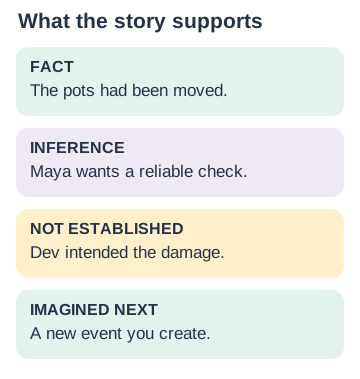
Ask why Maya rejects the guess. The pots had moved and she was unsure which was which, so checking was more reliable. Ask what saving the spare label suggests: she is preparing for a similar problem. These are supported explanations, not claims about every part of her personality.
Now test the boundary. “Dev deliberately ruined the label” is not established. The text describes a splash and later moves the watering can, but does not state deliberate harm. Encourage the child to distinguish a possible imagined continuation from something the story actually tells us.
5. Make a flexible holiday plan
Choose a few suitable reading moments around the family’s actual holiday. For example, one week might include shared reading, a short independent passage and a conversation about a favourite scene. The example is not a prescribed weekly dose. Leave room for travel, play and the child’s own choices.
Use a simple record with text, response type, one interesting idea and a question for next time. Avoid awarding more credit solely for longer books or faster reading. A child who rereads a passage to justify an answer is doing useful work even if the book count does not rise.
If a day is missed, resume at the next workable moment rather than doubling the task as a penalty. If the same response becomes repetitive, change the question or the text type. The challenge should help the child notice and explain more, not become a daily argument about completing boxes.
6. Finish with a recommendation and a next choice
At the end, ask the child to recommend one text to a specific reader: a younger sibling who likes animals, a friend who enjoys mysteries or someone curious about space. The recommendation should name a feature of the text and explain why that reader might enjoy it.
Compare an early response with a later one. Look for a clearer sequence, more relevant evidence or a better distinction between fact and inference. Do not infer a fixed ability level from one holiday sample. Ask what the child wants to read next and what kind of help would make it accessible.
Keep the record private unless the child and family choose to share it appropriately. There is no need to post a child’s full name, reading difficulty or work publicly to take part. The printable worksheet can be used independently of social media or registration.
My holiday reading record
Use one record for a meaningful reading moment. You can speak or sketch a response first. Finishing a whole book is not required to use the record.
Text and author: ____________________
Response chosen (retell, infer, compare, explain, question or recommend): ____________________
One idea worth remembering: ____________________
Detail from the text that supports my idea: ____________________
A question for next time: ____________________
Someone who might enjoy this text, and why: ____________________
Save the full guide to keep this record with the explanations. The separate worksheet contains the practice and decision questions; use its answer version to check your reasoning.
5 worked examples with reasoning
1. Explain why Maya does not guess the plant name.
- Find the detail that the pots had moved.
- Connect it with Maya not remembering which was which.
- Conclude that checking is more reliable than guessing in this situation.
2. What does the spare label suggest?
- Maya saves it after a label was damaged.
- Her words mention the next splash.
- A supported inference is that she is preparing for a similar problem.
3. A child says Dev was trying to ruin the labels.
- Ask for the supporting sentence.
- The story describes a splash but gives no deliberate intention.
- Mark the claim as not established rather than impossible.
4. Turn “I liked it” into a recommendation.
- Choose a reader who likes solving small practical problems.
- Mention Maya checking the notebook instead of guessing.
- Explain why that problem-solving scene may interest the reader.
5. A child has not finished a long book.
- Discuss a meaningful passage already read.
- Choose one response such as a supported inference.
- Do not treat an unfinished book as no learning.
Save the guide or print the practice
Download to save or share
Complete guide with answers (PDF) · Worksheet without answers (PDF) · Worksheet and answer key (PDF)
Read the original story before answering Questions 1–12. You may look back. For open responses, give a reason; the model answer is one possible supported response.
14 practice questions with explanations
Read the original story before answering Questions 1–12. You may look back. For open responses, give a reason; the model answer is one possible supported response.
Write an answer and your reason before opening the explanation. Check the reasoning as well as the final answer.
The spare label
Maya arrived at the community garden carrying six small labels. Her job was to mark the new pots before the visitors came. She wrote “mint” on the first label, but a sudden splash from the watering can blurred the ink. Only the letter m remained.
“We can guess,” said Dev, reaching for the pot. Maya shook her head. Two pots had been moved while the path was swept, and she could not remember which was which. She put the damaged label aside and opened the garden notebook. Beside yesterday’s drawing, Mrs Rao had written where each new plant belonged.
They compared the drawing with the shelf and checked the plants with Mrs Rao before attaching the labels. When Maya finished, one clean label remained. She tucked it into the notebook instead of throwing it away. “For the next splash,” she said. Dev moved the watering can to the other end of the table.
- Recall
How many labels does Maya bring?
Answer and reasoning
Six.
The opening sentence states the number.
- Sequence
What damages the first label?
Answer and reasoning
A splash from the watering can blurs the ink.
This happens before the guessing discussion.
- Evidence
Why is guessing unreliable here?
Answer and reasoning
The pots had moved and Maya was unsure which was which.
The explanation uses two connected details.
- Resource
What record do they consult?
Answer and reasoning
The garden notebook.
It contains a drawing and placement information.
- Check
Who helps confirm the plants?
Answer and reasoning
Mrs Rao.
They check with her before attaching labels.
- Inference
What does saving a spare label suggest?
Answer and reasoning
Preparation for a similar problem.
Maya mentions the next splash.
- Boundary
Does the story prove Dev caused damage deliberately?
Answer and reasoning
No.
His intention is not stated.
- Vocabulary
What does blurred mean in this story?
Answer and reasoning
The writing became unclear.
Only one letter remained readable.
- Sequence
Name the action after they consult the notebook but before attaching labels.
Answer and reasoning
They check the plants with Mrs Rao.
The order matters to the checking process.
- Response
Give a possible alternative title and explain it.
Answer and reasoning
For example: Checking Before Guessing.
It captures the central decision; other supported titles can work.
- Create
Write one plausible next event and label it correctly.
Answer and reasoning
For example: imagined continuation—Maya uses the spare label on another day.
A continuation is not a fact already in the story.
- Recommend
Who might enjoy this story, and why?
Answer and reasoning
For example, a reader who likes practical problem-solving because the children use records to resolve uncertainty.
The recommendation connects reader and text.
- Plan
What should a holiday reading record include besides a title?
Answer and reasoning
A response or idea and a question for next time.
Book counts alone say little about understanding.
- Review
What is useful after missing a planned reading day?
Answer and reasoning
Resume at the next workable moment.
Doubling the task is not necessary for this flexible challenge.
Use the ideas without looking at the notes
Choose an accessible text. Try a varied response, point to supporting details and distinguish inference from invention. Keep one interesting idea and a next question. Finish with a recommendation for a specific reader.
Common questions
Is this a compulsory Class 5 book list?
No. It is an optional challenge to adapt to the learner and any school instructions.
Must the child read independently throughout?
No. Shared reading and oral discussion can make the task accessible.
Can we look back at the story?
Yes. Use the text to check evidence unless a separate task explicitly tests recall.
Does the 2027 label specify school holiday dates?
No. Use the school’s actual calendar to choose reading moments.
Connect your learning
Ask about one-to-one learning support if your child needs help explaining these ideas.
About this guide
Original explanations, examples, diagrams and practice by BananaLearn. The grade label indicates the intended learning level; this is not an official textbook extract or exam paper.