
Start with the key idea
Reading words smoothly and understanding a text are related but different tasks. Use a short passage to check vocabulary, the sequence of events and the clues behind an answer. Let your child return to the text. If difficulties persist, share specific examples with the teacher.
Listen for meaning, not just smooth reading
A child may pronounce a page confidently yet be unsure who did what or why. Start with a short text that interests them. Ask for a brief retelling rather than a long list of questions. If the retelling is unclear, find the point where meaning became difficult.
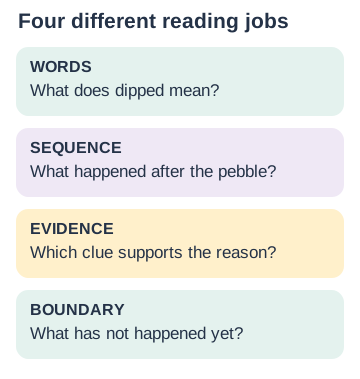
Check unfamiliar words, pronouns such as she and they, and words that connect events, such as because or although. Background knowledge matters too: a story about a ferry will be harder to picture if the child has never met the word.
Do not infer a particular learning difficulty from one reading session. A text may simply be unfamiliar, too demanding or read when the child is tired. Reading aloud to the child can make a useful comparison, but it is not a diagnostic test.
Read together: The paper boat
Meera and her brother Arun made a paper boat at the kitchen table. Arun wanted to test it in a puddle outside. Meera looked through the window. The trees were bending and rain tapped loudly against the glass.
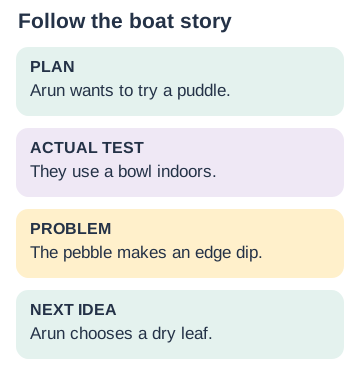
“Let's use the washing-up bowl first,” she said. They filled it with a little water and placed the boat on the surface. It floated. Arun added a small pebble. One edge dipped, and water crept inside.
Meera lifted the boat out before it sank. “Next time, a lighter passenger,” she said. Arun put the pebble aside and reached for a small dry leaf.
This is an original BananaLearn passage. Read it aloud, take turns, or let the child read independently. Explain surface as the top of the water and dipped as moved downwards if those words interrupt understanding. The passage is a discussion resource, not a grade-level assessment.
Four questions, with reasons for the answers
- Where did they first test the boat? In a washing-up bowl. The text states this directly.
- Why might Meera prefer the bowl to the puddle? The wind and rain suggest that testing outdoors would be difficult or unpleasant. “Trees were bending” and the loud rain are supporting clues. We are inferring her reason; the story does not state that she is afraid.
- What happened after Arun added the pebble? An edge dipped and water entered. Keep these events in that order before discussing why the boat might sink.
- Why did Arun choose a leaf next? He appears to be trying a lighter passenger after Meera's suggestion. We cannot know from this story whether the next test succeeded.
Ask “What in the story helped you?” after one answer, not mechanically after every sentence. Accept wording different from the model if the meaning and evidence are sound.
Match the help to the response
| Child's response | Useful next move |
|---|---|
| “They went outside.” | Reread the sentence about the bowl; distinguish a plan from what happened. |
| “The leaf sank.” | Find the final sentence. Explain the difference between a prediction and an event already described. |
| “Meera put it aside.” | Trace the names and pronouns in the last paragraph. |
| “I don't know what dipped means.” | Demonstrate a downward movement, then reread the sentence. |
Returning to the text is part of reading. Do not turn comprehension into a memory contest by hiding the passage too soon.
A small routine for another book
Before reading, look at the title or picture and explain any essential unfamiliar context. During reading, pause when meaning breaks down rather than at every full stop. Afterwards, ask for the main event, one reason and a detail that supports it.
With younger children, draw three moments and put them in order. With older children, compare two possible interpretations and decide which has stronger evidence. Gradually use nonfiction as well: ask what a diagram adds that the paragraph does not.
If understanding remains difficult across suitable texts, tell the teacher what happened when the child read independently and when you read aloud. Bring the passage and their actual answers. Ask which reading skills should be supported next rather than simply requesting harder books.
Further reading: Reading Rockets: understanding reading comprehension. The examples and printable activities on this page were created by BananaLearn.
Read, retell and find a clue
Use The paper boat above or a short text of your choice. Keep the text available. Spoken answers and drawings are welcome.
A completed example
Beginning: They made a paper boat
What changed?: A pebble made an edge dip
Ending: Arun chose a leaf for the next test
A clue from the text: Next time, a lighter passenger
Opens a separate sheet with the completed example and writing space. Save it as a PDF or print it using your browser. No account is required.
5 worked examples with reasoning
1. The child says the boat was tested outside.
- Ask them to find what Arun wanted to do.
- Then find the sentence explaining what they actually did.
- Contrast the plan with the event: the boat was first tested in a bowl.
2. The child says Meera was frightened.
- Ask which words support that exact feeling.
- Wind and rain support a reason to stay indoors, but do not prove fear.
- Use a qualified answer: she may have thought the bowl would be easier to use.
3. The child cannot explain dipped.
- Use a small downward hand movement to explain the word.
- Reread the edge-dipping sentence.
- Ask what changed after the pebble was added.
4. The child gives the right answer only after your hint.
- Keep the correct answer, but record the hint.
- Try a similar question about a different short passage later.
- Do not call the original response fully independent.
5. The child predicts the leaf will work.
- Accept it as a possible prediction.
- Ask why a lighter object might help.
- Keep the prediction separate from what the text already states.
Save the guide or print the practice
Download to save or share
Complete guide with answers (PDF) · Worksheet without answers (PDF) · Worksheet and answer key (PDF)
These are practice decisions for parents and learners, not an assessment or diagnosis. Compare the suggested response with the explanation and adapt it to the actual task.
14 practice questions with explanations
These are practice decisions for parents and learners, not an assessment or diagnosis. Compare the suggested response with the explanation and adapt it to the actual task.
Write an answer and your reason before opening the explanation. Check the reasoning as well as the final answer.
Read this passage before the related questions
Meera and her brother Arun made a paper boat at the kitchen table. Arun wanted to test it in a puddle outside. Meera looked through the window. The trees were bending and rain tapped loudly against the glass.
“Let's use the washing-up bowl first,” she said. They filled it with a little water and placed the boat on the surface. It floated. Arun added a small pebble. One edge dipped, and water crept inside.
Meera lifted the boat out before it sank. “Next time, a lighter passenger,” she said. Arun put the pebble aside and reached for a small dry leaf.
- Evidence
Is “Meera hates rain” established in the passage?
Answer and reasoning
No.
The passage shows windy, rainy weather but does not state her preference.
- Sequence
What happens immediately after the pebble is added?
Answer and reasoning
An edge dips and water enters.
These events appear before Meera removes the boat.
- Vocabulary
Which word means the top of the water?
Answer and reasoning
Surface.
Understanding it helps picture where the boat sits.
- Reference
Who puts the pebble aside?
Answer and reasoning
Arun.
The final paragraph names him.
- Plan
Was the puddle the original plan or the actual first test?
Answer and reasoning
The original plan.
The actual first test takes place in a bowl.
- Prediction
Can we report that the leaf test succeeded?
Answer and reasoning
No.
The text ends before that test occurs.
- Inference
What supports choosing a lighter passenger?
Answer and reasoning
The pebble made an edge dip and Meera suggests a lighter passenger.
Use relevant details rather than an unrelated guess.
- Support
Should the passage be hidden while checking a new inference?
Answer and reasoning
Not at first.
Looking back helps the learner verify evidence.
- Observation
Does one weak retelling prove a learning disorder?
Answer and reasoning
No.
A single session cannot establish a diagnosis.
- Adapt
How can a younger learner show the sequence without a long written answer?
Answer and reasoning
Draw three moments or explain them aloud.
This separates understanding from writing demands.
- Transfer
Does repeating a memorised model answer prove understanding of a new passage?
Answer and reasoning
No.
Try a fresh text with a similar reasoning demand.
- Feedback
What should you ask after an unexpected but plausible answer?
Answer and reasoning
Which part of the text helped you?
A different interpretation may be reasonable if supported.
- Record
What should a teacher see if the difficulty persists?
Answer and reasoning
The passage, the learner’s actual answer and the help supplied.
Specific evidence is more useful than a broad label.
- Create
Write a supported reason for Meera choosing the bowl.
Answer and reasoning
For example: The wind and rain could make an outdoor test difficult.
The clues support this possibility without proving a particular emotion.
Use the ideas without looking at the notes
Use this record for one real task: What happened? What help was offered? What could the learner then do? What new example will we use next? Record support honestly and choose one next step.
Common questions
Should my child answer without looking back?
Not at first. Returning to a passage helps readers check evidence and repair misunderstandings. Memory and comprehension are not the same task.
Are audiobooks useful here?
Listening and discussing can support access to ideas and vocabulary. It does not replace any decoding instruction a child needs. Ask the teacher how to combine the two.
What if my child gives a different answer?
Ask for the supporting clue. Accept a reasonable interpretation backed by the text; distinguish it from a guess or prediction.
Connect your learning
Ask about guided English learning if your child needs help explaining these ideas.
About this guide
Original explanations, examples, diagrams and practice by BananaLearn. The grade label indicates the intended learning level; this is not an official textbook extract or exam paper.