1. Grow a four-by-four square to five-by-five.
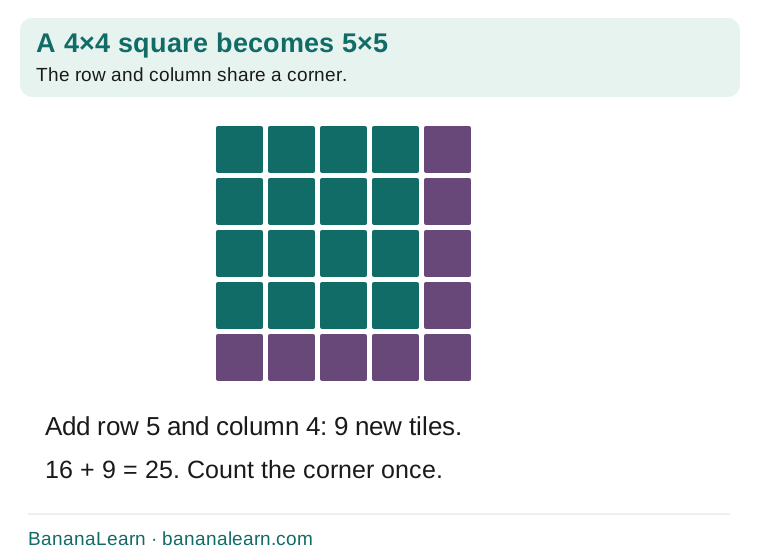
- Add a row of 5 tiles and a column of 4 tiles.
- The new border has 9 tiles; 16+9=25.
- The corner tile is counted once, not in both the row and the column.
English · Suggested Classes 5–8
Give the audience a pattern they can see: 1, then 4, then 9, then 16. A short demonstration can make a maths speech memorable.
Start here
India’s National Mathematics Day is 22 December 2026. Use an original student speech with a square-number demonstration, verified context and a rehearsal plan.
Original BananaLearn guide · 7 November 2026
On a narrow screen, swipe the diagram or open it full size.
India observes National Mathematics Day on 22 December in honour of Srinivasa Ramanujan’s birthday. The 2026 date is 22 December. The official source below confirms the annual observance.
The speech and square-number demonstration are original educational material. The pattern is not presented as Ramanujan’s discovery, and no quotation is attributed to him. An event date does not establish your school’s programme or an official 2026 theme.
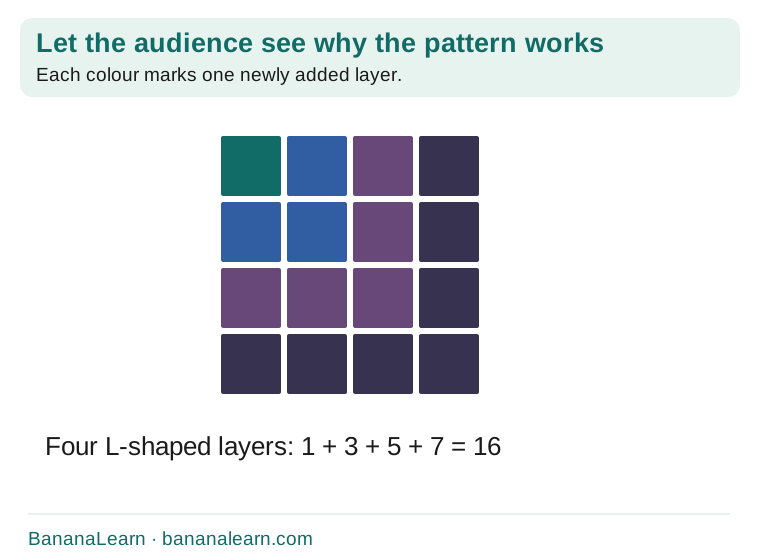
Good morning, teachers and friends. On National Mathematics Day, we honour Srinivasa Ramanujan and celebrate mathematical thinking. I would like to share one pattern. One tile makes a one-by-one square. Add three tiles and we have a two-by-two square. Add five more and we have a three-by-three square. The totals are 1, 4 and 9.
The next border needs seven tiles, making 16. The pattern is more interesting when we ask why it works. Each new border makes both sides of the square one tile longer.
Mathematics gives us ways to notice, test and explain. Today, try one question beyond “What is the answer?” Ask, “How can I show someone why?” Thank you.
Good morning, respected teachers and dear friends. We observe National Mathematics Day on 22 December in honour of Srinivasa Ramanujan. Today I want to celebrate something every learner can practise: turning a pattern into an explanation.
Imagine a single square tile. Add an L-shaped border of three tiles and the small square becomes a two-by-two square. Add a border of five tiles and it becomes three-by-three. Add seven more and it becomes four-by-four. We have built the totals 1, 4, 9 and 16.
It is tempting to stop at the pattern and predict the next answer, 25. But a useful question follows: why does the next border contain nine tiles? To grow a four-by-four square into a five-by-five square, we add one row of five and one column of four. Together that is nine. The same reasoning works at each stage.
This small example shows several habits we can use in mathematics. We can draw an idea instead of only memorising it. We can test a prediction on a new case. We can explain the step so another person can check it. And when an answer does not fit, we can change the model or look for a mistake.
Some of us enjoy numbers immediately; others need more time or a different picture. A classroom can make room for both. Asking a clear question or giving a careful explanation is worthwhile, even when the calculation is simple.
On this National Mathematics Day, let us choose one idea we can demonstrate to someone else. It might be a pattern, a measurement, a fraction model or a fair way to count outcomes. An explanation shared clearly can make another learner’s next step easier. Thank you.
On a narrow screen, swipe the diagram or open it full size.
Use a drawing with four coloured L-shaped layers or arrange paper tiles. Show each layer separately and label the cumulative totals. Do not claim that a row of five alone changes a four-by-four square into a five-by-five square.
Keep the diagram large enough for the intended audience. If the room cannot see individual tiles, point to a projected model or describe row and column counts. The demonstration should support the argument, not interrupt it with a long construction task.
An n-by-n square contains n² unit tiles. Extending an (n−1)-by-(n−1) square adds n+(n−1)=2n−1 tiles. This explains why the first n odd numbers sum to n².
The speech uses only the first few cases so younger listeners can follow. Older students can add the algebra if appropriate, but should explain what n counts before displaying the symbols.
Read the selected version aloud and measure its duration. A short slot may need only the first three squares and a closing question. A longer slot can include the row-and-column proof.
Use your own pace and leave a pause when the picture changes. Remove a supporting paragraph if necessary rather than squeezing the entire text into a rushed delivery.
If you add a historical fact or quotation, verify its source. A phrase that sounds inspiring is not automatically something Ramanujan said. The original speech does not need a famous quotation to explain its central idea.
Do not add claims that the activity raises marks or makes every child love maths. Describe what the audience can actually do: build, notice, predict and explain the next layer.
Write the date, chosen version, one diagram cue, the next predicted total, the reason for the new border and your rehearsal duration. Ask a listener to explain the pattern back to you.
For participation afterwards, use the linked National Mathematics Day stations. They cover different models and tasks; this page supplies speech writing and a focused live demonstration rather than duplicating that event programme.
See the reasoning
Try, explain, check
Try each task before opening its explanation. These are original BananaLearn questions, not official exam or past-paper questions. Where several answers can work, the explanation gives the criteria.
22 December 2026
It is the annual 22 December observance.
Srinivasa Ramanujan
The date marks his birthday.
No
It is original student-facing writing.
16
4×4=16.
9
Add a row of 5 and a column of 4.
That would not be the required L-shaped border
The corner would be counted twice in the intended row-and-column method.
25
The five layers make a five-by-five square.
Ask a listener to explain why the next border has its stated size
It checks whether the demonstration communicated the idea.
Copy these headings and fill them for one worked task, then for a fresh attempt. Use your own evidence rather than copying the model answer.
Explore BananaLearn’s games, learning features and one-to-one tutoring. Maths is our priority; English and Science tutoring are also available. Bring a recent example of schoolwork when checking teaching fit.
Original BananaLearn explanations, examples, illustrations and practice. Source facts checked 7 November 2026. Suggested levels are learning guides, not a claim that every board or textbook uses the same sequence.
Event timing is calendar-backed. Search demand is a forecast unless a separately measured trend is stated. No official event theme, school programme or affiliation is implied.
How we prepare guides · Report a correction
Share the complete guide: https://bananalearn.com/learn/national-mathematics-day-speech-2026.html