Human Rights Day 2026: Reading, Evidence & Fair Decisions
A “fair” rule can solve one problem and create another. Read a fictional library decision, then separate the shared goal, the evidence and the unanswered questions.
Start here
Human Rights Day is 10 December 2026. This original reading activity uses a school-library scenario to practise evidence, respectful disagreement and practical revision.
On a narrow screen, swipe the diagram or open it full size.
Find a section, worked example or practice question
Date and learning purpose
Human Rights Day is observed annually on 10 December. The UN source below explains the observance and the Universal Declaration of Human Rights. This independent 2026 activity does not claim an official theme or provide a legal interpretation.
The task is a fictional school discussion. Read the passage, identify each person’s concern and propose a change that preserves access while using the available evidence. No personal experience of harm or private family information is needed.
Passage: the new library rule — part 1
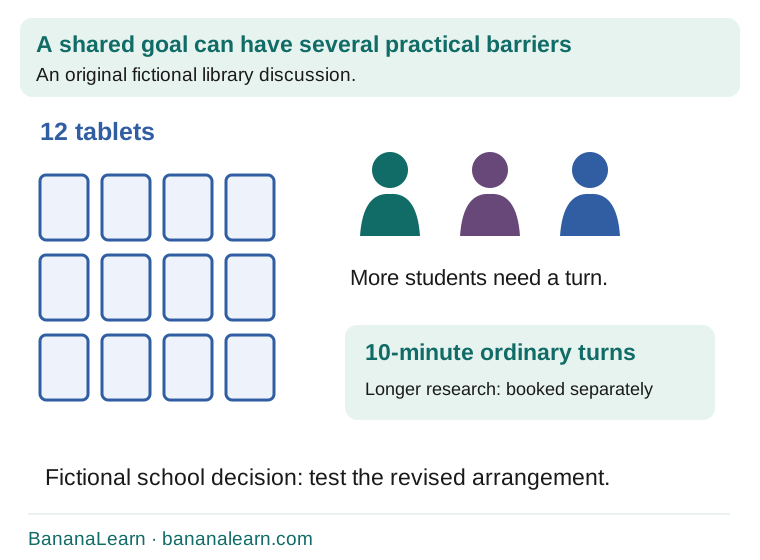
The school library had twelve tablets for reading and research. For several weeks, the same small group arrived first at lunchtime and used them until the bell. Other students sometimes left without a turn. The librarian proposed a rule: every user would have ten minutes, and students would sign up on a sheet beside the door.
At the next class meeting, Nisha supported the time limit. “More people will get a chance,” she said. Omar agreed with the goal but raised a question. His class’s research task required reading a long article, and ten minutes might not be enough to finish it. “Could we book a longer session when we have a specific task?” he asked.
Passage: the new library rule — part 2
Eli noticed another problem. The sign-up sheet was available only at the library door just before lunch. A student whose classroom was far away could arrive after every place was taken. The teacher asked the class not to guess which students cared most about reading. The location of their classrooms was not evidence of their interest.
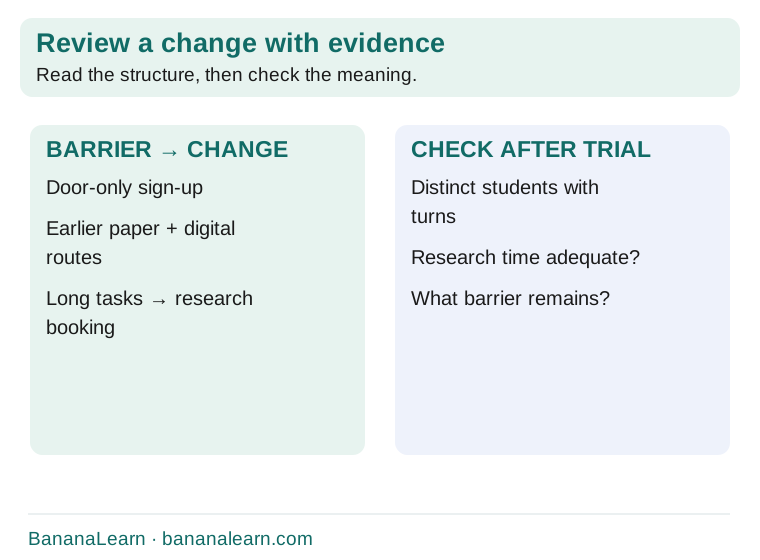
The librarian suggested a two-week trial. Short lunchtime turns would remain, but teachers could request a separate research session for a class task. The sign-up list would open earlier through both a classroom paper copy and the school’s existing digital system. Staff would record how many students obtained a turn and whether booked research sessions were long enough.
No one claimed that the revised plan would solve every difficulty. At the end of the trial, the class would review the record and ask what still prevented participation. Nisha wrote the shared goal at the top of the meeting notes: “A fair chance to use the library resources.”
On a narrow screen, swipe the diagram or open it full size.
Identify the shared goal before the disagreement
Nisha, Omar and Eli do not necessarily disagree about access. They identify different barriers: repeat use by one group, time needed for a real task and unequal opportunity to sign up.
A useful summary names both agreement and difference. “Omar opposes fairness” is not supported; he asks how a time limit can work with a longer task.
Distinguish equal treatment from a workable arrangement
An identical ten-minute limit is simple, but its practical effect depends on the task and the route to booking. The revised trial keeps short turns while adding a separate route for longer class research.
This is a design discussion, not a claim that one scheduling rule defines a legal right in every school. Explain which barrier a change addresses and how its effect could be checked.
Use the evidence and keep the unknowns
The passage states that some students left without a turn, but it does not provide an exact count. It states that classrooms differ in distance from the library, but does not identify a particular child’s circumstances.
Propose a measure the trial could collect, such as the number of distinct students receiving turns. Do not invent a percentage improvement or assume the trial has already succeeded.
Write a respectful response
A useful response can say: “I support the goal of more students using the tablets. I am concerned that opening the list only at the door favours students who can arrive first. An earlier classroom sign-up route could address that barrier. We should check whether the trial reaches students who previously missed a turn.”
The response links agreement, concern, proposal and evidence. It criticises an arrangement without making an unsupported judgment about another student’s motives.
Create a review record
Make four columns: barrier, proposed change, evidence to collect and question left open. For example: short turns may not fit a research task; add booked class sessions; record whether tasks can be completed; ask whether booking access is consistent.
For an extension, propose a different workable plan and state its trade-off. The best classroom answer explains its assumptions and a way to test them, rather than only labelling one person right and another wrong.
See the reasoning
Worked examples and checks
1. Explain Omar’s position fairly.
He agrees that more students should have access.
He questions whether one short limit fits a longer research task.
His proposed longer booking is a response to a task constraint, not evidence that he rejects the shared goal.
2. Evaluate “Students who arrive late are less interested.”
The passage identifies classroom distance as one possible factor.
Arrival order alone does not establish interest.
A fair revision addresses the booking barrier without inventing motives.
3. Propose a useful trial measure.
Count how many distinct students obtain a turn and compare with a comparable earlier period if available.
Also record whether longer research bookings meet the stated need.
Neither measure by itself proves all access barriers are solved.
Try, explain, check
12 questions with explained answers
Try each task before opening its explanation. These are original BananaLearn questions, not official exam or past-paper questions. Where several answers can work, the explanation gives the criteria.
What is the 2026 observance date?
Check answer and reasoning
10 December 2026 Human Rights Day is the annual 10 December observance.
How many tablets were in the fictional library?
Check answer and reasoning
12 The passage gives that number.
What was the proposed ordinary turn length?
Check answer and reasoning
10 minutes The initial rule applied the same limit to each user.
What goal did Nisha support?
Check answer and reasoning
Giving more students a chance to use the tablets Her comment states that purpose.
What practical concern did Omar raise?
Check answer and reasoning
A long research article might need more time He suggested longer bookings for a specific task.
What barrier did Eli identify?
Check answer and reasoning
Students farther from the library could reach the sign-up sheet after places were taken It concerns access to booking, not just tablet time.
Did the passage establish that later arrivals were less interested?
Check answer and reasoning
No The teacher explicitly rejects that unsupported inference.
How long was the trial?
Check answer and reasoning
Two weeks The revision was to be reviewed afterwards.
Did the trial already prove success?
Check answer and reasoning
No The passage describes a plan to collect evidence.
Name one measure the staff planned to record.
Check answer and reasoning
How many students obtained a turn, or whether research sessions were long enough Both are stated in the passage.
Give the shared goal written in the notes.
Check answer and reasoning
A fair chance to use the library resources That is the stated purpose of the discussion.
What makes a useful alternative proposal?
Check answer and reasoning
A clear barrier, a workable change and a way to check its effects Several plans may be defensible if assumptions and trade-offs are explained.
A checking record to use in your notebook
Copy these headings and fill them for one worked task, then for a fresh attempt. Use your own evidence rather than copying the model answer.
Date and setting
What is confirmed, and which example is fictional?
Task and conditions
Which rule, quantity, passage or clue is supplied?
Original BananaLearn explanations, examples, illustrations and practice. Source facts checked 7 November 2026. Suggested levels are learning guides, not a claim that every board or textbook uses the same sequence.
Event timing is calendar-backed. Search demand is a forecast unless a separately measured trend is stated. No official event theme, school programme or affiliation is implied.