1. Repair “Sam gave Alex the notebook because he needed it” when Alex needed it.
- He could refer to either person.
- Write “Sam gave the notebook to Alex because Alex needed it.”
- The repeated name makes the intended reason explicit.
English · Suggested Class 9 · school sequences vary
A paragraph can contain correct sentences and still make the reader ask, “Who is she? Why therefore?” Cohesion makes the connections traceable.
Start here
Build cohesion with clear reference, repeated key ideas and connectors that match the logic. A linking word cannot repair a missing reason.
Original BananaLearn guide · 7 November 2026
On a narrow screen, swipe the diagram or open it full size.
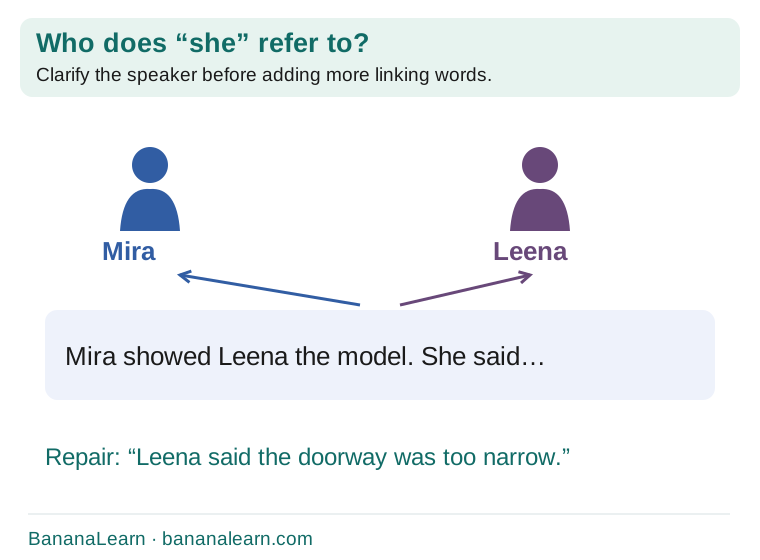
Draft: “Mira showed Leena the model beside the window. She said it was too narrow. The model used cardboard. Therefore, the team painted it blue. This solved the problem.” Each sentence is grammatical, but the reference and reasoning are unclear.
Who spoke? What was narrow? Why would blue paint solve a width problem? Do not add more connectors until you can answer those questions from the intended meaning.
Cohesion concerns the visible language links between sentences. Coherence concerns whether the ideas fit together and develop a sensible line of thought. Clear pronouns and transitions help cohesion, but an unrelated conclusion can remain incoherent.
A paragraph full of however, moreover and therefore is not automatically well connected. Each word commits the writer to a relationship that the surrounding ideas must support.
In the draft, she could refer to Mira or Leena. Replace it with the intended name: “Leena said that the model’s doorway was too narrow.” That sentence also replaces vague it with the part being discussed.
Repeating a noun is useful when it prevents confusion. Avoiding every repetition can make the reader work harder than necessary. Once a referent is clear and nearby, a pronoun can keep the prose natural.
On a narrow screen, swipe the diagram or open it full size.
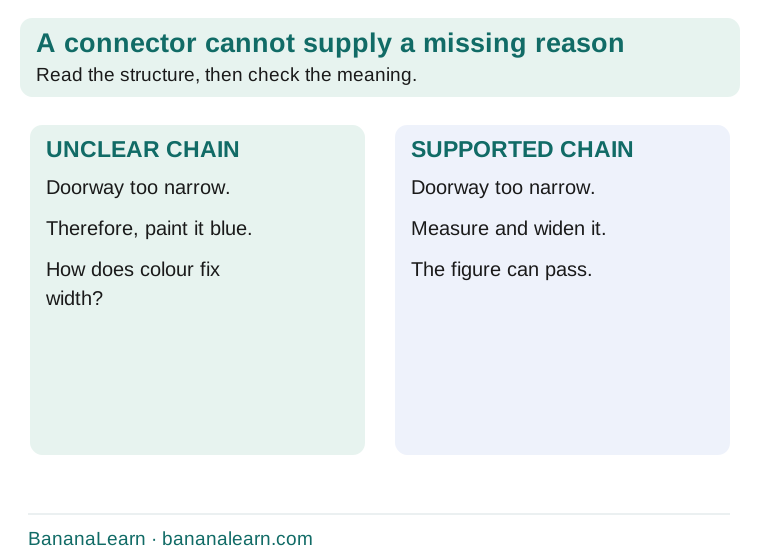
Because and therefore express reason and result; however signals contrast; for example introduces an instance. In “The doorway was narrow. Therefore, the team widened it”, the result follows logically.
“The doorway was narrow. Therefore, the team painted it blue” needs an explanation that is absent. Changing therefore to meanwhile might remove the false causal link, but it would not explain how the original problem was solved.
A bare this can refer vaguely to several preceding events. “This adjustment made the entrance wide enough” names the change being evaluated. “This colour made the model easier to see” would refer to a different improvement.
The summary noun is part of the explanation. Words such as decision, change, result and comparison can gather a previous idea without making the reader guess what this means.
Choose one main task: explaining how the team fixed a model entrance. Details about cardboard matter if they explain how the doorway could be cut wider. Unrelated facts about lunch or the weather can wait for another paragraph.
A topic sentence sets a direction but does not replace development. Each following sentence should add evidence, explanation, an example or a consequence related to that direction.
Revision: “Mira showed Leena the cardboard model. Leena noticed that its doorway was too narrow for the toy figure. The team measured the figure and marked a wider opening. Because the doorway was cardboard, they could trim it without rebuilding the walls. This adjustment let the figure pass through. They then painted the model blue as a finishing step.”
The revised paragraph identifies the speaker, explains the relevant material, links the repair to the problem and separates decoration from the solution. It adds the missing reasoning rather than only replacing pronouns.
For each sentence, write its job and the earlier idea it connects to. Circle pronouns and demonstratives; draw a line to their referents. Underline connectors and state their relationship in plain language.
Ask another reader to explain the chain without extra help. If they identify a different speaker or cause, revise the wording. This checks clarity in this text; it does not establish that every possible reader will interpret it identically.
See the reasoning
Try, explain, check
Try each task before opening its explanation. These are original BananaLearn questions, not official exam or past-paper questions. Where several answers can work, the explanation gives the criteria.
Both Mira and Leena are possible referents
The reader cannot reliably identify the speaker.
No
It could describe the model, a part or another object.
Not according to the supplied information
The draft gave no reason connecting colour to usable width.
They could trim the doorway without rebuilding the walls
It explains how the material supported the repair.
Widening the doorway
The preceding sentences establish that change.
however
Therefore signals a result.
for example
It should be followed by a real example of the preceding idea.
No
It can prevent ambiguity.
No
The reason must be supplied by the ideas or facts.
Widening solves the access problem; painting changes appearance
The paragraph makes their functions separate.
For example: this decision, this test, this change
Choose a noun that accurately identifies the preceding idea.
Who acted, what changed and why the change followed
A clear chain is a practical check on the revision.
Copy these headings and fill them for one worked task, then for a fresh attempt. Use your own evidence rather than copying the model answer.
Explore BananaLearn’s games, learning features and one-to-one tutoring. Maths is our priority; English and Science tutoring are also available. Bring a recent example of schoolwork when checking teaching fit.
Original BananaLearn explanations, examples, illustrations and practice. Source facts checked 7 November 2026. Suggested levels are learning guides, not a claim that every board or textbook uses the same sequence.
How we prepare guides · Report a correction
Share the complete guide: https://bananalearn.com/learn/class-9-paragraph-cohesion-reference.html