
Start with the key idea
Begin each sentence with a capital letter. Use a full stop for an ordinary statement, a question mark for a direct question and an exclamation mark for a strong exclamation. Capitalise particular names and the pronoun I. Use commas to separate items in a simple list.
1. Give the reader a clear beginning and ending
Read “the rain stopped we went outside”. There are two complete ideas: the rain stopped, and we went outside. One clear edit is “The rain stopped. We went outside.” Each sentence begins with a capital and ends with a full stop.
A sentence is not simply a line of writing. A long sentence may wrap onto the next line. Do not add a capital just because your pencil or screen has moved to a new line; look for the start of a new sentence.
Read your draft aloud, but do not place a full stop at every breathing pause. First check whether the words express a complete idea. “Because it was raining” leaves the reader waiting for more; “We stayed inside because it was raining” completes the thought.
2. Match the ending to the message
“The gate is open.” gives information, so a full stop fits. “Is the gate open?” asks a direct question, so it needs a question mark. “What a huge gate!” expresses a strong reaction, so an exclamation mark is suitable.
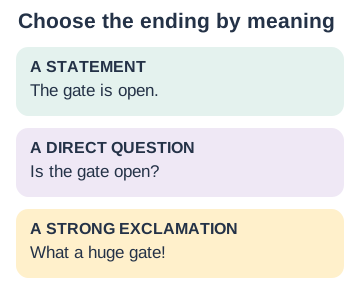
Do not decide from the first word alone. “What a lovely picture!” begins with what but expresses an exclamation. “I wonder where the key is.” reports a thought rather than asking the reader a direct question.
A calm instruction can end with a full stop: “Please close the gate.” An urgent warning may use an exclamation mark: “Look out!” Context and tone matter. In ordinary school writing, one ending mark is enough.
3. Give each capital letter a reason
Use a capital for the first word of a sentence. Use capitals in particular names: Tara, Mumbai, Friday and October. Write the pronoun I as a capital wherever it appears: “Tara and I waited.”
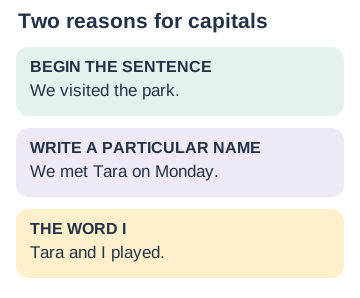
Compare “We visited a city” and “We visited Jaipur”. City is an ordinary naming word; Jaipur is a particular name. At the start of “Cities can be busy”, Cities has a capital because it begins the sentence.
Ordinary subjects such as maths and science are usually lower case in a sentence. Language names such as English and Hindi take capitals. Headings on a school timetable may follow title conventions; do not copy those capitals into every ordinary sentence.
4. Separate the items in a simple list
“We packed apples, bread and water.” has three items. Commas separate the items, and and joins the last pair. The comma after apples helps the reader see where one item ends and the next starts.
Some writing styles also use a comma before the final and: “apples, bread, and water”. That final serial comma is acceptable. Keep the style consistent and use clarity as your guide; do not mark it wrong simply because it is present.
A comma does not replace every missing full stop. “The bell rang, we stood up” joins two complete clauses with only a comma. For this level, write “The bell rang. We stood up.” You can also join the ideas with and.
5. Check whether the punctuation changes the meaning
Compare “Let’s eat, Grandma!” with “Let’s eat Grandma!” The first speaks to Grandma; the comma separates the person being addressed. The second accidentally makes Grandma the thing being eaten. This is a useful meaning check, not a rule to put commas around every name.
“Grandma made lunch.” needs no comma after Grandma because Grandma is the subject of that sentence. “Thank you, Grandma.” speaks directly to her, so the comma has a different job. Read who is doing what before editing.
Apostrophes are another punctuation topic. You may see one in let’s, which means let us. This guide focuses on sentence endings, capitals and simple commas; use a separate lesson for contractions and possession rather than guessing every apostrophe.
6. Edit in three small passes
First find each complete sentence and choose its ending. Next check sentence beginnings, names and I for capitals. Finally read lists and direct addresses to see whether commas help. Three focused passes are easier than trying to spot everything at once.
Try editing a two-sentence note: “on monday i packed pencils paper and glue did you bring scissors”. One possible version is “On Monday I packed pencils, paper and glue. Did you bring scissors?” Explain each change instead of counting how many marks you added.
When two versions are possible, describe their effect. “You finished.” is a calm statement; “You finished!” can express excitement. The context should tell the learner which tone is wanted. Punctuation practice should not pretend that every sentence has only one possible tone.
5 worked examples with reasoning
1. Edit “where is my bag”.
- It asks a direct question.
- Begin with a capital W and end with a question mark.
- Where is my bag?
2. Edit “ravi and i went to delhi”.
- Ravi and Delhi are particular names; I is always capitalised.
- The sentence gives information, so finish with a full stop.
- Ravi and I went to Delhi.
3. Edit “we need cups plates and spoons”.
- Separate the three list items: cups, plates and spoons.
- Capitalise We and add a full stop.
- We need cups, plates and spoons. A serial comma before and is also acceptable.
4. Split “the bus arrived we climbed aboard”.
- Each part can be a complete sentence.
- Use a full stop after arrived and a capital W next.
- The bus arrived. We climbed aboard.
5. Explain the comma in “Please wait, Maya.”
- The speaker is addressing Maya.
- The comma separates the direct address from the instruction.
- In “Maya waits”, Maya is the subject, so no comma is needed.
Save the guide or print the practice
Download to save or share
Complete guide with answers (PDF) · Worksheet without answers (PDF) · Worksheet and answer key (PDF)
Try each task before opening its answer. Give an example or reason, not only a label.
14 practice questions with explanations
Try each task before opening its answer. Give an example or reason, not only a label.
Write an answer and your reason before opening the explanation. Check the reasoning as well as the final answer.
- Question
Add capitals and punctuation: where are the keys
Answer and reasoning
Where are the keys?
This is a direct question.
- Statement
Edit: the keys are on the table
Answer and reasoning
The keys are on the table.
An ordinary statement takes a full stop.
- Reaction
Show excitement: what a beautiful rainbow
Answer and reasoning
What a beautiful rainbow!
The words express an exclamation, not a direct question.
- Names
Edit: i met sara on tuesday
Answer and reasoning
I met Sara on Tuesday.
I, the person’s name and the day name need capitals.
- List
Edit: pack a hat a bottle and a towel
Answer and reasoning
Pack a hat, a bottle and a towel.
The commas separate three items; a final serial comma is also acceptable.
- Boundary
Make two sentences: the dog barked the baby woke
Answer and reasoning
The dog barked. The baby woke.
Both parts express complete ideas.
- Instruction
Punctuate as a calm request: please sit down
Answer and reasoning
Please sit down.
A request does not automatically need an exclamation mark.
- Line break
Does a new line always need a capital letter?
Answer and reasoning
No.
A sentence may continue onto a new line.
- Address
Edit: thank you arun
Answer and reasoning
Thank you, Arun.
Arun is the person being addressed.
- Subject
Does “Arun carries a bag.” need a comma after Arun?
Answer and reasoning
No.
Arun is the subject, not a separate direct address.
- Meaning
Choose the ending: I wonder where my shoes are
Answer and reasoning
I wonder where my shoes are.
It reports a thought rather than asking a direct question.
- Edit
Correct: We studied english and Maths.
Answer and reasoning
We studied English and maths.
English is a language name; maths is an ordinary subject in this sentence.
- Repair
Repair the comma join: The rain stopped, we played.
Answer and reasoning
The rain stopped. We played.
Two full sentences need a proper boundary or a joining word.
- Create
Write one statement and one related question.
Answer and reasoning
For example: The box is heavy. What is inside it?
Use a full stop for information and a question mark for the direct question.
Use the ideas without looking at the notes
Write a short note about your day. Underline each sentence beginning, circle its ending mark and explain every name capital. Read the edited note to someone else and check that the meaning is clear.
Common questions
Does every sentence beginning with what need a question mark?
No. What a surprise! is an exclamation. Decide from the meaning.
Should every line start with a capital?
No. Capitalise sentence beginnings, names and I; a line break alone is not a reason.
Is a comma before the final and wrong?
No. The serial comma is a valid style choice. Use it consistently and where it helps clarity.
Can an instruction end with a full stop?
Yes. Please close the door. is a calm instruction.
Should children learn all punctuation at once?
Start with clear sentence boundaries and capitals, then introduce other marks through short examples.
Connect your learning
Ask about guided English learning if your child needs help explaining these ideas.
About this guide
Original explanations, examples, diagrams and practice by BananaLearn. The grade label indicates the intended learning level; this is not an official textbook extract or exam paper.