
Start with the key idea
A noun is a naming word, such as duck, Asha, garden or ball. An action word tells what someone or something does: runs, draws, opens. Action words are verbs, but some verbs, such as is and has, do other jobs. Read the sentence to decide how a word is being used.
1. Start with a scene you can picture
Imagine a duck beside a puddle. Say “duck”. That word names the animal. Now imagine it splashing: “The duck splashes.” Splashes adds what is happening. Together the words tell a tiny story.
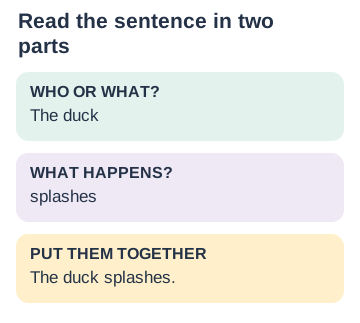
Point to each word as you read. Ask “Who or what is this about?” and then “What does it do?” In this sentence, duck and splashes answer those questions. Keep the small word the when you say the whole sentence.
Try a second scene: “Asha draws.” Asha is the name of a person. Draws tells the action. You can mime drawing with a finger without using a pencil. Read the sentence again while you mime.
2. Find names for people, places, animals and things
Teacher names a person. Park names a place. Cat names an animal. Cup names a thing. These are familiar groups of nouns. A noun does not have to name something alive: table and stone are nouns too.
A particular name can also be a noun: Ravi, Delhi or the pet name Coco. At this stage, practise finding the naming word. You can learn the common and proper noun groups in the linked guide when these first examples feel comfortable.
Use real objects for a quick hunt. Name a chair, a book and a window. Then choose one noun and put it in a sentence. Naming a thing and saying a whole sentence are two different tasks; both are useful.
3. Find the action in a complete sentence
Read “The baby laughs.” Laughs tells what the baby does. Read “The leaves fall.” Fall tells what happens to the leaves. Actions can involve people, animals or things.
Some actions are easy to mime: jump, clap, stretch. Others are quiet: listen, think, notice. A word can be a verb even when you cannot see someone moving. Begin with clear examples before trying the quiet ones.
Keep the word as it appears in the sentence. In “Riya jumps”, the action word is jumps, not just jump. In “The birds jumped”, it is jumped. The ending can give information about who acts or when it happens.
4. A word can do different jobs
Compare “The paint is blue” with “We paint a box”. In the first sentence, paint names the material. In the second, paint tells what we do. Reading the whole sentence helps you choose.
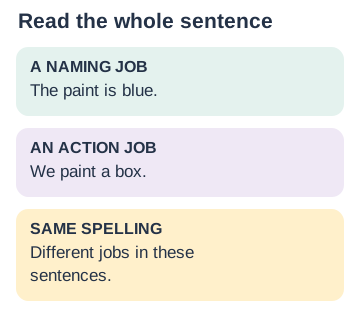
Try “I have a brush” and “I brush my hair”. Brush names a thing in the first sentence and tells an action in the second. Do not sort these words into permanent groups without a sentence.
For a first lesson, an adult can read the pair and ask the child to point to the object or mime the action. If a child hesitates, supply the scene. The purpose is to understand the word’s job, not to guess a label.
5. Build a sentence, then check it
Choose a noun such as rabbit. Choose an action such as hops. Add the small opening word: “The rabbit hops.” Begin with a capital and finish with a full stop. Read it aloud to check that it tells a complete idea.
Add one helpful detail: “The rabbit hops across the grass.” Rabbit is still the animal being described, and hops is still the action. Grass is another noun. A sentence can contain more than one noun.
Change only the action: “The rabbit rests.” Notice how the scene changes. Then change only the animal: “The frog hops.” This makes sentence building a choice about meaning, rather than copying words into empty spaces.
6. Keep a place for verbs that do not show action
“The bag is heavy” is a complete sentence, although heavy is not an action. Is is the verb joining the bag to its description. Heavy tells what the bag is like. It should not be labelled an action word.
“Mina has a pencil” uses has to tell about possession. This guide begins with action verbs, but the wider verb family includes words such as is and has. Avoid telling a child that every verb must be something they can act out.
Finish with a drawing and two sentences. For example: “The dog runs. It is tired.” Ask the learner to find the clear action runs. An adult can point out that is has a different job in the second sentence.
5 worked examples with reasoning
1. Find a noun and an action word: “The puppy shakes.”
- Puppy names the animal, so it is a noun.
- Shakes tells what the puppy does, so it is an action verb.
- Read the sentence while gently miming the action.
2. Find both nouns in “Ravi kicks the ball.”
- Ravi names the person; ball names the thing.
- Kicks is the action.
- There can be more than one noun in a sentence.
3. Build a sentence using bird and sings.
- Add a small opening word: The bird sings.
- Use a capital T and a full stop.
- Bird names the animal; sings tells its action.
4. Explain brush in “I brush the dog.”
- Read the whole sentence before choosing.
- Brush tells what I do here.
- It is an action word in this sentence, although a brush can also name a thing.
5. Is heavy an action in “The box is heavy”?
- Heavy describes the box.
- Is is the verb in this sentence.
- The sentence describes a state rather than showing an action such as lifts.
Save the guide or print the practice
Download to save or share
Complete guide with answers (PDF) · Worksheet without answers (PDF) · Worksheet and answer key (PDF)
Read each sentence aloud. An adult may read the instructions. Say, point to or write your answer, then check the explanation.
14 practice questions with explanations
Read each sentence aloud. An adult may read the instructions. Say, point to or write your answer, then check the explanation.
Write an answer and your reason before opening the explanation. Check the reasoning as well as the final answer.
- Find
Name the animal noun in “The horse trots.”
Answer and reasoning
Horse.
It names the animal.
- Action
Find the action word in “Sara claps.”
Answer and reasoning
Claps.
It tells what Sara does.
- Two nouns
Find the two nouns in “Ali opens the door.”
Answer and reasoning
Ali and door.
One names a person; the other names a thing.
- Place
Find the place noun in “We visit the park.”
Answer and reasoning
Park.
It names the place we visit.
- Build
Make a sentence with rabbit and jumps.
Answer and reasoning
For example: The rabbit jumps.
Use the noun with the action, a capital and a full stop.
- Meaning
Complete “The baby ___” with an action.
Answer and reasoning
For example: The baby smiles.
Other sensible actions are possible.
- Context
Is paint a noun or an action word in “We paint the wall”?
Answer and reasoning
An action word.
It tells what we do.
- Context
Is paint a noun or an action word in “The paint is wet”?
Answer and reasoning
A noun.
It names the material being described.
- Keep the ending
Find the action word in “The frog jumped.”
Answer and reasoning
Jumped.
Use the form actually written in the sentence.
- Extend
Add a place to “The children play.”
Answer and reasoning
For example: The children play in the garden.
The place adds detail while play keeps its action job.
- Check
Is red an action word in “The cup is red”?
Answer and reasoning
No.
Red describes the cup; is is the verb.
- Quiet action
Find the action word in “Asha listens.”
Answer and reasoning
Listens.
An action need not involve large visible movements.
- Create
Write a sentence about a toy with an action.
Answer and reasoning
For example: The toy car rolls.
Car names the thing; rolls tells what happens.
- Explain
Why should you read a sentence before sorting brush?
Answer and reasoning
Brush can name a thing or tell an action.
A brush is an object; I brush shows an action.
Use the ideas without looking at the notes
Draw a simple scene. Label one person, animal or thing, then write a sentence about what happens. Circle the naming word and underline the action. Explain each choice aloud.
Common questions
Are nouns only things we can touch?
No. These first examples use familiar objects and people, but nouns can also name ideas and feelings.
Is every verb an action word?
No. Is and has are verbs too, although they can describe a state or possession.
Can a sentence have two nouns?
Yes. In Ravi kicks the ball, Ravi and ball are both nouns.
Can the same word name a thing and express an action?
Yes. Brush and paint can do either job; the sentence tells you which.
Should a Grade 2 learner write every answer?
Spoken answers, pointing and acting can help first. Move to short written sentences when the learner is ready.
Connect your learning
Ask about guided English learning if your child needs help explaining these ideas.
About this guide
Original explanations, examples, diagrams and practice by BananaLearn. The grade label indicates the intended learning level; this is not an official textbook extract or exam paper.