What does it mean?
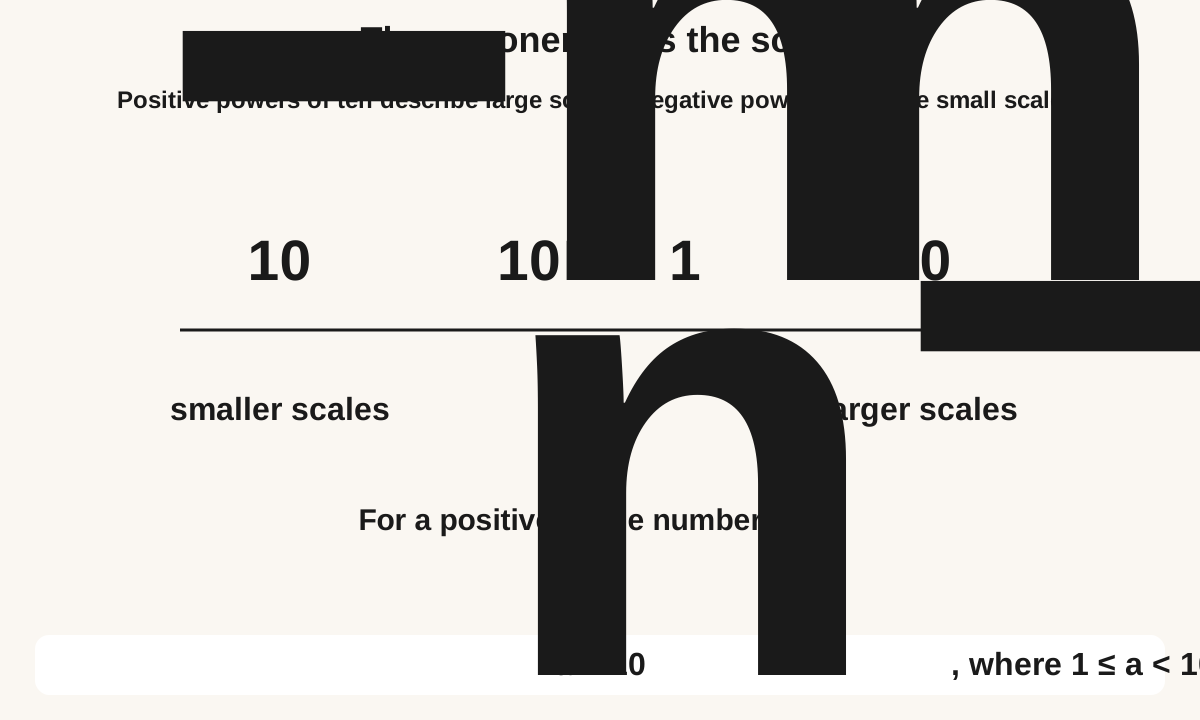
Scientific notation separates a number’s significant digits from its scale. For positive numbers, the coefficient is at least 1 and less than 10. The power of ten tells how far its value is scaled. A negative exponent means a small positive number, not a negative number.
Standard form (scientific notation) writes a number as a × 10^n, where 1 ≤ |a| < 10 and n is an integer. Moving the point one place to the left increases n by 1. Moving it one place to the right decreases n by 1. To multiply, multiply the coefficients and add the indices. To compare, first compare the powers of 10.
Learning goal: Read, compare and calculate with standard/scientific notation. The grade is a suggested starting point; school sequences vary. Use the first worked example to check readiness, and Grade 8 Power Play: exponents, rules and practice questions if an earlier idea needs revisiting.
See the idea
Read each diagram with its labels, then follow the worked examples. Practice questions include their own measurements and information.

Enlarge diagram to read the labels
Swipe across the enlarged diagram to read every label.
Enlarge diagram to read the labels
Swipe across the enlarged diagram to read every label.
Choose a method and explain why it works
Place the decimal point after the first non-zero digit and choose the exponent that reconstructs the original value. To multiply, multiply coefficients and add exponents, then normalise the coefficient again if needed. To add, first rewrite the terms with the same power of ten; adding exponents would apply the multiplication rule to the wrong operation.
Key rule and when to use it
For a non-zero real number, scientific notation is a × 10ⁿ with 1 ≤ |a| < 10 and integer n. Zero is written separately as 0.
Worked examples, step by step
Example 1: Write 56000 in standard form.
- The first non-zero digit is 5, so the coefficient is 5.6.
- The point moved 4 places from 5.6 to 56000, so the power is 10^4.
- 56000 = 5.6 × 10^4.
Answer: 5.6 × 10^4
Check: 10^4 = 10000, and 5.6 × 10000 = 56000.
Example 2: Write 0.0072 in standard form.
- This number is less than 1, so the index will be negative.
- The coefficient is 7.2. The point moved 3 places to the right, so multiply by 10^-3.
- Check: 7.2 × 0.001 = 0.0072.
Answer: 7.2 × 10^-3
Check: 10^-3 is thousandths, which matches a number with three digits after the point starting from 7.
Example 3: Calculate (6 × 10³) × (4 × 10²) in standard form.
- Multiply coefficients: 6 × 4 = 24. Add indices: 3 + 2 = 5.
- The intermediate result is 24 × 10⁵.
- Normalise: 24 = 2.4 × 10, so the answer is 2.4 × 10⁶.
Common mistakes and important boundaries
For a negative number the coefficient is negative and its absolute value is from 1 up to 10, excluding 10. Comparing exponent sizes alone works for positive numbers in normalised form, but negative numbers need an order comparison with their signs. Zero is written as 0; it has no non-zero normalised coefficient.
A point to explain
A learner may leave a coefficient of 12.5, or compare 9.9 × 10^4 with 1.01 × 10^5 by looking only at 9.9 versus 1.01.
Compare an uncertain attempt with the closest worked example. Look at the meaning of each operation, unit and label before repeating the arithmetic.
Scientific Notation: Standard Form and Powers of Ten — practice
Work on paper first. Open each answer afterwards and compare the reasoning. Print the questions with or without the separate answer key; no account is required.
Name: ____________________ Date: __________
Which number is already in standard form?
Answer and a way to check
1.25 × 10^4
The coefficient must have exactly one non-zero digit to the left of the point.
Write 830000 as a × 10^n.
Answer and a way to check
8.3 × 10^5
Place the point after 8. Count how many places it moved.
Write 4.5 × 10^6 as an ordinary number.
Answer and a way to check
4500000
10^6 is 1 million. Multiply 4.5 by 1 000 000.
A number smaller than 1 is 0.00036. Write it in standard form.
Answer and a way to check
3.6 × 10^-4
Move the point to the right until the coefficient is between 1 and 10. Each move decreases the index by 1.
Calculate (2 × 10^3) × (4 × 10^2). Give the answer in standard form.
Answer and a way to check
8 × 10^5
Multiply 2 by 4. Add the indices 3 and 2.
Which is larger, 9.9 × 10^4 or 1.01 × 10^5? Why?
Answer and a way to check
1.01 × 10^5, because 10^5 is ten times 10^4
Compare the powers of 10 first. A larger index wins when both numbers are positive.
A student writes 0.52 × 10^5 as standard form. What must change?
Answer and a way to check
Write 5.2 × 10^4
Move the point so the coefficient is from 1 up to but not including 10. Adjust the index by the same number of places.
A cell is 8 × 10^-6 m long. Write this as an ordinary number of metres, then as millimetres. (1 m = 1000 mm)
Answer and a way to check
0.000008 m = 0.008 mm
First write 8 × 10^-6 as a decimal metre. Then multiply by 1000 to convert metres to millimetres.
Scientific Notation: Standard Form and Powers of Ten — answer key
1.25 × 10^4 The coefficient must have exactly one non-zero digit to the left of the point.
8.3 × 10^5 Place the point after 8. Count how many places it moved.
4500000 10^6 is 1 million. Multiply 4.5 by 1 000 000.
3.6 × 10^-4 Move the point to the right until the coefficient is between 1 and 10. Each move decreases the index by 1.
8 × 10^5 Multiply 2 by 4. Add the indices 3 and 2.
1.01 × 10^5, because 10^5 is ten times 10^4 Compare the powers of 10 first. A larger index wins when both numbers are positive.
Write 5.2 × 10^4 Move the point so the coefficient is from 1 up to but not including 10. Adjust the index by the same number of places.
0.000008 m = 0.008 mm First write 8 × 10^-6 as a decimal metre. Then multiply by 1000 to convert metres to millimetres.
Questions students and parents ask
How do I add numbers in scientific notation?
Use the same power of ten first. 3 × 10⁴ + 2 × 10³ = 3 × 10⁴ + 0.2 × 10⁴ = 3.2 × 10⁴. Adding exponents would be incorrect here.
Is 10 × 10³ in standard form?
It has the correct value 10,000, but its coefficient is not less than 10. The normalised form is 1 × 10⁴.
Is this a complete set of textbook exercise solutions?
No. This guide adapts BananaLearn’s own teaching examples and practice. It is not official NCERT material or a promise of the exact chapter sequence in a particular board, country or textbook edition.
What if the examples are still difficult?
Revisit Grade 8 Power Play: exponents, rules and practice questions. Try the first example with its model, then attempt one fresh question independently. A correct copied answer is not evidence that the method can be used without support.
Help at home
Ask the learner to reconstruct one ordinary number from their answer. This tests both the sign of the exponent and the decimal place count.
Keep one example of the learner’s own working. A repeated difficulty across fresh questions can guide a discussion with their teacher; one short practice sheet does not establish a diagnosis or a full mastery profile.
Connect this idea to the next skill
About this guide
Based on BananaLearn’s Grade 8 course lesson “Standard Form”. The explanations have been adapted for independent reading; course diagrams are reused where they fit the idea, and missing classroom givens are made explicit in questions.
Need another way to understand it?
Bring one question your child found difficult to a free 50-minute session. Tell us their grade, curriculum and time zone so we can discuss a suitable next step.
Request a free session