
Start with the key idea
This guide uses the verified seven-chapter Ganita Prakash Grade 8 Part I contents. The official file records first edition July 2025, reprint January 2026 and 2026–27 printing. Original examples connect selected concepts to practice. This is not a complete current Class 8 syllabus or a verified map of Part II.
1. Check the part before using the chapter map
Match Grade 8, Ganita Prakash, the language and Part I against the school’s book. Record the edition and reprint information from the publication page. A search result headed “Class 8 maths” may still describe a different textbook with different chapters.
The seven verified Part I titles are listed below. Their presence in the official contents supports this map, but it does not establish every topic assigned by an individual school. Use the teacher’s plan to identify the order and any additional material.
If the child uses another part, obtain that part’s contents rather than extending the list from memory. The examples here are original supporting practice, not NCERT exercise answers. They are deliberately identified by skill so they remain useful without borrowing question numbering.
| Part I chapter | Verified title | Your study status |
|---|---|---|
| 1 | A Square and A Cube | Not studied / practising / revisit later |
| 2 | Power Play | Not studied / practising / revisit later |
| 3 | A Story of Numbers | Not studied / practising / revisit later |
| 4 | Quadrilaterals | Not studied / practising / revisit later |
| 5 | Number Play | Not studied / practising / revisit later |
| 6 | We Distribute, Yet Things Multiply | Not studied / practising / revisit later |
| 7 | Proportional Reasoning | Not studied / practising / revisit later |
2. Link squares, cubes and powers to quantities
The opening titles A Square and A Cube and Power Play suggest a useful connection between repeated multiplication and geometric models. A square of side eight has area sixty-four; a cube of side three has volume twenty-seven. The units change with dimension.
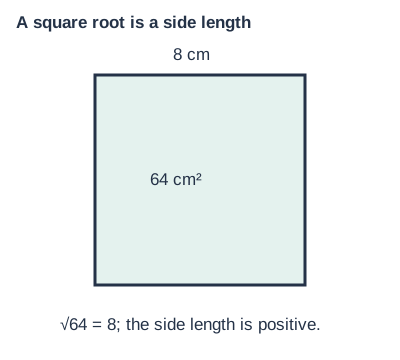
Distinguish the principal square root from solving an equation. √64 names the nonnegative root eight. The equation x² = 64 has solutions eight and negative eight because both square to sixty-four. A physical side length cannot be negative.
For equal bases, multiplying powers combines repeated factors: 2³ × 2² contains five factors of two, so it equals 2⁵. The rule is not “multiply all exponents”, and it does not directly turn 2³ × 3² into a single power by adding the exponents.
3. Test a number claim with a reason
A Story of Numbers and Number Play are separate titles in the verified part. For original supporting practice, investigate divisibility, factors and patterns by explaining why a claim works rather than collecting isolated answers.
For example, a number ending in an even digit is divisible by two because its tens part is already a multiple of ten, and therefore a multiple of two. The final digit determines whether another unpaired unit remains.
One successful example does not prove a statement about every number. The claim “every odd number is prime” fails at nine because 9 = 3 × 3. A counterexample is enough to refute an all-number claim, whereas a general proof needs a reason that covers every allowed case.
4. Use the conditions of the shape
Quadrilaterals is the fourth title in Part I. A quadrilateral has four sides and its interior angles total 360° in ordinary plane geometry. If three angles are 80°, 95° and 105°, the remaining angle is 80°.
Special shapes supply additional conditions. In a parallelogram, opposite sides are parallel and opposite angles are equal. Adjacent angles add to 180°. A diagram that merely looks like a parallelogram is not enough; the description or markings must establish the condition.
Area requires appropriate measurements. A parallelogram with base 10 cm and perpendicular height 6 cm has area 60 cm². Replacing the perpendicular height with a sloping side can give the wrong area even if the multiplication itself is correct.
5. See distribution as partitioning
We Distribute, Yet Things Multiply is the sixth title in the verified map. A rectangle four units tall and ten units wide can be split into widths seven and three. Its area is both 4 × 10 and 4 × 7 + 4 × 3.
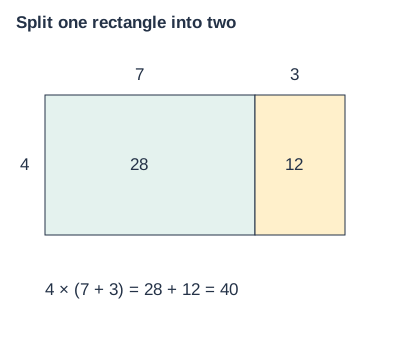
This explains 4(7 + 3) = 28 + 12. Every part inside the brackets receives the multiplier. The tempting expression 4 × 7 + 3 gives thirty-one because it multiplies only one part; it does not represent the full rectangle.
The same structure works with a letter: 4(x + 3) = 4 x + 12. The letter does not change the distributive rule. Reverse the reasoning to factorise 4 x + 12 as 4(x + 3), and check by expanding back.
6. Decide the relationship before calculating
Proportional Reasoning is the final title in the verified Part I contents. In original practice, identify the quantities and test whether their ratio is constant before using a direct-proportion method. Five notebooks costing ₹75 at one unit price imply ₹15 each.
At that price, eight notebooks cost ₹120. But a service charging ₹20 once plus ₹15 per item is not directly proportional: doubling the number of items does not double the fixed fee. A table of values can reveal the difference.
When reviewing a chapter, keep one reason and one counterexample beside the rule. Record the book title, an independent task, the misconception found and the next action. The mixed worksheet is a sample for this purpose, not a comprehensive Part I or Part II assessment.
5 worked examples with reasoning
1. A square has area 81 cm². Find its side length.
- The positive square root of eighty-one is nine.
- The side is 9 cm.
- Do not give −9 cm as a physical length.
2. Simplify 3² × 3³.
- Both powers have base three.
- Combine five factors: 3⁵ = 243.
- Adding the exponents is justified by repeated multiplication.
3. A quadrilateral has angles 70°, 110° and 95°. Find the fourth.
- The angle sum is 360°.
- Fourth angle = 360 − 70 − 110 − 95 = 85°.
- Check that all four total three hundred sixty.
4. Expand 5(x + 4).
- Multiply each term inside the brackets by five.
- The result is 5 x + 20.
- At x = 2 both original and expanded forms give thirty.
5. Three identical notebooks cost ₹54. Find the cost of seven at the same unit price.
- One notebook costs 54 ÷ 3 = ₹18.
- Seven cost 7 × 18 = ₹126.
- This assumes no fixed fee or quantity discount.
Save the guide or print the practice
Download to save or share
Complete guide with answers (PDF) · Worksheet without answers (PDF) · Worksheet and answer key (PDF)
Try each task before opening its answer. Give an example or reason, not only a label.
14 practice questions with explanations
Try each task before opening its answer. Give an example or reason, not only a label.
Write an answer and your reason before opening the explanation. Check the reasoning as well as the final answer.
- Roots
Find √49.
Answer and reasoning
7.
The square-root symbol denotes the nonnegative root.
- Equation
Solve x² = 49 over the real numbers.
Answer and reasoning
x = 7 or x = −7.
Both values square to forty-nine.
- Cube
Find the volume of a cube of side 4 cm.
Answer and reasoning
64 cm³.
4 × 4 × 4.
- Power
Simplify 2⁴ × 2³.
Answer and reasoning
2⁷ = 128.
Add exponents for the equal base.
- Divisibility
Is 246 divisible by 2? Explain.
Answer and reasoning
Yes.
Its units digit is even.
- Reason
Give a counterexample to “every odd number is prime”.
Answer and reasoning
9, for example.
It is odd but equals 3 × 3.
- Angles
A quadrilateral has three right angles. Find the fourth angle.
Answer and reasoning
90°.
360 − 270.
- Shape
One angle of a parallelogram is 65°. Find an adjacent angle.
Answer and reasoning
115°.
Adjacent angles are supplementary.
- Area
A parallelogram has base 8 cm and perpendicular height 5 cm. Find its area.
Answer and reasoning
40 cm².
Base times perpendicular height.
- Expand
Expand 3(x + 6).
Answer and reasoning
3 x + 18.
Distribute three to both terms.
- Factorise
Factorise 5 x + 15 using the common factor.
Answer and reasoning
5(x + 3).
Expand to check.
- Rate
Four identical pens cost ₹28. Find the cost of nine at the same unit price.
Answer and reasoning
₹63.
Each pen costs seven rupees.
- Model
A delivery costs ₹10 plus ₹4 per item. Is the total directly proportional to item count?
Answer and reasoning
No.
The fixed charge prevents a constant cost-per-item ratio.
- Edition
Can this verified Part I list confirm a Part II chapter number?
Answer and reasoning
No.
Use Part II’s own official contents.
Use the ideas without looking at the notes
Match the official part first. Then use one chapter row with a dated independent example, a question to revisit and a next action.
Common questions
Is this the entire Class 8 syllabus?
No. The verified map is limited to Grade 8 Ganita Prakash Part I.
Does √64 equal both eight and negative eight?
No. √64 is eight. Both signs solve the different statement x² = 64.
Are the examples taken from NCERT exercises?
No. They are original BananaLearn examples supporting selected concepts.
What if the school book uses different chapter names?
Match the book, part, language and publication details before using the numbered map.
What should a parent record after practice?
The specific misconception, one successful independent explanation and the next review task.
Connect your learning
Ask about guided Maths learning if your child needs help explaining these ideas.
About this guide
Original explanations, examples, diagrams and practice by BananaLearn. The grade label indicates the intended learning level; this is not an official textbook extract or exam paper.