What does it mean?
Column addition organises equal place-value units. Ones sit below ones, tens below tens and hundreds below hundreds. A regrouped “1” has a different value in each new place: moving from ones to tens represents ten, while moving from tens to hundreds represents one hundred.
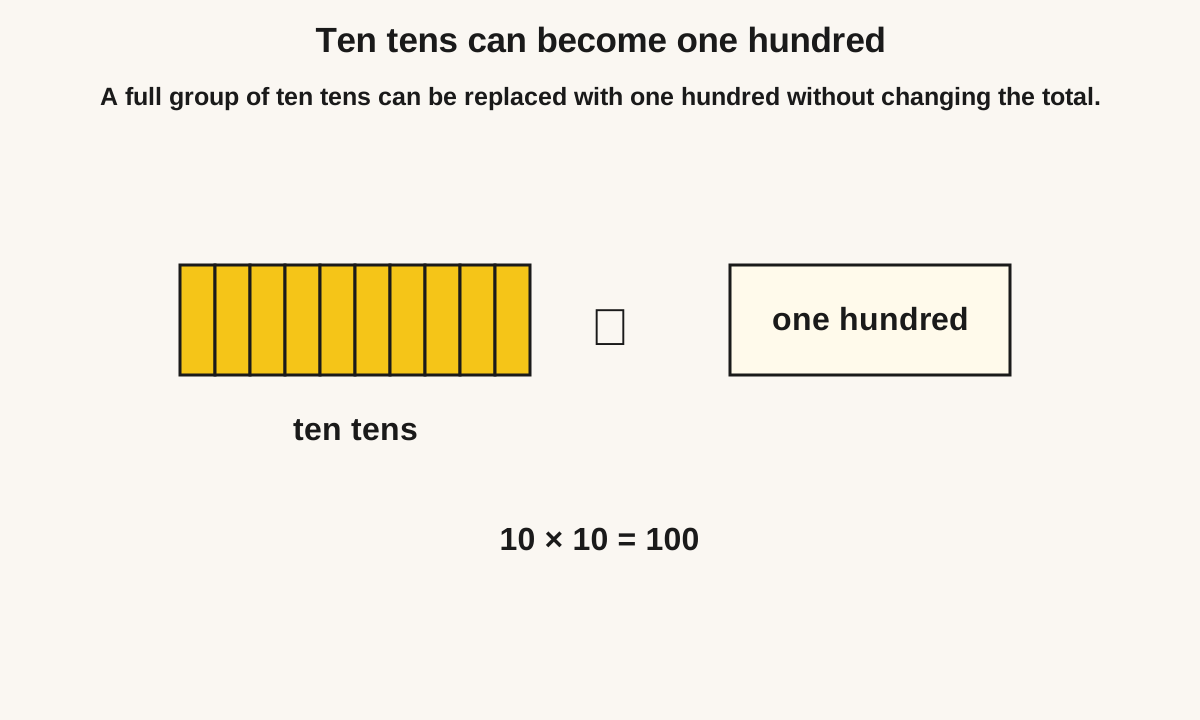
Regrouping is a place-value exchange. When a place has 10 or more units, compose 10 of them into 1 unit of the next place.
Learning goal: Add within 1,000 by composing a new ten or hundred using place-value exchanges. The grade is a suggested starting point; school sequences vary. Use the first worked example to check readiness, and Number sense and multiplication if an earlier idea needs revisiting.
See the idea
Read each diagram with its labels, then follow the worked examples. Practice questions include their own measurements and information.

Enlarge diagram to read the labels
Swipe across the enlarged diagram to read every label.
Enlarge diagram to read the labels
Swipe across the enlarged diagram to read every label.
Choose a method and explain why it works
Write the numbers with their place values aligned. Add the ones; if there are ten or more, rename ten ones as one ten and record what remains. Include that new ten when adding the tens. Repeat for the hundreds. Say the units as you work so that the small carried mark has a clear meaning.
Key rule and when to use it
Align ones under ones, tens under tens and hundreds under hundreds. Exchange 10 ones for 1 ten, and 10 tens for 1 hundred.
Worked examples, step by step
Example 1: Solve 268 + 157.
- 8 + 7 gives 15 ones.
- Exchange 10 ones for 1 ten; 5 ones remain.
- 6 tens + 5 tens + the new ten gives 12 tens.
- Exchange 10 tens for 1 hundred; 2 tens remain.
- 2 hundreds + 1 hundred + the new hundred gives 4 hundreds.
- Total: 425.
Answer: 425
Example 2: Solve 376 + 248.
- 6 + 8 gives 14 ones: exchange 10 ones for 1 ten.
- 7 tens + 4 tens + 1 ten gives 12 tens: exchange 10 tens for 1 hundred.
- 3 hundreds + 2 hundreds + 1 hundred gives 6 hundreds.
- Total: 624.
Answer: 624
Example 3: Add 485 and 237, naming each exchange.
- 5 + 7 = 12 ones: write 2 ones and exchange 10 for 1 ten.
- 8 + 3 + 1 = 12 tens: write 2 tens and exchange 10 for 1 hundred.
- 4 + 2 + 1 = 7 hundreds. The answer is 722. Check 722 − 237 = 485.
Common mistakes and important boundaries
Record the exchanged unit in the next column and include it exactly once. Do not put the entire two-digit column total in the ones column. An estimate can catch a major error, but an inverse subtraction checks the exact total. A column that totals exactly ten leaves zero units in that column and creates one in the next.
A point to explain
The learner may carry a digit mechanically without understanding the exchange, or forget the new unit in the next place.
Compare an uncertain attempt with the closest worked example. Look at the meaning of each operation, unit and label before repeating the arithmetic.
Column Addition with Regrouping — practice
Work on paper first. Open each answer afterwards and compare the reasoning. Print the questions with or without the separate answer key; no account is required.
Name: ____________________ Date: __________
When 8 ones and 7 ones are combined, what exchange is needed?
Show answer
10 ones become 1 ten, leaving 5 ones
In 268 + 157, which places compose a new unit?
Show answer
ones and tens
268 + 157 = __
Show answer
425
376 + 248 = __
Show answer
624
487 + 356 = __
Show answer
843
Why does 10 tens become 1 hundred during addition?
Show answer
Ten tens have the same value as one hundred.
A child gets 392 + 189 = 481. What likely happened?
Show answer
The child did not carry the new hundred after the tens total reached 10 or more.
Solve 459 + 274 and explain one exchange.
Show answer
733
Column Addition with Regrouping — answer key
10 ones become 1 ten, leaving 5 ones
ones and tens
425
624
843
Ten tens have the same value as one hundred.
The child did not carry the new hundred after the tens total reached 10 or more.
733
Questions students and parents ask
Can one column need two exchanges?
A sum can require exchanges in successive columns. In 268 + 157, 15 ones create a new ten, and the tens then total 12, creating a new hundred.
Why do we usually start with the ones?
An exchange from a smaller place affects the next larger place. Starting at the ones lets you include each new unit as you reach that column.
Is this a complete set of textbook exercise solutions?
No. This guide adapts BananaLearn’s own teaching examples and practice. It is not official NCERT material or a promise of the exact chapter sequence in a particular board, country or textbook edition.
What if the examples are still difficult?
Revisit Number sense and multiplication. Try the first example with its model, then attempt one fresh question independently. A correct copied answer is not evidence that the method can be used without support.
Help at home
Ask what the carried mark is worth. If your child says “one”, ask “one what?” and connect it to a bundle of ten smaller units.
Keep one example of the learner’s own working. A repeated difficulty across fresh questions can guide a discussion with their teacher; one short practice sheet does not establish a diagnosis or a full mastery profile.
Connect this idea to the next skill
- Number sense and multiplication
- Grade 3 Estimating Sums and Differences
- Grade 3 Odd and Even Numbers: Pairs and Patterns
- Grade 3 Mental Addition: Bridge Tens and Compensate
Explore our games and the skills they practise →
Try whole-number expression practice in Math Worm →
Use the game for related arithmetic practice, then return to a fresh written question here. Guest play has question, level and time limits.
About this guide
Based on BananaLearn’s Grade 3 course lesson “Addition with Regrouping”. The explanations have been adapted for independent reading; course diagrams are reused where they fit the idea, and missing classroom givens are made explicit in questions.
Need another way to understand it?
Bring one question your child found difficult to a free 50-minute session. Tell us their grade, curriculum and time zone so we can discuss a suitable next step.
Request a free session