Science · Suggested Class 9
Diffusion & Osmosis: Class 9 Models, Data & Practice
Particles can keep moving even when their overall distribution stops changing. Balance means no net change, not that every particle has become still.
Original BananaLearn guide · 2 November 2026
On a phone, swipe across the illustration to read every label.

Diffusion describes a net spread
Particles move randomly. If more of one substance is present in one region than another, random movement can produce a net spread from higher to lower concentration, provided particles can move between the regions. Concentration means amount per volume, not simply the total amount in an unequal-sized container.
At an even distribution, particles can still cross in both directions. If the average movements balance, there is no net change. A diagram with arrows in both directions is therefore more informative than a picture suggesting every particle travels only one way.
Osmosis specifies water and a membrane
Osmosis is the net movement of water through a selectively permeable membrane. In the simple model used here, the membrane lets water pass but blocks the pictured solute. With comparable pressure conditions, water tends to move toward the side with more dissolved solute and lower water availability.
The solute is not what crosses in this osmosis model. A real membrane’s permeability depends on the substance and membrane properties, so the phrase selectively permeable needs a stated selection. This school model does not describe every pressure effect or every transport process in a living cell.
Read a two-compartment model
Imagine equal-volume compartments separated by a membrane that passes water but not the solute dots. One side begins with fewer solute dots and the other with more. Water moves both ways, but the initial net movement in this simplified setup is toward the more concentrated solute side.
As the system changes, other effects such as pressure differences can matter. Do not turn the initial-direction explanation into a claim that any two real systems must end with equal solute concentration. The diagram is for identifying the membrane, the moving substance and the initial net direction under stated conditions.
On a phone, swipe across the illustration to read every label.
Connect the model to plant cells
A plant cell has a selectively permeable cell membrane and a surrounding cell wall with a different role. In a suitable more dilute external solution, net water entry can increase pressure against the wall and make the cell turgid. The wall is not the selectively permeable membrane in this explanation.
In a sufficiently concentrated external solution, a cell can lose water and the living contents may pull away from the wall. These are conceptual descriptions, not a diagnosis of every wilting plant. Plant water balance also depends on tissues, environment and other processes.
Interpret an original fictional mass experiment
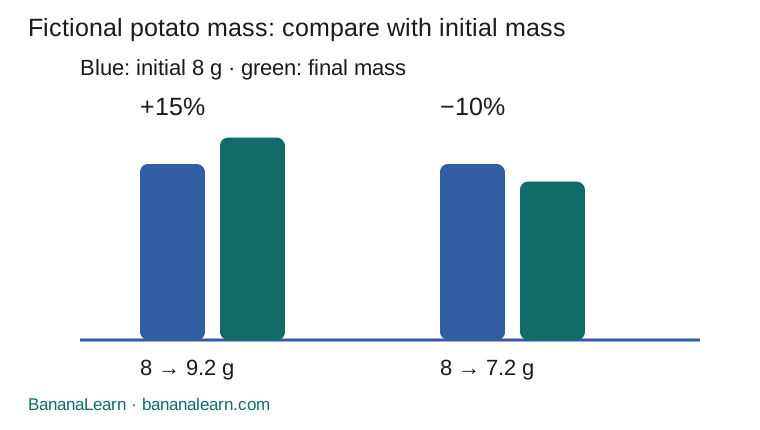
Suppose two comparable potato samples begin at 8.0 g. After equal times in two labelled solutions, sample A is 9.2 g and sample B is 7.2 g. Assume consistent blotting and measurement. These are invented learning data, not a real experiment or predicted result for a particular solution.
Sample A gained 1.2 g, so its percentage mass change is 1.2/8.0×100=15%. Sample B changed by −0.8 g, giving −10%. The sign records gain or loss. A gain is consistent with net water entry under an osmosis interpretation, but the data must be considered with the method and solution information.
Plan what must stay comparable
If a school teacher conducts a potato comparison, starting sample dimensions, time, temperature, solution volume and the blotting method should be kept consistent as practical. Repeat samples help reveal variation. Wet solution left on the outside can make a sample seem heavier without showing extra water inside it.
This guide can be completed entirely with the fictional data. Cutting samples, preparing solutions and disposal require an adult or school-supervised method. Do not taste experimental material. A raw mass number without a method is weaker evidence than a clear record of what was measured.
Distinguish osmosis, diffusion and active transport
Diffusion is a broader movement concept and does not always require a membrane. Osmosis refers specifically to water across a selectively permeable membrane. Active transport is different: cells can use energy through transport systems to move substances against a concentration gradient.
Do not label every movement into a cell osmosis. If the question describes a mineral ion, ask about its transport route rather than changing the substance into water. Likewise, saying a cell needs water does not explain the physical direction of movement in a specified setup.
Explain a result with boundaries
A careful answer names the substance, the barrier and the net direction, then connects the explanation to the observations. For sample A, say the measured mass increased by 15%, consistent with net water entry if the membrane and solution conditions support that interpretation.
The record below separates observations from explanations and limitations. A learner who says particles stop at equilibrium needs the two-way movement model; a learner who gets the direction right but divides by final mass needs calculation practice. Neither error is fixed by memorising a definition alone.
Observe, calculate, explain
Copy this record into a notebook. Fill each blank using your own example or the activity above.
On a phone, swipe across a wide table to see every column.
| Sample | Initial mass | Final mass | Change / initial × 100 |
|---|---|---|---|
| Fictional A | 8.0 g | 9.2 g | ___ |
| Fictional B | 8.0 g | 7.2 g | ___ |
| Your conclusion | Moving substance? | Membrane role? | Evidence and limitation? |
12 questions with explained answers
Try each question first. Open the explanation to check your reasoning. These are original BananaLearn questions, not official exam questions.
Does diffusion require a membrane in every example?
Check answer and reasoning
No.
It can occur within a continuous region as well as across a suitable barrier.What moves in the osmosis model here?
Check answer and reasoning
Water.
The pictured solute is blocked by the stated membrane.What does selectively permeable mean in this model?
Check answer and reasoning
Water passes, but the pictured solute does not.
The selection must be specified rather than assumed for every substance.Do particles stop moving at dynamic equilibrium?
Check answer and reasoning
No.
Their average movements can balance so there is no net change.Which plant-cell structure is the selectively permeable boundary here?
Check answer and reasoning
The cell membrane.
The cell wall has a different supporting role.Find the mass change from 8.0 g to 9.2 g.
Check answer and reasoning
+1.2 g.
Final minus initial: 9.2−8.0.Find the percentage change for that sample.
Check answer and reasoning
+15%.
1.2÷8.0×100=15.Find the percentage change from 8.0 g to 7.2 g.
Check answer and reasoning
−10%.
(7.2−8.0)÷8.0×100=−10.Why blot samples consistently before weighing?
Check answer and reasoning
To reduce differences from liquid left on the surface.
Surface liquid can affect mass without showing internal water gain.Is a mineral ion entering a cell automatically osmosis?
Check answer and reasoning
No.
Osmosis describes water; other substances need their own transport explanation.What is the denominator for percentage mass change?
Check answer and reasoning
The initial mass.
It is the reference amount for the change.Does the fictional dataset prove a result for every potato in a named solution?
Check answer and reasoning
No.
It illustrates calculation and interpretation under stated assumptions, not universal real-world data.
Choose your next learning step
- Locate the membrane and wall
- Calculate a percentage change carefully
- Plan a comparison with controlled conditions
Explore BananaLearn games, learning resources and tutoring. Maths is our priority; English and Science tutoring are also available. Share your current schoolwork when checking teaching fit.
Sources and scope
Explanations, activities, diagrams and practice are original BananaLearn work. Class labels suggest a learning level; school sequences and current textbook editions can differ. Sources checked 2 November 2026.
How we prepare guides · Report a correction
Share the complete guide: https://bananalearn.com/learn/class-9-diffusion-osmosis.html