1. Repair “They has been wait since two hours.”
- They takes have. The verb needs waiting.
- Two hours is a duration, so use for.
- They have been waiting for two hours.
English · Suggested Class 8 · school sequences vary
“I have painted three chairs” counts finished results. “I have been painting chairs” makes the activity—and perhaps the paint on my hands—the focus.
Start here
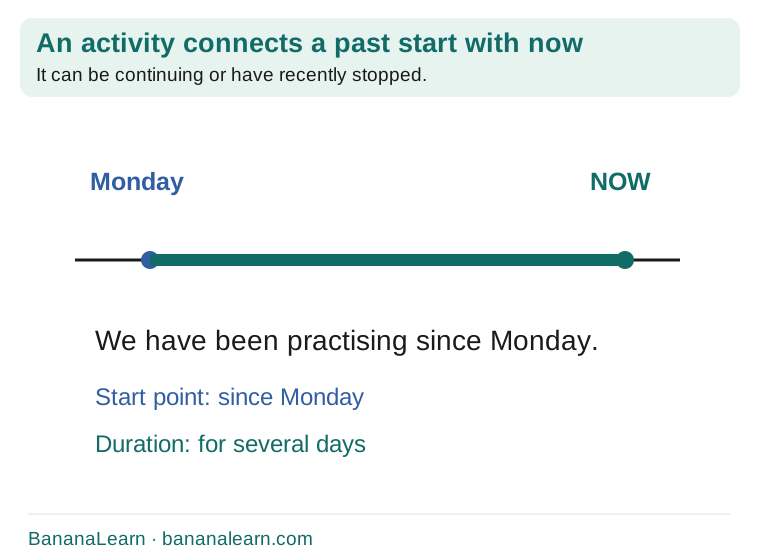
Use have/has been + verb-ing for an activity connected with now, often continuing or recently stopped. Since names a starting point; for names a duration.
Original BananaLearn guide · 7 November 2026
On a narrow screen, swipe the diagram or open it full size.
Use I/you/we/they have been working and he/she/it has been working. Negatives put not after have or has: “She has not been sleeping well.” Questions invert the first helping verb: “Have they been waiting?”
Keep been in the group. “She has working” and “She has been work” leave out required parts. The -ing form belongs to the activity verb.
“We have been practising since Monday” connects a past start with the present. The activity may still be continuing. The exact starting point can be stated with since or left unstated if context supplies it.
It can also describe an activity that recently stopped but has a present result: “You look tired. Have you been running?” Do not assume every use means the person is still doing the activity at the moment of speaking.
Since introduces a starting point: since 9 am, since Tuesday, since we moved. For introduces a length of time: for two hours, for a week. In “since we moved”, the following clause names the event that began the interval.
The word following the gap matters. Tuesday is a point in time, but three Tuesdays is a count of intervals. Read the whole phrase instead of memorising one isolated word.
On a narrow screen, swipe the diagram or open it full size.
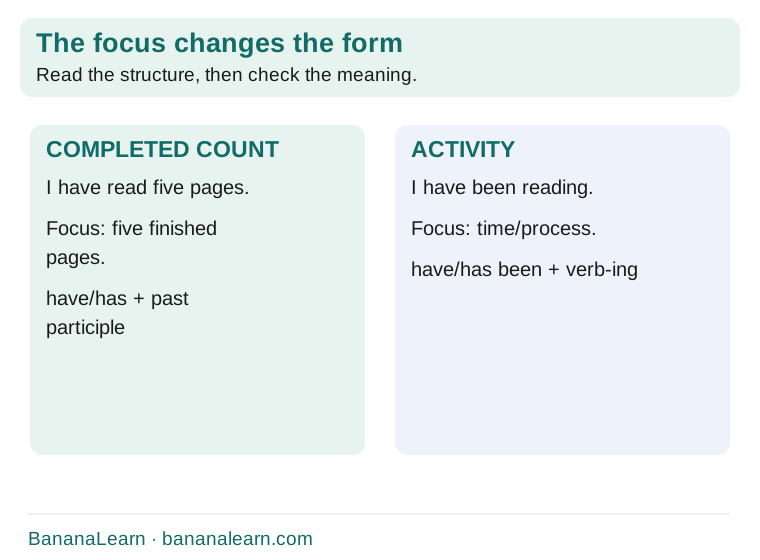
“I have written four invitations” focuses on a completed count. “I have been writing invitations” focuses on the process or time spent. Both can be true of the same situation, but they answer different questions.
Continuous forms do not normally combine with a completed total in the same meaning: “I have been writing four invitations” is awkward if it is meant to report that four are finished. Use the simple form for that completed result.
“I practised yesterday” places the event in a finished past period. “I have been practising this morning” can connect with now if the morning is still current. The speaker’s time reference matters.
Do not combine the present perfect continuous with a finished past marker in the intended standard use: “I have been practising yesterday” should become “I practised yesterday” or “I was practising yesterday”, depending on meaning.
Verbs expressing states, such as know, believe and own, commonly use the present perfect simple for this meaning: “I have known her for years.” “I have been knowing her” is not the standard choice here.
Some verbs have both state and action meanings. “I have a bicycle” describes possession, while “I have been having lessons” describes repeated events. Examine the meaning rather than banning the verb have from every continuous form.
Ask “How long have you been learning?” to focus on duration. Answer “For six months” or “Since April”, if those are the actual facts. A yes/no question can have the short answer “Yes, I have” or “No, she hasn’t”.
A short answer repeats the first helping verb, not the full activity. “Yes, I been” does not form the required response.
Draft: “She have been learn guitar since three months.” The standard repair is “She has been learning guitar for three months.” This fixes agreement, the -ing form and the duration marker without changing the activity.
For practice, draw a start point and a line to NOW, then explain what the sentence emphasises. Ask whether the activity continues, has recently stopped, or is being contrasted with a completed result. Context can permit more than one appropriate tense.
See the reasoning
Try, explain, check
Try each task before opening its explanation. These are original BananaLearn questions, not official exam or past-paper questions. Where several answers can work, the explanation gives the criteria.
has
She takes has.
working
The activity uses the -ing form.
for
Two days is a duration.
since
Friday names the starting point.
since
It is a point in time.
I have known him for years.
Know describes a state in this use.
Have they been practising?
Invert have and the subject.
Yes, she has. / No, she hasn’t.
Repeat has in the short answer.
Yes
A present result can motivate this form.
have made three cakes
The simple form naturally reports the finished number.
For example: I walked yesterday.
Yesterday identifies a finished past period; another past form may fit a different intended meaning.
Starting point versus duration
The two can describe the same span only when the dates make that true.
Copy these headings and fill them for one worked task, then for a fresh attempt. Use your own evidence rather than copying the model answer.
Explore BananaLearn’s games, learning features and one-to-one tutoring. Maths is our priority; English and Science tutoring are also available. Bring a recent example of schoolwork when checking teaching fit.
Original BananaLearn explanations, examples, illustrations and practice. Source facts checked 7 November 2026. Suggested levels are learning guides, not a claim that every board or textbook uses the same sequence.
How we prepare guides · Report a correction
Share the complete guide: https://bananalearn.com/learn/class-8-present-perfect-continuous.html