Science · Suggested Class 8
Coal, Petroleum & Natural Gas: Class 8 Explained Guide
A petrol pump does not draw ready-made petrol straight from an underground lake. Crude oil is a mixture that must be processed, and the rock holding it is often porous rather than an empty cavern.
Original BananaLearn guide · 2 November 2026
On a phone, swipe across the illustration to read every label.

A fossil fuel is an energy resource from ancient organic matter
Coal, petroleum and natural gas formed through geological processes involving buried organic material over long times. Their exact formation histories differ. They are called fossil fuels because their origin involves ancient living matter; the name does not mean every lump contains a visible fossil.
Coal commonly developed from accumulated plant material in ancient wet environments. Petroleum and natural gas commonly derive from organic matter buried in sedimentary settings. Heat, burial and time contribute to transformation. These are simplified school explanations, not a claim that every deposit has an identical history.
Separate the three raw resources
Coal is a solid carbon-rich resource containing other substances. Petroleum, or crude oil, is a liquid mixture of hydrocarbons and other components. Natural gas is a gaseous resource made largely of methane, with composition varying by deposit and processing.
State is useful for distinguishing the resources under ordinary conditions, but transport and storage can change a product’s condition. A resource name is not a guarantee of purity. Natural gas and pure methane are not automatically interchangeable labels in a detailed chemical analysis.
Understand storage in rock
Oil and gas can occupy connected pore spaces in reservoir rock, with less permeable layers limiting their movement. A sponge holding water is a useful limited model of pores; it does not reproduce the actual rock chemistry, pressure or deposit geometry.
An underground reservoir is therefore not necessarily a large empty cave full of fuel. A diagram should show a rock layer with pores and clearly label itself as schematic. A model helps explain one feature, not every feature of extraction or underground flow.
On a phone, swipe across the illustration to read every label.
Refining produces different useful fractions
Crude oil is processed in a refinery to obtain useful fractions and products. Fractional distillation separates components according to their boiling behaviour; further processes can change or improve fractions. Petrol and diesel are processed fuel mixtures, not the names of all crude oil underground.
The everyday words petrol and gasoline usually refer to the same broad road-fuel product in different varieties of English. Petroleum is broader than petrol. Write the complete term in a science answer so the reader knows whether you mean a raw resource or a particular product.
Why nonrenewable does not mean absolutely no new material ever forms
The important comparison is with human use timescales. Fossil resources form through very slow geological processes, while people can extract and use accessible deposits much faster. They are not replenished quickly enough for ordinary consumption to count as renewable resources.
This does not supply a reliable exact year when the world will run out of a fuel. That depends on deposits, technology, demand and other changing factors. Avoid invented countdowns. The school conclusion is about replenishment rate, not an unsupported forecast about the last barrel or mine.
Distinguish energy use from material use
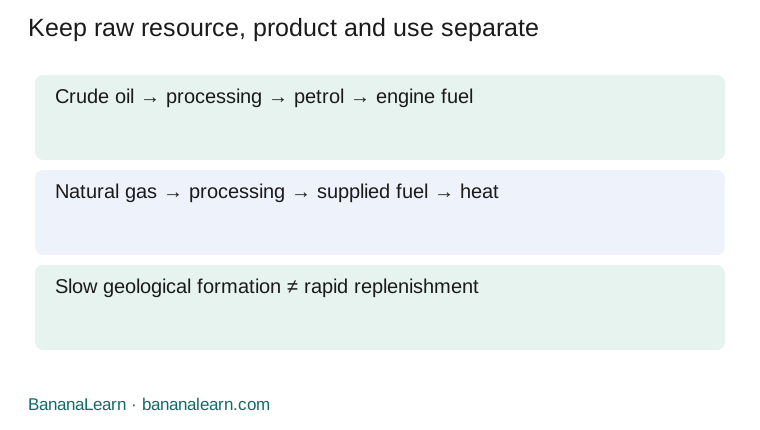
A fuel can be burned to release energy, but petroleum-derived materials also enter manufacturing. The input resource, the processed product and its use are three different parts of an explanation. For example, crude oil can supply feedstocks for making some plastics; the plastic object is not simply liquid crude oil in a new shape.
Combustion of carbon-containing fuels can produce carbon dioxide. Real combustion can also produce other pollutants depending on the fuel and conditions. This guide does not recommend a home burning experiment: use diagrams, provided data or an appropriately supervised school lesson instead.
A fictional classification task
Sort these labels into raw resource, processed product and use: crude oil, petrol, powering an engine; natural gas, processed gas supply, heating; coal, prepared coal fuel, energy generation. Some real supply chains are more complicated, so treat this as a conceptual sorting task rather than an engineering specification.
A strong answer connects a sequence: petroleum is extracted as a raw mixture, processed into useful products, and one product may be used as a fuel. An answer that simply lists coal, petrol, plastic and electricity together has mixed resources, products, materials and an energy carrier.
Explain conservation without unsupported claims
Resource conservation can involve reducing unnecessary use, improving efficiency or substituting suitable alternatives. Each option needs a practical context; a pupil cannot infer from this lesson that one product is always the best choice for every family or country.
For a school explanation, identify the resource, its slow replenishment and the particular unnecessary use being avoided. The record below keeps formation, processing and use separate. Do not collect unknown fuels, open gas equipment or ignite samples for the activity. It is designed to work entirely on paper.
From resource to purpose
Copy this record into a notebook. Fill each blank using your own example or the activity above.
On a phone, swipe across a wide table to see every column.
| Resource | Processing / product | Use and distinction |
|---|---|---|
| Coal | ___ | ___ |
| Petroleum / crude oil | ___ | ___ |
| Natural gas | ___ | ___ |
| Meaning of nonrenewable | ___ | ___ |
12 questions with explained answers
Try each question first. Open the explanation to check your reasoning. These are original BananaLearn questions, not official exam questions.
Name the three fossil resources in this guide.
Check answer and reasoning
Coal, petroleum and natural gas.
They are distinct resources with different common states and processing routes.Is petrol the same label as all crude petroleum?
Check answer and reasoning
No.
Petrol is a processed fuel mixture; crude oil is the raw resource mixture.Does an oil reservoir have to be an empty underground cave?
Check answer and reasoning
No.
Oil can occupy pore spaces in reservoir rock.What does the sponge model illustrate?
Check answer and reasoning
Connected spaces that can contain a fluid.
It does not reproduce every geological condition.Why are fossil fuels considered nonrenewable?
Check answer and reasoning
They are not replenished quickly on human consumption timescales.
Formation is far slower than ordinary extraction and use.Does nonrenewable justify an exact run-out date from this lesson?
Check answer and reasoning
No.
Such a forecast requires changing information about deposits, use and technology.What is natural gas largely made of?
Check answer and reasoning
Methane.
Composition varies; a natural-gas supply is not automatically a pure methane sample.What general property supports fractional distillation?
Check answer and reasoning
Differences in boiling behaviour.
Processing separates useful fractions from a mixture.Is electricity itself a fossil fuel?
Check answer and reasoning
No.
It is an energy carrier that can be produced from different sources.Can petroleum have uses besides being burned as fuel?
Check answer and reasoning
Yes.
It can provide manufacturing feedstocks for some materials.Name a product of burning a carbon-containing fuel in sufficient oxygen.
Check answer and reasoning
Carbon dioxide, among relevant products depending on the fuel.
This is a paper explanation, not a home combustion instruction.What should a conservation answer connect?
Check answer and reasoning
A resource, its slow replenishment and a specific use that can be reduced or improved.
A vague slogan does not explain the mechanism.
Choose your next learning step
- Review state and material descriptions
- Distinguish separation from chemical change
- Review evidence for different kinds of change
Explore BananaLearn games, learning resources and tutoring. Maths is our priority; English and Science tutoring are also available. Share your current schoolwork when checking teaching fit.
Sources and scope
Explanations, activities, diagrams and practice are original BananaLearn work. Class labels suggest a learning level; school sequences and current textbook editions can differ. Sources checked 2 November 2026.
- US Department of Energy: fossil resources and formation
- US Energy Information Administration: energy sources
How we prepare guides · Report a correction
Share the complete guide: https://bananalearn.com/learn/class-8-coal-petroleum-natural-gas.html