On a narrow screen, swipe the diagram or open it full size.
Find a section, worked example or practice question
What determiners and quantifiers do
Determiners help identify or describe the quantity of a noun: this book, my notebook, some paper, three pens. Quantifiers focus on amount or number, such as many, much, a few and a little.
Noun meaning matters. Paper can mean material (“some paper”), while papers can mean documents (“three papers”). Choose the meaning in the sentence rather than treating every spelling as permanently countable or uncountable.
Count nouns and uncountable nouns
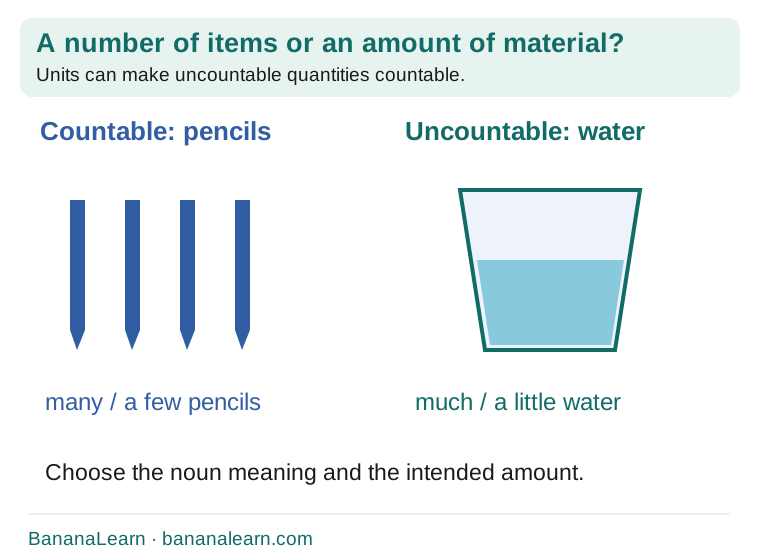
Count nouns have singular and plural uses: one pencil, several pencils. Uncountable uses include water, information and advice. Use many pencils but much information; use a few pencils but a little water.
To count an uncountable quantity, introduce a unit: two bottles of water or three pieces of advice. Do not add a plural ending to advice simply because the ideas are separate.
A few and few change the emphasis
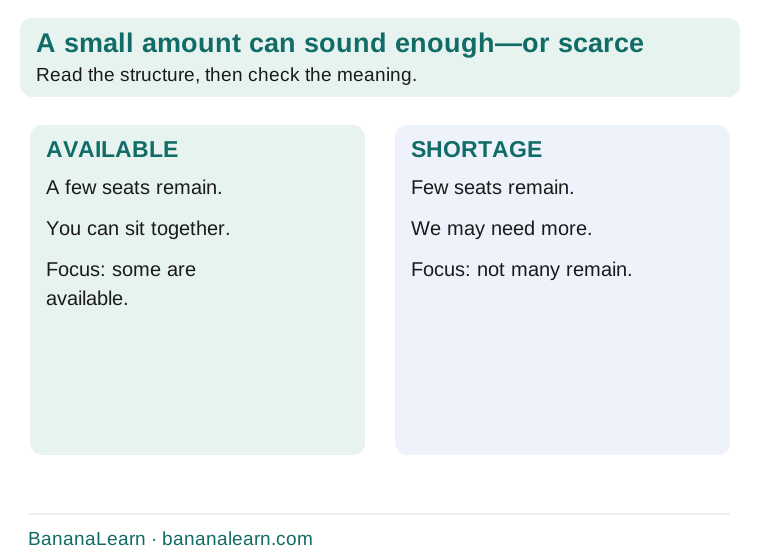
A few usually presents a small number as available: “We have a few spare pencils, so you can borrow one.” Few often emphasises a shortage: “Few spare pencils remain, so we need more.”
The difference is not a fixed numerical threshold. Context determines whether a small amount feels sufficient. Similarly, a little water focuses on an available small amount; little water often emphasises scarcity.
On a narrow screen, swipe the diagram or open it full size.
Some and any depend on the message
Some is common in affirmative statements; any is common in negatives and neutral questions. “There are some apples.” “There are not any apples.” “Are there any apples?”
Offers and requests often use some: “Would you like some water?” and “Could I have some paper?” Any can also mean no restriction: “Choose any seat.” Do not turn a useful tendency into an exceptionless rule.
Much, many and a lot of
Many goes with plural count nouns and much with uncountable nouns. A lot of works with both: a lot of questions, a lot of time. In informal affirmative sentences, a lot of is often more natural than much.
“We have much homework” is grammatically interpretable but “We have a lot of homework” is usually the more natural everyday choice. Distinguish a meaning-preserving style improvement from a clear grammar error.
Each, every, all and both
Each and every are normally followed by a singular count noun: each child, every page. Both requires two and usually takes a plural noun: both teams. All can refer to a whole plural group or an uncountable quantity.
“Each of the children has a card” places the plural noun after of, but each still controls the singular has. Do not choose the verb only by the noun nearest to it.
Less and fewer: meaning before a slogan
Fewer is the usual choice for a smaller number of separate countable items; less is usual for a smaller amount of an uncountable quantity: fewer mistakes, less noise.
Measurement expressions such as less than five minutes and less than ten kilometres are common because the phrase describes an amount. Follow your school’s style expectations while recognising these established uses.
Edit a short message
Draft: “We need many equipment but have few money. Each students should bring a little pencils.” A clearer version is “We need a lot of equipment but have little money. Each student should bring a few pencils.”
Explain each choice: equipment and money are uncountable here; student follows each in the singular; pencils are plural countable objects. Finish by checking whether the new message still says what the writer intended.
See the reasoning
Worked examples and checks
1. Choose few or a few: “We have ___ seats left, so your group can sit together.”
Seats are plural countable.
The second clause treats the remaining seats as enough for the group.
A few best matches that positive availability; few would emphasise shortage.
2. Edit “How many advice did you receive?”
Advice is uncountable in this use.
Write “How much advice did you receive?”
To ask about separate recommendations, use “How many pieces of advice did you receive?”
3. Choose a natural offer: “Would you like some/any soup?”
Soup is uncountable here, but both words can modify uncountable nouns.
The sentence is an offer expecting a possible acceptance.
Some is the usual choice; the question mark does not force any.
Try, explain, check
12 questions with explained answers
Try each task before opening its explanation. These are original BananaLearn questions, not official exam or past-paper questions. Where several answers can work, the explanation gives the criteria.
Choose: many/much water.
Check answer and reasoning
much water Water is uncountable in this use.
Choose: many/much books.
Check answer and reasoning
many books Books are plural count nouns.
Choose: a few/a little patience.
Check answer and reasoning
a little patience Patience is uncountable.
Choose: a few/a little marbles.
Check answer and reasoning
a few marbles Marbles are countable objects.
Edit “three advices”.
Check answer and reasoning
three pieces of advice Advice does not normally form that count plural.
Choose: “There aren’t some/any clean cups.”
Check answer and reasoning
any It is a negative statement about their availability.
Choose a usual request: “Could I have some/any rice?”
Check answer and reasoning
some Some is common in requests of this kind.
Choose: each student/students.
Check answer and reasoning
each student Each normally precedes a singular count noun.
Choose: both child/children.
Check answer and reasoning
both children Both refers to two members and takes the plural here.
Choose: fewer/less mistakes.
Check answer and reasoning
fewer mistakes The errors are separate countable items.
Choose: fewer/less noise.
Check answer and reasoning
less noise Noise is an uncountable amount here.
Does few always mean exactly two?
Check answer and reasoning
No It indicates a small number in context, often with a sense of shortage.
A checking record to use in your notebook
Copy these headings and fill them for one worked task, then for a fresh attempt. Use your own evidence rather than copying the model answer.
Question or sentence
What am I being asked to explain?
Model or evidence
Which diagram, rule or passage detail supports my method?
Work
What steps connect the question to the answer?
Independent check
Can I substitute, recount, trace a path or check the text?
Original BananaLearn explanations, examples, illustrations and practice. Source facts checked 7 November 2026. Suggested levels are learning guides, not a claim that every board or textbook uses the same sequence.