English · Suggested Class 6 · school sequences vary
Phrases vs Clauses: Class 6 Examples and Editing Practice
“After the rain” leaves you waiting. “After the rain stopped” adds a verb—but still leaves you waiting for the main idea. A clause and a complete sentence are different things.
Start here
In these school-grammar examples, a finite clause has a subject and a finite verb. A phrase does not have that complete pairing; a dependent clause still needs a main clause.
On a narrow screen, swipe the diagram or open it full size.
Find a section, worked example or practice question
Start with a sentence you can picture
Use “The players waited under the shelter after the rain started.” Under the shelter is a phrase adding place. After the rain started is a dependent clause adding time. The players waited supplies the main statement.
The groups have different structures even though both add information. Meaning alone does not tell you whether a group is a phrase or a clause.
Recognise a phrase
A phrase is a group of words functioning together without the subject-plus-finite-verb structure of the clauses studied here. Examples include under the shelter, a very wet afternoon and extremely slowly.
A phrase may contain a verb form: to finish the puzzle or running across the field. A verb-like word alone is not enough to make a finite clause. More advanced grammar also describes non-finite clauses; this introductory distinction focuses on finite clauses.
Recognise a finite clause
In “the rain stopped”, rain is the subject and stopped is a finite verb showing a past-tense event. In “she is reading”, the finite verb is is within the verb group is reading.
Questions and commands can have different word order or an understood subject. Begin with statements here, then use the same attention to the verb group when you meet other sentence patterns.
On a narrow screen, swipe the diagram or open it full size.
Distinguish main and dependent clauses
“The rain stopped” can stand as a complete statement. “Because the rain stopped” contains a subject and finite verb but its opening word makes it depend on another idea.
Join it to a main clause: “We left the shelter because the rain stopped.” The dependent clause explains the reason. Do not call it a phrase simply because it cannot stand alone.
Use punctuation with clause order
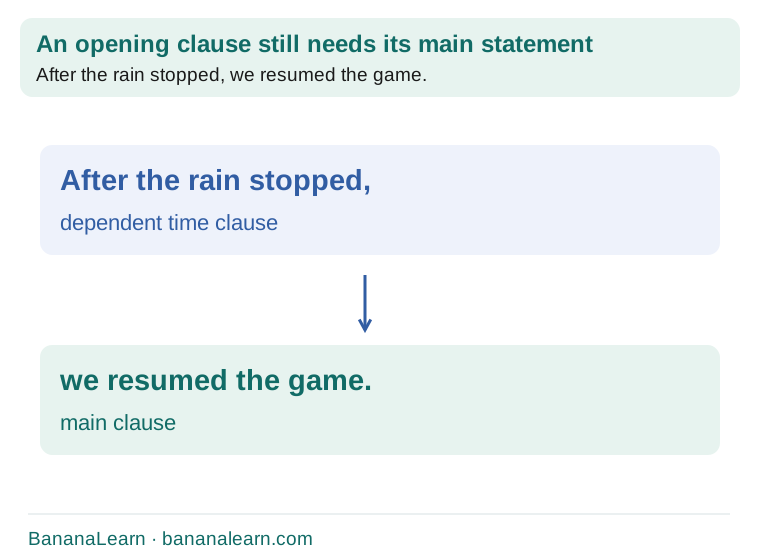
When a dependent time or reason clause comes first, a comma commonly separates it from the main clause: “After the rain stopped, we resumed the game.” When it comes last, a comma is often unnecessary: “We resumed the game after the rain stopped.”
Punctuation depends on the kind of clause and meaning. A comma is not the definition of a clause; find the grammatical structure before deciding the punctuation.
Expand without losing the main statement
Start with “Mira smiled.” Add a phrase: “Mira smiled at the doorway.” Add a dependent clause: “Mira smiled when she saw the repaired kite.” Combine both if they contribute useful information.
Avoid adding groups simply to make a sentence longer. Each group should clarify place, time, reason or description, and its attachment should be clear to the reader.
Repair the dependent-clause fragment
“Although the path was muddy.” leaves its contrast unfinished. Complete it with “Although the path was muddy, the group continued.” Alternatively remove although to make “The path was muddy.”
Both repairs create complete statements, but they do not express the same relationship. Choose the version that preserves the writer’s intended meaning.
A three-question checking routine
Ask: where is the finite verb? What subject goes with it? Can this group stand as the intended complete statement? Record phrase, main clause or dependent clause, then explain the evidence.
For home practice, build three versions of one real scene rather than memorising a list. This guide is a foundation for relative clauses and longer paragraph writing, not an exhaustive classification of every phrase or clause type.
See the reasoning
Worked examples and checks
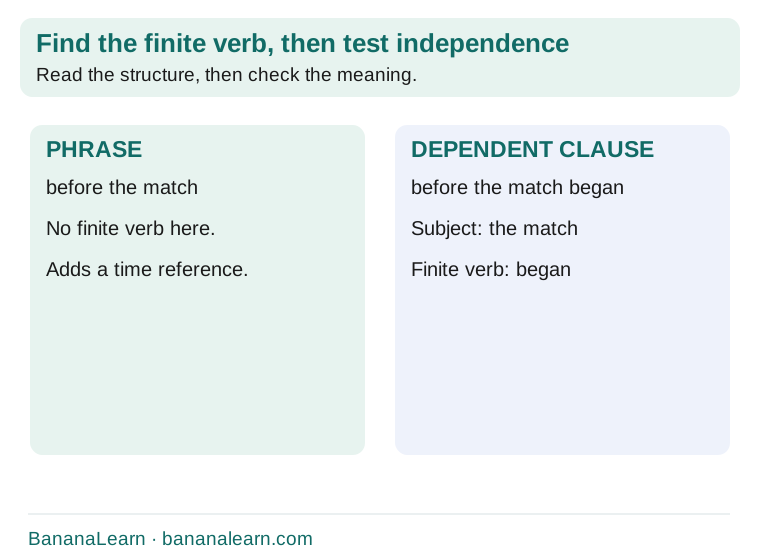
1. Compare “before the match” and “before the match began”.
Before the match is a prepositional phrase; it has no finite verb.
Before the match began has subject the match and finite verb began.
It is a dependent clause because before connects its time to a main event.
2. Repair “Because the gate was locked.”
Keep the reason relationship.
Add a main clause: “We used another entrance because the gate was locked.”
The gate was locked supplies a subject and finite verb inside the dependent clause.
3. Analyse “When the bell rang, the children packed their bags.”
Dependent clause: When the bell rang.
Main clause: the children packed their bags.
The opening clause gives time; the comma separates it from the main statement.
Try, explain, check
12 questions with explained answers
Try each task before opening its explanation. These are original BananaLearn questions, not official exam or past-paper questions. Where several answers can work, the explanation gives the criteria.
Classify “beside the river”.
Check answer and reasoning
Phrase There is no subject-plus-finite-verb pairing.
Classify “the river flooded”.
Check answer and reasoning
Main clause Subject the river combines with finite verb flooded and gives a complete statement.
Classify “because the river flooded”.
Check answer and reasoning
Dependent clause It has a subject and finite verb but because makes its reason depend on another statement.
Classify “a surprisingly heavy box”.
Check answer and reasoning
Phrase It is a noun phrase, not a complete statement.
Classify “the box was heavy”.
Check answer and reasoning
Main clause The finite verb was links the subject to a description.
Classify “although the box was heavy”.
Check answer and reasoning
Dependent clause Although signals an unfinished contrast.
Does the word running alone prove that a group is a finite clause?
Check answer and reasoning
No It may be a non-finite verb form; examine the full group.
Add punctuation: “After the bus left we walked home.”
Check answer and reasoning
After the bus left, we walked home. The dependent opening time clause is separated from the main clause.
Find the prepositional phrase: “The bag on the chair is mine.”
Check answer and reasoning
on the chair It describes which bag and has no finite verb.
Find the dependent clause: “I waited until the shop opened.”
Check answer and reasoning
until the shop opened It contains subject the shop and finite verb opened.
Repair “While they were waiting.”
Check answer and reasoning
For example: While they were waiting, they read a map. A main clause completes the time relationship.
Is every clause a complete sentence?
Check answer and reasoning
No A dependent clause can have a subject and finite verb but still need a main clause.
A checking record to use in your notebook
Copy these headings and fill them for one worked task, then for a fresh attempt. Use your own evidence rather than copying the model answer.
Question or sentence
What am I being asked to explain?
Model or evidence
Which diagram, rule or passage detail supports my method?
Work
What steps connect the question to the answer?
Independent check
Can I substitute, recount, trace a path or check the text?
Original BananaLearn explanations, examples, illustrations and practice. Source facts checked 7 November 2026. Suggested levels are learning guides, not a claim that every board or textbook uses the same sequence.