English · Suggested Grade 6
Class 6 Relative Clauses: Who, Which, That & Commas
The child who found the key and my brother, who found the key, tell the reader different things. A relative clause can identify someone or add information about someone already identified.
Original explanations and practice by BananaLearn · Published 31 October 2026
On a small screen, swipe across the illustration to read every label.
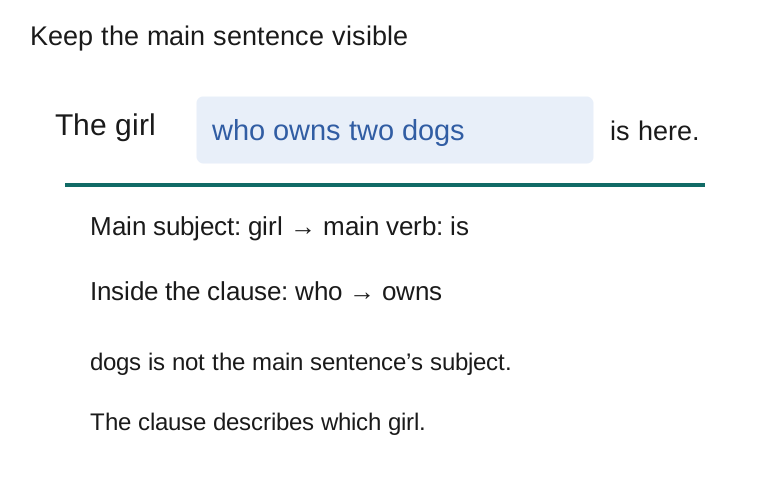
A clause that describes a noun
A relative clause gives information about a noun or noun phrase. In The cyclist who won the race waved, who won the race describes the cyclist. The whole noun phrase is the subject of waved. The relative clause has its own verb, won.
Start by identifying the noun being described. Then ask what information the clause adds. Do not treat every sentence containing who as a relative clause: Who won the race? is a direct question. The word’s job depends on the sentence, not only on the letters you recognise.
Choose who, which or that
Who commonly refers to people. Which commonly refers to things or animals. That can refer to people or things in defining clauses, although who is often a natural choice for people. For example: The student who solved it explained her method. The book that I borrowed is missing.
In a defining clause, the information tells us which person or thing is meant. The books that have blue labels belong on this shelf means the blue-labelled books, not every book. Keep the clause close to its noun so the reader does not attach it to the wrong object.
Worked example: combine without a repeated pronoun
Start with I met a teacher. The teacher runs the chess club. Combine them as I met a teacher who runs the chess club. Who takes the place of the repeated subject the teacher inside the clause. Do not write a teacher who she runs the chess club, because who and she would both fill that subject role.
Now try This is the bag. I lost the bag. Combine as This is the bag that I lost. Here I remains because it is the subject of lost; that represents the bag as its object. The two structures explain why some clauses contain another subject after the relative word.
Extra information is separated by commas
My sister, who lives in Pune, is visiting gives additional information about my already-identified sister. The commas mark the extra-information clause. For a thing, use which: My bicycle, which has a new bell, is outside. In these non-defining clauses, do not replace who or which with that.
The choice can change the meaning. My cousins who live nearby are coming identifies the nearby cousins among a larger group. My cousins, who live nearby, are coming presents living nearby as extra information about the cousins being discussed. Punctuation reflects the intended meaning; it is not decoration.
Worked example: where and whose
Where can introduce information about a place when a location relationship is needed: This is the room where we rehearse. Compare This is the room that we painted. Rehearse happens in the room; painted takes the room as its object. Using where in the second sentence would not express the same relationship.
Whose introduces possession: The pupil whose notebook was lost asked for help. The notebook belongs to the pupil. Do not confuse whose with who’s, which is a contraction of who is or who has. Expanding who’s is a useful check when the sentence needs possession instead.
When an object relative word can be omitted
In an informal defining clause such as The book that I borrowed is useful, that can be left out: The book I borrowed is useful. I is still the subject of borrowed, so the sentence remains complete. This is an extension once the basic pattern is secure.
Do not omit a relative word acting as the clause subject: The student who borrowed it has arrived cannot become The student borrowed it has arrived. Extra-information clauses also keep their relative word. If omission makes the sentence confusing, retain the word rather than chasing the shortest version.
Edit for clarity, then practise with your own nouns
Underline the noun, bracket its relative clause and identify the main verb outside that clause. Check agreement: The girl who owns two dogs is here still has the singular main subject girl. The nearby plural dogs does not make the main verb are correct.
Write three pairs of short sentences about a club, a place and an object. Combine each pair, then read it without the clause to find the main sentence. A parent can ask whether the added information identifies which one or merely adds detail. If that distinction is hard, begin with defining clauses before introducing the comma contrast.
Plan a relative clause
Copy the record into a notebook or use it to organise your own answer. Blank spaces are for your work.
| Noun being described | Information to add | Identifying or extra? | Relative word | Finished sentence |
|---|---|---|---|---|
| a teacher | runs the club | Identifying | who | ___ |
| my bicycle | has a new bell | Extra | which | ___ |
| your noun | ___ | ___ | ___ | ___ |
10 questions with explained answers
Try the questions before opening the answers. Explain the reason, then try a changed example to check your understanding.
Join: I met a boy. The boy draws maps.
Show answer and explanation
I met a boy who draws maps.
Who replaces the repeated subject inside the clause.Choose: The notebook ___ I lost was red.
Show answer and explanation
that or which
The defining clause describes a thing; the relative word is its object.Correct: The girl who she won is smiling.
Show answer and explanation
The girl who won is smiling.
Remove the duplicate subject she.Can that replace which in My bike, which is new, is outside?
Show answer and explanation
No
This extra-information clause uses which, not that.Choose: This is the hall ___ we practise.
Show answer and explanation
where
The practice happens in that place.Choose: This is the hall ___ we painted.
Show answer and explanation
that or which
The hall is the object of painted.Choose: The pupil ___ bag is blue is waiting.
Show answer and explanation
whose
The clause describes possession.Can that be omitted in The book that I borrowed is short?
Show answer and explanation
Yes
It is an object relative word in a defining clause.Can who be omitted in The child who waved is my cousin?
Show answer and explanation
No
Who is the subject of waved.Choose: The girl who owns two dogs (is / are) here.
Show answer and explanation
is
The main subject girl is singular; dogs belongs inside the clause.
Keep the ideas connected
- Find the main subject before choosing the verb
- Review clear noun references
- Distinguish who’s from possession
For help with a school-learning difficulty, bring one attempted question to a discussion about tutoring and curriculum fit. Maths is our priority; English and Science tutoring are also available.
Sources, scope and sharing
The examples, diagrams and practice are original BananaLearn work. Grade labels suggest a learning level; teaching sequences and school requirements can differ. Official sources below support the stated facts and resource links. These activities are independent resources, not official exam questions or endorsed campaign materials.
How we prepare learning guides · Report a correction
Share this guide: https://bananalearn.com/learn/class-6-relative-clauses-who-which-that.html