
Start with the key idea
This mixed revision pack checks calculation, decimal place value, fractions, measurement, time and word-problem reasoning. Use the worksheet first, then the explained answers. It is a flexible Grade 5 readiness resource, not a complete syllabus or a standardised assessment.
1. Use the worksheet to find a next step
Try the tasks without looking at the examples first if your aim is to check what you remember. Have paper for working, a pencil and a ruler. Unless the school sets a different expectation, leave calculators aside for these manageable numbers.
Do not turn the first attempt into a race. Note whether the difficulty is reading the question, selecting an operation, recalling a fact or carrying out the written method. Two children with the same total score can need very different practice.
The fourteen questions sample several skills rather than covering every Grade 5 objective. If a topic has not yet been taught, mark it “not studied” rather than treating it as a failure. A parent can use the result to choose one short follow-up lesson.
2. Estimate before using a written method
For 398 + 207, a quick estimate is 400 + 200 = 600. The exact answer is 605, which is close. An answer such as 5,105 should trigger a place-value check even before the original columns are inspected.
In multiplication, connect the written steps to place value. For 24 × 13, calculate 24 × 10 plus 24 × 3, giving 240 + 72 = 312. The second part is not simply added to an unlabelled digit; both partial products have a meaning.
Check division by multiplying the quotient and adding the remainder. For 157 ÷ 6, 26 remainder 1 is verified by 6 × 26 + 1 = 157. The remainder must also be smaller than the divisor.
3. Align values, not the ends of numbers
For 3.7 + 0.46, write 3.70 + 0.46 and align the decimal points. Tenths combine with tenths and hundredths with hundredths, giving 4.16. Adding the final printed digits together without considering their columns gives the wrong model.
A zero at the end of a decimal does not change its value: 0.5 and 0.50 name the same quantity. But a zero between the decimal point and a nonzero digit does matter: 0.05 is five hundredths, not five tenths.
Compare decimals using place value or a number line. For 0.48 and 0.5, compare 48 hundredths with 50 hundredths. Counting printed digits is not a reliable size rule, because more decimal places do not automatically mean a larger value.
4. Keep the whole and the unit fraction visible
To find three quarters of twenty counters, first divide twenty into four equal groups of five, then take three groups: fifteen. The denominator tells how many equal parts make the whole, and the numerator tells how many to select.
When adding fractions, the parts need a common size. In 1/2 + 1/4, one half is two quarters, so the total is three quarters. Adding the denominators would change the size of the parts without justification.
Use a check based on size. Three quarters of twenty must be less than twenty but more than half of twenty. A sum of one half and one quarter should be between one half and one whole. These checks can catch a method error before every calculation is redone.
5. Separate length, area, perimeter and elapsed time
A rectangle measuring 9 cm by 5 cm has area 45 cm² and perimeter 28 cm. Area counts square units covering the surface; perimeter measures the outside edge. Choose from what the story asks you to cover or surround.
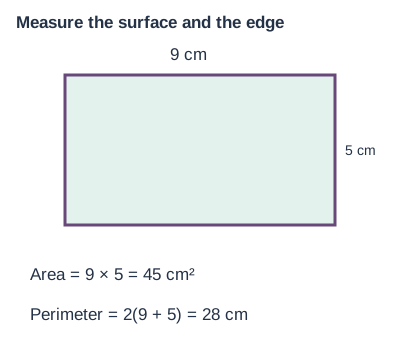
Convert units before combining quantities. One metre and thirty centimetres is 130 cm, not 31 cm. A journey from 09:45 to 11:10 lasts 15 minutes to ten, then 60 minutes to eleven, then ten more: 85 minutes.
Time is not a decimal hundred-part system. The change from 09:45 to 10:00 is fifteen minutes, not fifty-five. A timeline with intermediate hours often makes the regrouping easier to see than trying to subtract the clock displays as ordinary decimal numbers.
6. Interpret a remainder and plan the follow-up
For 53 pupils and buses with 24 pupil seats each, division gives two full buses and five pupils left over. The practical answer is three buses. Giving “two remainder five buses” does not answer how many complete vehicles must be arranged.
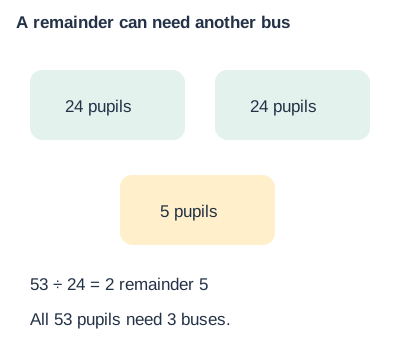
A different story can use the same division differently. If 53 counters are shared equally among 24 children and only whole counters are allowed, each gets two and five remain. The arithmetic is unchanged; the required answer depends on the object and condition.
After checking, choose one missed question and explain why the original approach failed. Solve a fresh question with the same structure the next day. A corrected answer copied beside the original is useful feedback, but it is not yet evidence that the method can be used independently.
5 worked examples with reasoning
1. Calculate 36 × 14 and check its size.
- 36 × 10 = 360 and 36 × 4 = 144.
- Total = 504.
- An estimate 40 × 14 = 560 confirms that 504 is plausible.
2. Calculate 5.2 − 1.75.
- Write 5.20 − 1.75, aligning place values.
- Regroup to subtract hundredths and tenths; the result is 3.45.
- Check 3.45 + 1.75 = 5.20.
3. Find 3/5 of 35.
- One fifth is 35 ÷ 5 = 7.
- Three fifths are 3 × 7 = 21.
- 21 is less than 35 and greater than half of 35.
4. A film starts at 14:35 and ends at 16:05. Find its duration.
- From 14:35 to 15:00 is 25 minutes.
- From 15:00 to 16:00 is 60 minutes, then five more.
- Total = 90 minutes, or 1 hour 30 minutes.
5. A rectangular floor is 6 m by 4 m. Find its area and the length of its outside boundary.
- Area = 6 × 4 = 24 m².
- Boundary = 6 + 4 + 6 + 4 = 20 m.
- The different units identify the different measurements.
Save the guide or print the practice
Download to save or share
Complete guide with answers (PDF) · Worksheet without answers (PDF) · Worksheet and answer key (PDF)
Try each task before opening its answer. Give an example or reason, not only a label.
14 practice questions with explanations
Try each task before opening its answer. Give an example or reason, not only a label.
Write an answer and your reason before opening the explanation. Check the reasoning as well as the final answer.
- Number
Round 47,683 to the nearest thousand.
Answer and reasoning
48,000.
The hundreds digit is six, so round up.
- Add
Calculate 398 + 207.
Answer and reasoning
605.
398 + 200 = 598, then add seven.
- Multiply
Calculate 24 × 13.
Answer and reasoning
312.
240 + 72 = 312.
- Divide
Calculate 157 ÷ 6, giving a whole-number quotient and remainder.
Answer and reasoning
26 remainder 1.
6 × 26 + 1 = 157.
- Decimal
Calculate 3.7 + 0.46.
Answer and reasoning
4.16.
Use 3.70 + 0.46.
- Compare
Which is greater, 0.48 or 0.5? Explain.
Answer and reasoning
0.5.
0.50 is fifty hundredths, greater than forty-eight.
- Fraction
Find 3/4 of 20 counters.
Answer and reasoning
15 counters.
20 ÷ 4 × 3.
- Fraction
Calculate 1/2 + 1/4.
Answer and reasoning
3/4.
Two quarters plus one quarter.
- Units
Convert 2.3 m to centimetres.
Answer and reasoning
230 cm.
Each metre contains one hundred centimetres.
- Time
How many minutes pass from 09:45 to 11:10?
Answer and reasoning
85 minutes.
15 + 60 + 10.
- Area
Find the area of a rectangle measuring 9 cm by 5 cm.
Answer and reasoning
45 cm².
Multiply the two side lengths.
- Perimeter
Find the perimeter of a rectangle measuring 9 cm by 5 cm.
Answer and reasoning
28 cm.
Add two lengths and two widths.
- Story
53 pupils need buses with 24 pupil seats each. Find the fewest buses needed.
Answer and reasoning
3 buses.
Two buses hold 48 pupils; five still need seats.
- Pattern
Continue 7, 12, 17, 22 by two terms and state the rule.
Answer and reasoning
27, 32; add five each time.
The same difference connects consecutive terms.
Use the ideas without looking at the notes
Record the question, what went wrong and one next step. Revisit a similar task after a short gap and look for an independent explanation, not only a corrected total.
Common questions
Should this be timed?
Use an untimed first attempt to see the method. Add time limits only when fluency is the specific goal.
Is this a full Grade 5 exam?
No. It is a short mixed sample, with grade expectations varying by curriculum and school.
Should a parent explain every question first?
Read unfamiliar wording if needed, but preserve an independent attempt before teaching the method.
What should happen after an error?
Identify the reason, revisit one model and try a fresh question rather than only copying the answer.
Can the worksheet be saved without answers?
Yes. Use the separate worksheet download; explained answers are available separately.
Connect your learning
Ask about guided Maths learning if your child needs help explaining these ideas.
About this guide
Original explanations, examples, diagrams and practice by BananaLearn. The grade label indicates the intended learning level; this is not an official textbook extract or exam paper.