
Start with the key idea
Evaporation is the change from liquid to gas at a liquid’s surface and can happen below the boiling point. Condensation is the change from gas to liquid. Water vapour in air can condense on a sufficiently cool surface; the outside droplets need not have leaked through the container.
1. Explain where a drying puddle goes
A shallow puddle can become smaller even when the water never boils. Some water changes into water vapour and mixes with the surrounding air. This surface change is evaporation. Water may also soak into ground, so a real puddle can lose water in more than one way.
To focus on evaporation, imagine water in a non-leaking shallow dish. If no water is poured out and the dish loses water over time, evaporation is a plausible explanation. The liquid has not turned into nothing; it has changed state and moved into the air.
Water vapour is an invisible gas. The white cloud above hot water consists mainly of tiny liquid droplets formed after vapour cools. Do not teach that every visible white mist is the gas itself.
2. Use a particle model carefully
In a simple model, liquid particles are close together and move around one another. Some at the surface have enough energy to escape into the gas phase. Gas particles spread through the available space. The drawing uses dots as a model; real water molecules are far too small to see individually.

Evaporation occurs at the surface, which is why spreading the same water into a wider shallow container can increase its rate under otherwise similar conditions. The surface gives more opportunities for particles to leave.
Heating usually makes evaporation faster, but evaporation can happen in cooler conditions too. A wet cloth can dry on a cool day, especially with moving dry air. Avoid saying that liquid water must reach 100°C before any can become gas.
3. Distinguish evaporation from boiling
Evaporation happens at the surface over a range of temperatures. Boiling involves vapour bubbles forming within the liquid when conditions allow them to persist and rise. The two processes both produce gas, but their patterns differ.
Pure water boils at about 100°C at standard atmospheric pressure. The boiling temperature changes with pressure, so 100°C is not a universal value in every place or container. For Grade 5, the main distinction is surface evaporation versus bubbling throughout the liquid.
Do not heat water for this exercise without a responsible adult and suitable equipment. A photograph or teacher demonstration is enough to compare bubbling with ordinary drying. Steam and hot water can burn even when the gas itself is invisible.
4. Trace the water on a cold surface
Air can contain water vapour even when it looks clear. Near a sufficiently cold surface, some vapour can change into liquid. Those droplets are condensation. They appear outside a cold bottle because the source is the surrounding air.
A watertight bottle does not have to leak for this to happen. Wipe the outside dry, place it on a dry surface and observe with an adult. The droplets may reappear if the conditions remain suitable. Do not open or damage the bottle to test the idea.
Condensation also helps explain a fogged mirror after a warm shower and dew on grass. The surface temperature and moisture in the air matter. A cold object does not always collect obvious droplets in very dry air.
5. Compare drying conditions fairly
Evaporation often becomes faster with higher temperature, greater exposed surface area, more air movement or drier surrounding air. These factors influence the rate; they do not mean all water disappears immediately.
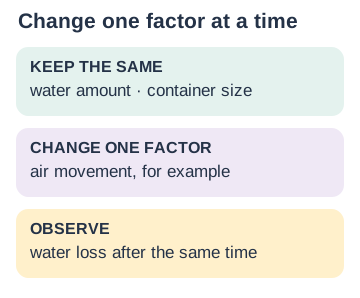
For a safe comparison, place equal small amounts of water in identical shallow dishes. Keep the location and observation time consistent, and change only one chosen factor where feasible. For example, compare air movement while avoiding spill risk and electrical equipment near water.
If one dish is warmer, wider and exposed to stronger airflow, you cannot tell which factor caused the difference. Record both the result and the limitation. Classroom comparisons often approximate a fair test rather than perfectly controlling every variable.
6. Connect the changes without losing the matter
In a simplified water cycle, liquid water evaporates, vapour travels in air, and cooling can lead to condensation into cloud droplets or ice particles. Water later returns through precipitation. A complete cycle includes more pathways than one classroom arrow diagram.
The same substance can change state repeatedly. Evaporation is not the creation of air, and condensation is not the creation of new water from nothing. In an open dish the water leaves the local system; in a closed system it remains somewhere within that system.
Use two questions when explaining an everyday case: What was the starting state? Where did the water go or come from? These questions are more reliable than simply naming “evaporation” whenever something becomes wet or dry.
5 worked examples with reasoning
1. A wet shirt dries without boiling. Explain.
- Water at its surface can evaporate below boiling temperature.
- The vapour mixes with surrounding air.
- Boiling is not required for drying.
2. Droplets appear outside a sealed cold bottle.
- Air near the surface contains water vapour.
- Cooling at the surface can cause condensation.
- The droplets need not have leaked through the bottle.
3. Which dries faster: equal water in a wide or narrow dish, all else similar?
- The wide dish exposes more liquid surface.
- More surface can increase evaporation rate.
- This comparison assumes other conditions are kept similar.
4. Is visible white mist the same as invisible water vapour?
- No. Vapour is the gas and is invisible.
- Visible mist contains tiny liquid droplets.
- Name the state carefully.
5. A test changes both heat and airflow. Can it isolate airflow?
- No. Two factors changed together.
- Either or both may explain faster drying.
- Repeat with one chosen factor changed if a causal comparison is needed.
Save the guide or print the practice
Download to save or share
Complete guide with answers (PDF) · Worksheet without answers (PDF) · Worksheet and answer key (PDF)
Try each task before opening its answer. Give an example or reason, not only a label.
14 practice questions with explanations
Try each task before opening its answer. Give an example or reason, not only a label.
Write an answer and your reason before opening the explanation. Check the reasoning as well as the final answer.
- Name
Liquid water becomes gas at its surface. Name the change.
Answer and reasoning
Evaporation.
It can happen below boiling temperature.
- Name
Water vapour forms droplets on a cool lid. Name the change.
Answer and reasoning
Condensation.
Gas changes to liquid.
- Source
Where can droplets outside a cold bottle come from?
Answer and reasoning
Water vapour in surrounding air.
It condenses near the cool surface.
- Temperature
Must a wet cloth reach 100°C to dry?
Answer and reasoning
No.
Evaporation occurs over a range of temperatures.
- Compare
Where does evaporation occur in a liquid?
Answer and reasoning
At the surface.
Boiling is associated with vapour bubbles within the liquid.
- Surface
Why can spreading water thinly help it evaporate faster?
Answer and reasoning
It increases exposed surface area.
Other conditions must be comparable.
- Air
How can air movement affect drying?
Answer and reasoning
It can carry moist air away and increase evaporation.
The result also depends on humidity and temperature.
- Mist
Is visible white mist pure invisible vapour?
Answer and reasoning
No.
The visible part contains droplets.
- Fair test
Name one factor to keep the same when comparing dish width.
Answer and reasoning
For example: starting water amount or temperature.
Change width without changing every other condition.
- Pressure
Is water’s boiling point always exactly 100°C?
Answer and reasoning
No.
Pressure and composition affect it; about 100°C assumes standard pressure and pure water.
- Matter
Does evaporation destroy water?
Answer and reasoning
No.
It changes state and location.
- Evidence
A puddle shrinks on soil. Must all lost water have evaporated?
Answer and reasoning
No.
Some may soak into the ground.
- Safety
Should a learner handle boiling water alone to test this?
Answer and reasoning
No.
Use a safe model or supervised demonstration.
- Explain
Give an everyday condensation example.
Answer and reasoning
For example: a mirror fogging after a warm shower.
Vapour forms droplets on a cooler surface.
Use the ideas without looking at the notes
Explain one drying example and one droplet-forming example. State the starting state, final state and source or destination of the water. Add one condition that could change the rate.
Common questions
Can evaporation happen in cold weather?
Yes, although the rate depends on several conditions.
Why does a cold glass get wet outside?
Vapour in the surrounding air can condense on its cool surface.
Are evaporation and boiling identical?
No. They both form gas, but evaporation occurs at the surface and boiling forms vapour bubbles within the liquid.
Can we see water vapour?
The gas itself is invisible; visible mist consists of tiny droplets.
Does water disappear permanently?
No. It changes state and moves through the environment.
Connect your learning
Ask about guided Science learning if your child needs help explaining these ideas.
About this guide
Original explanations, examples, diagrams and practice by BananaLearn. The grade label indicates the intended learning level; this is not an official textbook extract or exam paper.