
Start with the key idea
Transparent materials transmit enough light with little scattering to give a clear view. Translucent materials transmit light but scatter it enough to blur the view. Opaque materials do not transmit visible light through the tested sample to a useful extent. Thickness, surface treatment and conditions can affect the classification.
1. Ask two questions about the same sample
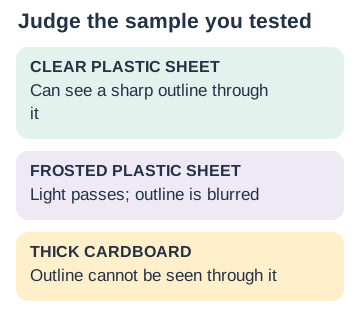
Hold a safe material sample between your eyes and a printed shape in ordinary room light. Ask whether light passes through and whether you can see a clear outline. These are different questions. A glowing sheet may transmit light without letting you read through it.
Use clean, unbroken plastic samples or teacher-provided materials. Do not handle broken glass, look at the Sun, or point a bright beam into anyone’s eyes. Ordinary lighting and a high-contrast printed shape are sufficient.
Keep the shape, distance and lighting similar when comparing samples. If one sample is against the paper and another is far away, the apparent sharpness may change for reasons other than the material itself.
2. Transparent means a clear view through the sample
A clean, clear glass pane or clear plastic sheet can let you see an object sharply. Much of the transmitted light keeps an orderly path, so a recognisable image reaches your eyes. Transparent does not mean perfectly invisible.

A transparent sample can reflect some light and absorb some light. It may also be coloured: a clear coloured filter can remain transparent while changing which colours pass through most strongly. Colourless and transparent are not synonyms.
Scratches, dirt, frosting or several layers can change the view through a material. Describe the actual sample you tested. “This clear plastic sheet is transparent in our test” is more precise than “all plastic is transparent”.
3. Translucent means light passes but the view blurs
Frosted glass and some thin papers or plastics allow light through while scattering it. You may see a bright patch or a vague silhouette rather than a sharp object. The material is translucent under those conditions.
Scattering changes the directions in which light travels. A simplified ray diagram shows outgoing lines spreading in several directions. It is a model of the effect, not a picture of a few large physical rays inside the material.
Translucent materials are useful when light is wanted but a clear view is not, such as some privacy screens. The exact amount of privacy depends on distance, lighting and material; a translucent screen does not guarantee that every silhouette will be hidden.
4. Opaque means light is not transmitted through the sample
A thick cardboard sheet or a wooden board prevents a useful view through it. Light reaching it may be absorbed or reflected rather than transmitted. Opaque objects can therefore be visible because reflected light reaches our eyes.
Opaque does not mean black. A white wall is opaque even though it reflects much visible light. A shiny metal sheet can also be opaque while producing a bright reflection. Do not classify materials by colour alone.
A hole in cardboard lets light pass through the hole, not through the cardboard material. Keep the sample intact when testing its property. Similarly, a window frame and the glass inside it are different materials in one object.
5. Thickness and surface treatment can change the result
A thin sheet may transmit light that a thick stack of the same material blocks. Frosting a clear surface can make a formerly clear view blurred. This is why the sample and its thickness belong in the observation record.
Paper is a useful example of variation: some thin papers are translucent, while thicker card appears opaque. Do not demand one label for every item called paper. Compare actual pieces under the same lighting.
Use a table with sample description, light transmission, image clarity and classification. Add a note when the result is borderline. Scientific descriptions can include uncertainty instead of forcing every observation into an oversimplified absolute.
6. Choose a material for a purpose
For a window where a clear outside view is needed, a transparent material is appropriate. For a lampshade, a suitable translucent material may spread light. For a screen meant to block light, an opaque material may suit the purpose. Real products also need strength and heat-safety considerations.
When explaining a choice, name the function: “I chose a transparent sheet because the viewer must read the label behind it.” Avoid “It is best” without saying best for what. Different jobs need different properties.
Finish by comparing two materials with the same everyday name, such as clear and frosted plastic. State how their observed behaviour differs. This shows why classification should follow evidence rather than a memorised list of materials.
5 worked examples with reasoning
1. A sheet lets light through but blurs letters.
- Transmission is present.
- The image is not clear because light is scattered.
- Classify the sample as translucent.
2. A clear red sheet allows sharp letters to be seen.
- Colour does not determine opacity.
- The view is clear through the sample.
- It can be transparent and coloured.
3. A white board blocks the view through it.
- The board may reflect light strongly.
- It does not transmit a useful view.
- It is opaque despite being white.
4. Light passes through a hole in cardboard. Is the card transparent?
- The light travelled through empty space at the hole.
- That is not transmission through the card material.
- Test an intact part of the sample.
5. One thin paper sheet glows, but a stack blocks light.
- Thickness changed.
- More layers can reduce transmission.
- Describe each sample separately rather than forcing one label for all paper.
Save the guide or print the practice
Download to save or share
Complete guide with answers (PDF) · Worksheet without answers (PDF) · Worksheet and answer key (PDF)
Try each task before opening its answer. Give an example or reason, not only a label.
14 practice questions with explanations
Try each task before opening its answer. Give an example or reason, not only a label.
Write an answer and your reason before opening the explanation. Check the reasoning as well as the final answer.
- Classify
A sample gives a sharp view of a printed letter.
Answer and reasoning
Transparent in that test.
It transmits light with little image-blurring scattering.
- Classify
A sample glows but letters behind it blur.
Answer and reasoning
Translucent.
Some light passes but the image is scattered.
- Classify
A thick wooden board blocks the view.
Answer and reasoning
Opaque.
Visible light does not transmit through the tested board to a useful extent.
- Colour
Must an opaque material be black?
Answer and reasoning
No.
White and shiny objects can also be opaque.
- Colour
Can coloured material be transparent?
Answer and reasoning
Yes.
A clear coloured filter can preserve a sharp view.
- Hole
Does light through a hole prove cardboard transmits light?
Answer and reasoning
No.
The light passes through the hole, not through the material.
- Fair test
Name one condition to keep similar.
Answer and reasoning
For example: lighting or distance from the printed shape.
Different conditions can change apparent clarity.
- Surface
What can frosting do to clear glass?
Answer and reasoning
Scatter light and blur the view.
The sample may become translucent.
- Thickness
Why can a stack of paper differ from one thin sheet?
Answer and reasoning
More layers can reduce transmission.
Classify the tested thickness.
- Use
Choose a property for a window with a clear view.
Answer and reasoning
Transparency.
The viewer needs a sharp image through it.
- Use
Choose a property for a light-blocking screen.
Answer and reasoning
Opacity.
Transmission should be blocked.
- Safety
Should you test by looking at the Sun through plastic?
Answer and reasoning
No.
That can harm eyes; use ordinary room light.
- Record
Why record clear plastic rather than just plastic?
Answer and reasoning
Plastic samples have different surface and transmission properties.
The sample description makes the claim accurate.
- Explain
How can we see an opaque object?
Answer and reasoning
It reflects some light into our eyes.
Being opaque does not mean absorbing every bit of light.
Use the ideas without looking at the notes
Compare three safe samples in the same light. Record whether light passes and whether a printed shape stays sharp. Name the sample and its thickness rather than making a claim about every material of that name.
Common questions
Are transparent and colourless the same?
No. A coloured sample can still give a clear view.
Does translucent mean no light passes?
No. Light passes, but scattering blurs the view.
Can thickness change a classification?
Yes. A thicker sample may transmit much less light.
Is all glass transparent?
No. Frosted, coated and other glass samples can behave differently.
Why is a white wall opaque?
It reflects light but does not transmit a useful view through its thickness.
Connect your learning
Ask about guided Science learning if your child needs help explaining these ideas.
About this guide
Original explanations, examples, diagrams and practice by BananaLearn. The grade label indicates the intended learning level; this is not an official textbook extract or exam paper.