1. Find the equivalent of 4 Ω and 12 Ω in parallel.
- 1/R=1/4+1/12=4/12=1/3.
- R=3 Ω.
- It is below 4 Ω, the smaller branch, as expected.
Science · Suggested Class 10 · school sequences vary
The same 3 Ω and 6 Ω resistors can behave like 9 Ω—or like 2 Ω. The difference is the junctions, not where the symbols sit on the page.
Start here
Series resistances add and carry the same current. Parallel branches share voltage and add conductances: 1/R = 1/R₁ + 1/R₂ + … .
Original BananaLearn guide · 7 November 2026
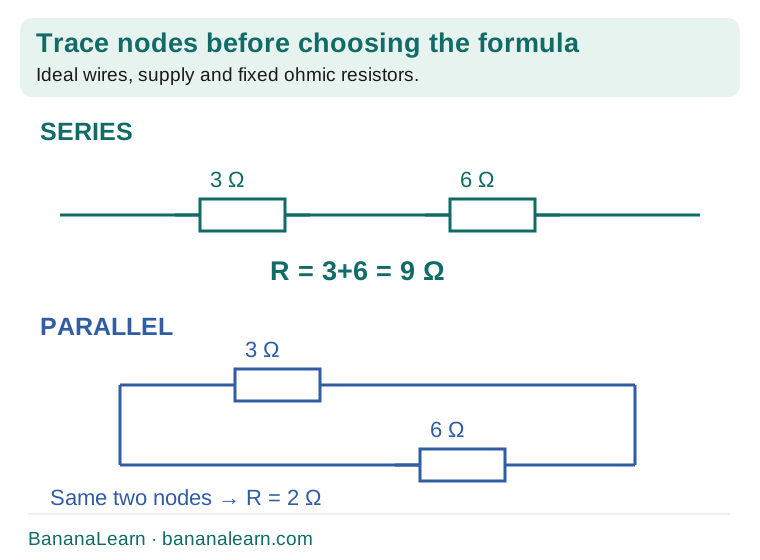
On a narrow screen, swipe the diagram or open it full size.
Resistors are in series when they share a current path without a branching junction between them. In parallel, their endpoints connect to the same pair of circuit nodes. Trace the wires and label the nodes first.
Two symbols drawn beside each other need not be series. Wires may bend or be redrawn without changing which nodes connect. This guide uses ideal wires, an ideal supply and fixed ohmic resistors.
For two series resistors, the current I is the same through both. Their voltage drops are V₁=IR₁ and V₂=IR₂. The total supply drop is I(R₁+R₂), so the equivalent resistance is R₁+R₂.
The current is not “used up” by the first resistor. Energy is transferred, while charge flows through the complete circuit. Individual voltage drops need not be equal unless the resistances are equal.
Parallel branches share the same voltage V. Their currents are I₁=V/R₁ and I₂=V/R₂, and the total current is their sum. Therefore I=V(1/R₁+1/R₂), giving 1/R=1/R₁+1/R₂.
For two resistors this simplifies to R=R₁R₂/(R₁+R₂). Do not use that two-resistor shortcut unaltered for three branches. Add the reciprocals or combine one stage at a time.
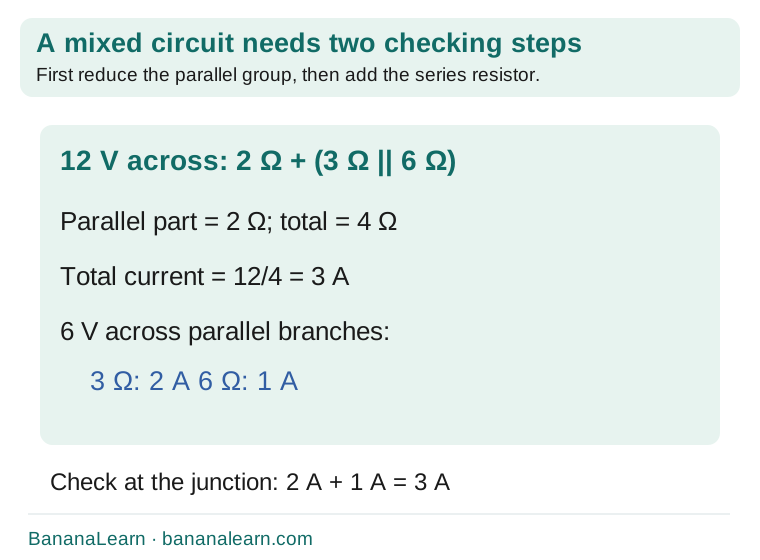
On a narrow screen, swipe the diagram or open it full size.
A series equivalent of positive resistances is greater than any individual resistor. A parallel equivalent is smaller than the smallest branch resistance.
If 3 Ω and 6 Ω in parallel produce 9 Ω in your work, the size check reveals a connection or formula error. It does not replace the calculation, but it is an independent way to catch one.
Across a 6 V supply, separate 3 Ω and 6 Ω parallel branches carry 2 A and 1 A. The total is 3 A, consistent with the 2 Ω equivalent.
If the same resistors are series across 6 V, the total resistance is 9 Ω and current is 2/3 A. Voltage drops are 2 V and 4 V, adding to 6 V. State the circuit before reusing any of those values.
If a 2 Ω resistor is in series with the parallel combination of 3 Ω and 6 Ω, first replace the parallel part by 2 Ω. The whole circuit is then 2+2=4 Ω.
Across 12 V, total current is 3 A. The series 2 Ω resistor drops 6 V, leaving 6 V across the parallel section. The branch currents 2 A and 1 A add back to 3 A.
An open branch interrupts that path; in a simple parallel network other intact branches can still carry current. An ideal zero-resistance bypass across a resistor is a short circuit and changes the network differently.
These are circuit reasoning examples, not instructions to modify equipment. Use the supplied diagrams and numbers; do not experiment with mains electricity or deliberately short a cell.
Record the two nodes for each parallel section, reduce one stage at a time, apply V=IR and verify current conservation at junctions and voltage sums around the chosen path. Include units at every final value.
Parents can ask which quantity is shared—current or voltage—before asking for a formula. This guide covers reducible series/parallel combinations; not every bridge network can be simplified by visual pair grouping alone.
See the reasoning
Try, explain, check
Try each task before opening its explanation. These are original BananaLearn questions, not official exam or past-paper questions. Where several answers can work, the explanation gives the criteria.
9 Ω
Series resistances add.
2 Ω
Two equal parallel resistors give half one resistance.
2 Ω
18/9=2.
Voltage
They share the same pair of nodes.
Current
There is no branching between them.
No
A parallel equivalent must be below 3 Ω here.
2 A
I=V/R.
2 V
V=IR.
2 Ω
1/R=3/6=1/2.
No
In a steady series path the same charge flow passes both.
No
Node connections determine the relationship.
Branch currents sum at a junction; voltage drops match the supply path
Also check the equivalent resistance is sensible.
Copy these headings and fill them for one worked task, then for a fresh attempt. Use your own evidence rather than copying the model answer.
Explore BananaLearn’s games, learning features and one-to-one tutoring. Maths is our priority; English and Science tutoring are also available. Bring a recent example of schoolwork when checking teaching fit.
Original BananaLearn explanations, examples, illustrations and practice. Source facts checked 7 November 2026. Suggested levels are learning guides, not a claim that every board or textbook uses the same sequence.
How we prepare guides · Report a correction
Share the complete guide: https://bananalearn.com/learn/class-10-series-parallel-resistance.html