Christmas Reading Comprehension 2026: Story & Answers
The missing detail on a notice changes a whole event. Read an original Christmas-season story, then use evidence to decide what happened and why.
Start here
This original Christmas 2026 reading resource includes a complete story, vocabulary in context, inference questions and explained answers for suggested Classes 4–6.
On a narrow screen, swipe the diagram or open it full size.
Find a section, worked example or practice question
Before reading
This fictional story is set in a cold-weather town during the Christmas season. Its weather is part of the setting, not a claim that December is cold everywhere. Christmas Day is 25 December 2026; the story’s community event is fictional.
Read once for the main event, then again to underline details that support your answers. You can answer in your own words unless a question asks for a quotation.
Story: The notice beside the door — part 1
On the Monday before the community centre’s Christmas gathering, Sana found a box of paper decorations in the cupboard. Some stars were bent, but their colours were bright. “We can flatten these under a few books,” she said. Her friend Leo wanted to make new ones. He had drawn a large silver star for the entrance.
The centre had promised an afternoon of stories and crafts, open to everyone in the neighbourhood. Outside, a cold wind pushed dry leaves against the steps. Inside, volunteers moved tables to leave a clear route from the door to the reading corner. Sana placed the repaired stars along the shelves. Leo hung his new star where it would catch the light.
Story: The notice beside the door — part 2
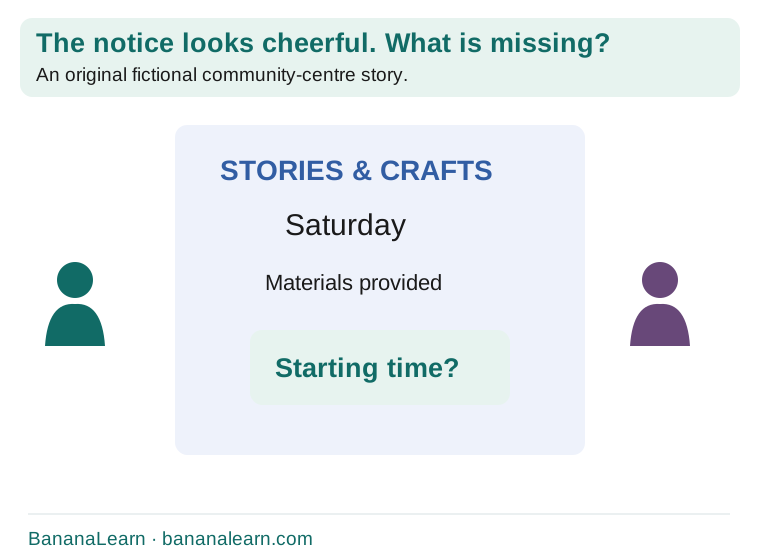
At two o’clock, no visitors had arrived. Leo looked through the window. “Perhaps nobody wants to come,” he said. Sana checked the notice they had put beside the entrance. It read: “Stories and crafts on Saturday. Materials provided.” The page showed a colourful drawing of a tree and several books, but it gave no starting time.
“We told the volunteers two o’clock,” Sana said. “We did not tell everyone else.” They could not change the invitations already taken home. They wrote the time clearly on the entrance notice and asked the centre’s coordinator to send an update through its usual community channel. They also put a volunteer by the door to answer questions.
On a narrow screen, swipe the diagram or open it full size.
Story: The notice beside the door — part 3
The first family arrived at half past two. Then an older neighbour came with a book of short stories. “I saw the time in the update,” she explained. A few visitors said they had planned to drop in later because the original notice gave only the day.
Soon the reading corner was busy. One child chose a story while another repaired a torn paper chain. Leo’s silver star glittered above them, but the smaller reused stars made the shelves look cheerful too. At the end, Sana kept the notice in their planning folder. Beside it she wrote, “Next time: who, what, where and when.” Leo added one more line: “Ask someone outside the team to read it first.”
Follow the story’s change
At first, Leo interprets the empty room as a lack of interest. Sana checks the information available to visitors and notices a missing time. Their response addresses an observable problem rather than accepting the first explanation.
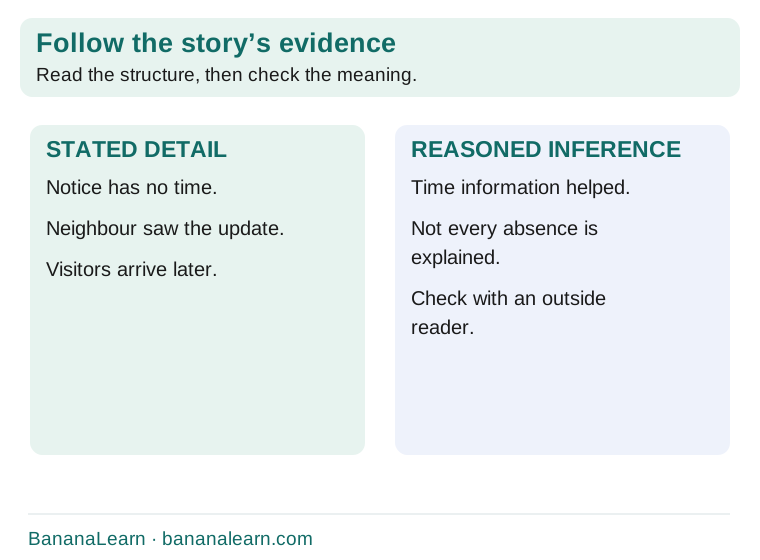
The later visitors support the importance of the update, but the story does not say that every absence was caused by the missing time. Keep an inference proportional to the evidence.
Vocabulary from the surrounding details
Flatten means make flat; the books are intended to press the bent stars. Coordinator names the person organising the centre’s work. Drop in means visit informally rather than arrive at a precisely booked time.
Glittered describes the star reflecting points of light. Use the context before looking at a dictionary. The word can have a more figurative meaning elsewhere, but here it describes a visible effect.
Compare the two kinds of evidence
Direct details include the wording of the notice and the neighbour’s statement about the update. Inferences include why Sana saves the notice and what Leo has learned about checking a plan.
An opinion about which decoration looks best is different again. The text describes both reused and new decorations positively; it does not require the reader to prefer one.
A useful writing follow-up
Create a new fictional notice containing the event, audience, location, date and start/end times. Ask a reader who has not helped you write it to say what they would do next. Check that your wording answers their practical questions.
For the story, write a five-sentence summary: plan, problem, discovery, action and outcome. Keep the missing time central rather than listing every decoration. Do not invent exact attendance numbers or a cause the story does not establish.
See the reasoning
Worked examples and checks
1. Why did Sana check the notice instead of accepting Leo’s explanation?
The empty room showed a problem, but not its cause.
Reading the notice revealed missing practical information.
This provides a text-supported alternative to “nobody wants to come”.
2. Explain why keeping the notice is meaningful.
Sana adds a checklist beside it, and Leo adds a reader test.
The notice becomes a record of what the team learned.
This is an inference supported by their written comments, not a claim that the event will never have another problem.
3. Improve the original notice.
Supply an actual fictional location and date, then include start and end times.
Keep the stories-and-crafts offer clear and readable.
A colourful image can support the notice, but it cannot replace the missing practical details.
Try, explain, check
12 questions with explained answers
Try each task before opening its explanation. These are original BananaLearn questions, not official exam or past-paper questions. Where several answers can work, the explanation gives the criteria.
What did Sana find in the cupboard?
Check answer and reasoning
A box of paper decorations The story says some stars were bent but still bright.
How did she plan to repair the bent stars?
Check answer and reasoning
Flatten them under books That action explains the word flatten.
What did Leo make?
Check answer and reasoning
A large silver star for the entrance It is distinct from the reused stars.
Why did volunteers move tables?
Check answer and reasoning
To leave a clear route to the reading corner This purpose is stated directly.
What important information was missing from the original notice?
Check answer and reasoning
The starting time It gave Saturday but no time.
Did the original notice prove that people were uninterested?
Check answer and reasoning
No Missing information offered another explanation.
Who sent the update?
Check answer and reasoning
The centre’s coordinator through its usual channel Sana and Leo requested that action.
Give one direct piece of evidence that the update helped.
Check answer and reasoning
The older neighbour said she saw the time in it Her statement explicitly links her information to the update.
What does drop in mean here?
Check answer and reasoning
Visit informally Some visitors had planned to come later because only the day was specified.
Why did Sana save the notice?
Check answer and reasoning
To help the team improve future planning Her checklist supports that inference.
Does the text establish an exact number of visitors?
Check answer and reasoning
No Do not invent a total from “a few” or “soon busy”.
Give a possible theme supported by two details.
Check answer and reasoning
For example: check practical information before judging interest The missing time and the later reader-test suggestion both support it; other reasoned themes are possible.
A checking record to use in your notebook
Copy these headings and fill them for one worked task, then for a fresh attempt. Use your own evidence rather than copying the model answer.
Date and setting
What is confirmed, and which example is fictional?
Task and conditions
Which rule, quantity, passage or clue is supplied?
Original BananaLearn explanations, examples, illustrations and practice. Source facts checked 7 November 2026. Suggested levels are learning guides, not a claim that every board or textbook uses the same sequence.
Event timing is calendar-backed. Search demand is a forecast unless a separately measured trend is stated. No official event theme, school programme or affiliation is implied.