1. Count a five-row canopy and the two-tile trunk.
- Rows contain 1,3,5,7,9 tiles, totalling 25.
- Add the unchanged trunk: 25+2=27.
- Check by the canopy rule n²: 5²=25.
Maths · Suggested Classes 4–6
A pretty arrangement can still use too many tiles. These three Christmas-season challenges ask children to plan, calculate and explain—not just colour a worksheet.
Start here
Use three original maths stations for Christmas 2026: a growing tile tree, a whole-pack decoration budget and a fair timetable. Questions include explained answers.
Original BananaLearn guide · 7 November 2026
On a narrow screen, swipe the diagram or open it full size.
Christmas Day is 25 December 2026. These independent fictional planning activities can be used in a family or classroom session during December; they are not an official school holiday programme.
Allow about 30–45 minutes for all three stations or choose one for a shorter session. Use paper and pencil or the supplied diagrams. The named prices, quantities and schedules are invented for the maths tasks, not shopping recommendations.
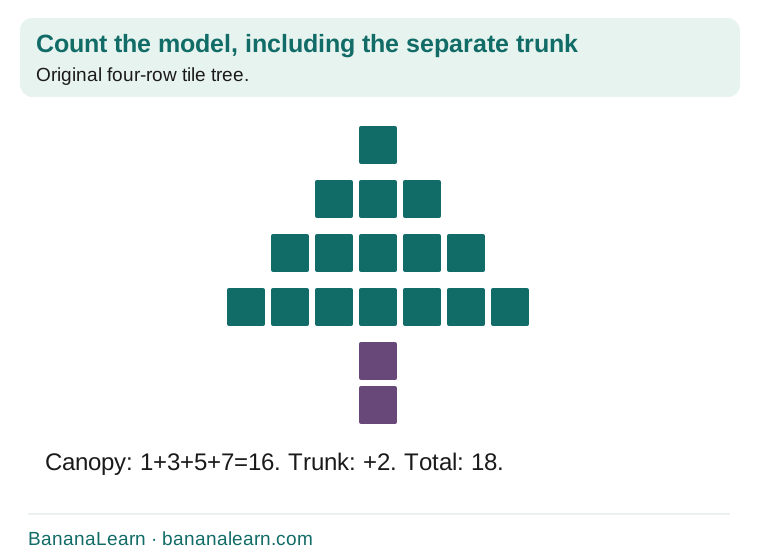
Make a tree from centred rows containing 1, 3, 5 and 7 square tiles. Add a separate trunk of 2 tiles. Count the canopy by rows: 1+3+5+7=16, then add the trunk to get 18.
Ask what changes if the canopy grows by one more row of 9 tiles while the trunk stays the same. The new total is 27. A picture of more rows should preserve the stated pattern; not every decorative tree follows the same counting rule.
The first n odd numbers add to n². One way to see this is to grow a square: adding an L-shaped border to an (n−1) by (n−1) square requires 2n−1 tiles.
The tree’s canopy uses the same row counts as this square-building pattern, even though the rows are arranged differently. The trunk is separate; forgetting it changes the total object being counted.
On a narrow screen, swipe the diagram or open it full size.
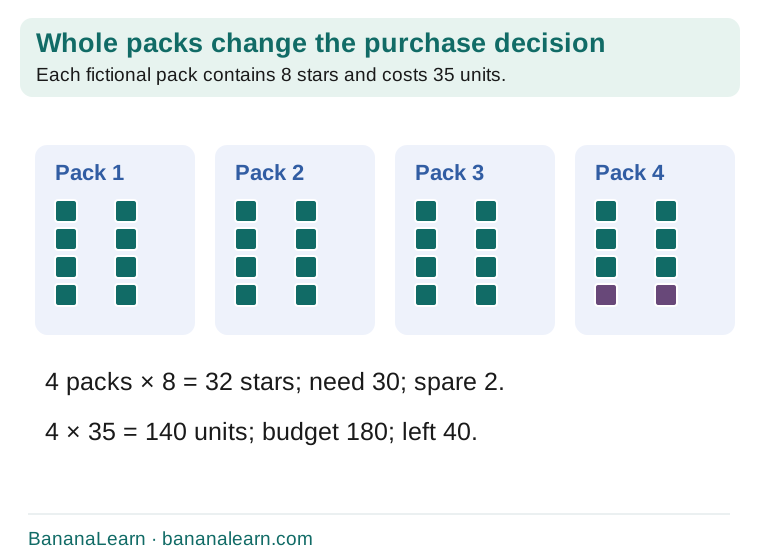
A fictional class display needs 30 paper stars. Packs contain 8 stars and cost 35 currency units each. Three packs give only 24 stars, so buy 4 packs for 32 stars. Cost: 4×35=140 units, with 2 stars unused.
With a 180-unit budget, 40 units remain. Do not use 30÷8=3.75 as the number of purchasable packs. The quotient helps you decide which whole number of packs is sufficient.
A second fictional offer sells 10-star packs for 48 units. Three packs provide exactly 30 stars and cost 144. It has no leftover stars but costs 4 more than the first offer.
If the task is minimum purchase cost for at least 30 stars, choose the first offer. If another constraint forbids leftovers, the choice changes. State the decision criterion rather than calling one pack “best” in every situation.
A group starts at 2:10 pm. It spends 18 minutes planning, 7 minutes collecting materials and 25 minutes making the display. The making stage therefore begins at 2:35 pm and ends at 3:00 pm.
If a 10-minute clean-up must finish by 3:15 pm, this plan finishes at 3:10 pm and leaves 5 minutes spare. Keep stage boundaries visible on a timeline so that a break is not counted twice or omitted.
For a gentler version, give a four-row tree picture and offer multiplication facts for the pack costs. For a harder version, require 45 stars, keep whole packs and allow combining the two offers.
The harder version needs systematic comparison, not just the cheapest unit price. List feasible pack combinations and costs. Keep each new assumption beside the calculation so that the answer remains checkable.
For each station, write the quantity needed, model or diagram, calculation, answer with units and a sentence checking the constraint. Use the questions below as a resource, not a speed race.
A parent can ask why 3 packs fail, why the trunk is separate or how much timetable buffer remains. Those explanations reveal more than whether a final number matches the answer.
See the reasoning
Try, explain, check
Try each task before opening its explanation. These are original BananaLearn questions, not official exam or past-paper questions. Where several answers can work, the explanation gives the criteria.
9
1+3+5=9=3².
11
The trunk is outside the square-number count.
9
The rows follow consecutive odd numbers.
36
6²=36.
4
Three give only 24.
140 units
4×35=140.
2
32−30=2.
40 units
180−140=40.
144 units
3×48=144.
Eight-star packs
140 is 4 below 144, though it leaves two spare stars.
2:35 pm
2:10 plus 18 plus 7 minutes.
5 minutes
The plan ends at 3:10, before the 3:15 deadline.
Copy these headings and fill them for one worked task, then for a fresh attempt. Use your own evidence rather than copying the model answer.
Explore BananaLearn’s games, learning features and one-to-one tutoring. Maths is our priority; English and Science tutoring are also available. Bring a recent example of schoolwork when checking teaching fit.
Original BananaLearn explanations, examples, illustrations and practice. Source facts checked 7 November 2026. Suggested levels are learning guides, not a claim that every board or textbook uses the same sequence.
Event timing is calendar-backed. Search demand is a forecast unless a separately measured trend is stated. No official event theme, school programme or affiliation is implied.
How we prepare guides · Report a correction
Share the complete guide: https://bananalearn.com/learn/christmas-maths-activities-2026-grades-4-6.html