Children’s Day Speech 2026: Original Short & Longer Versions
A good Children’s Day speech needs more than a famous name and “children are the future”. Give your audience one school moment they recognise and one idea worth remembering.
Start here
India’s Children’s Day is 14 November 2026. Use these original speech versions, then replace a general example with one true detail from your own school.
On a narrow screen, swipe the diagram or open it full size.
Find a section, worked example or practice question
Date, purpose and what is original
India observes Children’s Day on 14 November, the birthday of its first Prime Minister, Jawaharlal Nehru. In 2026 the date is 14 November. That annual observance is distinct from the UN’s World Children’s Day on 20 November.
The speeches below are original BananaLearn writing, not quotations from Nehru or official speeches. Their timing depends on reading pace and pauses. Practise aloud once before deciding which length fits your school’s slot.
Short speech: a place to ask questions
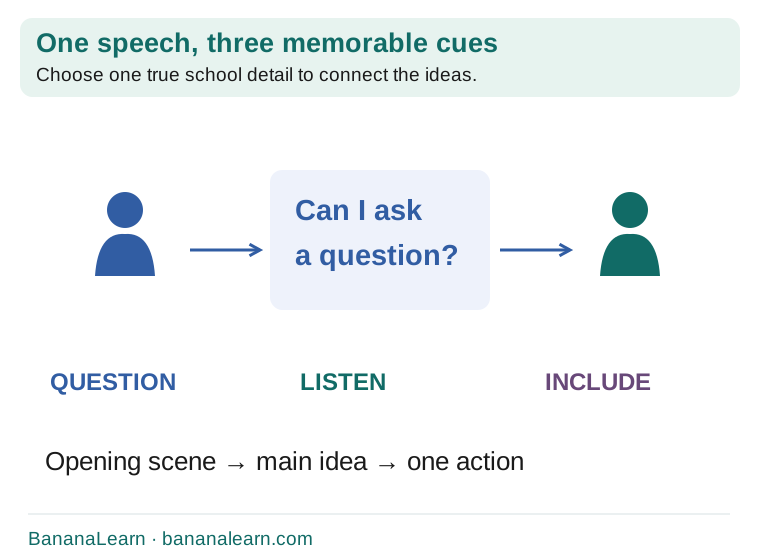
Good morning, teachers and friends. Today, on Children’s Day, I want to celebrate a small but important moment: when someone in class says, “I do not understand yet.” It can take courage to say those words. Often, several other children have the same question.
We observe Children’s Day on 14 November, Jawaharlal Nehru’s birthday. Along with celebrating, we can make our classroom a kinder place to learn. We can listen when a classmate speaks, explain without laughing at a mistake, and invite someone who has been left out.
My wish for our school is simple: let every child have room to ask, try and improve. Today, let us choose one action that helps another child feel included. Thank you, and happy Children’s Day.
Longer speech: what makes a school feel welcoming?
Good morning, respected teachers and dear friends. Think about a new student entering a classroom. They may know the lesson, but not where to sit. They may know an answer, but not feel ready to speak. One welcoming action can change that first day: a classmate makes space and says, “You can join us.”
Children’s Day is observed in India on 14 November, the birthday of Jawaharlal Nehru. It is a day to celebrate children. It is also a useful moment to ask what helps children take part in school every day.
Taking part means more than being present in a room. It means being able to ask a question, borrow a needed book, join a game and make a mistake without being mocked. Different children may need different kinds of support. A friend might need a clearer explanation; another might need a little more time; a new student might need someone to show them around.
We can help in ordinary ways. When we work in groups, we can make sure one person does not do all the talking. When someone answers incorrectly, we can discuss the idea instead of judging the person. When we notice a classmate alone, we can offer an invitation and respect their choice.
Teachers and families have important roles, and children can contribute too. My suggestion for today is to choose one small action and follow through tomorrow. A welcoming school is built through repeated actions, not only a speech on a special day.
Let us celebrate our curiosity, our different interests and our ability to help each other learn. Thank you, and happy Children’s Day.
On a narrow screen, swipe the diagram or open it full size.
Personalise without inventing a story
Replace one general example with a true school detail: a buddy system, a shared reading shelf or a game where teams rotate roles. State only what actually happens or what you are proposing.
Use “we could” for a proposal and “we do” for an existing practice. Do not turn a suggested activity into a claimed school achievement. Avoid naming a classmate’s difficulty or private experience without their permission.
Make a three-part cue card
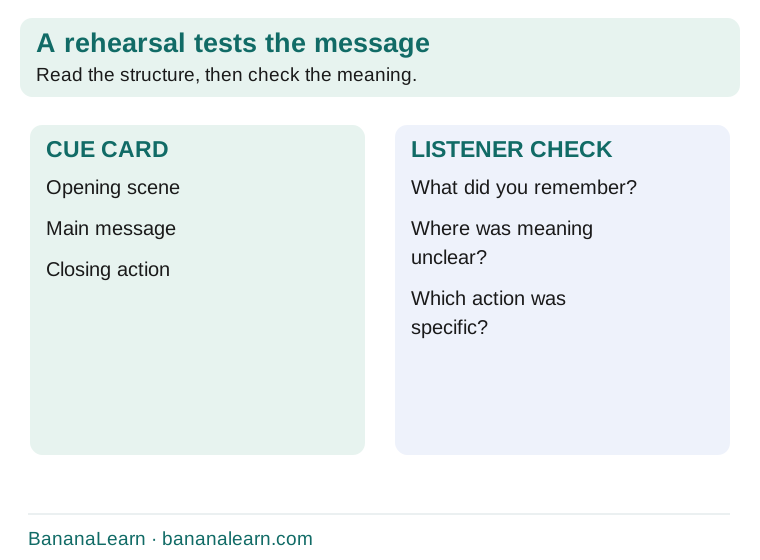
Write only the opening scene, the main message and the closing action on a small card. For the short version those cues might be QUESTION → LISTEN → INCLUDE. A cue is a reminder, not the whole paragraph in tiny writing.
Mark a pause after the opening question or scene. Look up at the audience at the end of an idea. Practise recovering from a missed word by continuing with the next point rather than restarting the whole speech.
Check the timing with your own voice
Read the chosen version aloud and time it. Leave space for a greeting, natural pauses and a closing. If it is too long, remove one example before trying to speak faster.
The longer version has several complete paragraphs that can be shortened without losing the main argument. Keep the date, one concrete example and the final action. Your measured rehearsal is more reliable than a universal “one-minute” label.
Rehearse with useful feedback
Ask a listener to say what they remember, where they lost the meaning and whether the proposed action was clear. “Speak louder” may help audibility, but it does not tell you which sentence needs rewriting.
Try a second rehearsal after changing one difficult line. A parent can listen and time the speech without supplying a performance style that feels unnatural to the child.
A final fact-and-delivery record
Before presenting, record the event date, your chosen version, the true detail you added, the measured duration and one place for a pause. Verify any extra historical statement before adding it.
Pair the speech with a learning game if your school wants participation after the assembly. The related activity guide offers rules and adaptations; no school holiday or event schedule is implied by this page.
See the reasoning
Worked examples and checks
1. Turn “Our school includes everyone” into a specific, supportable line.
If true, name one practice: “Our class rotates the group speaker so more people can contribute.”
If it is only an idea, write “We could rotate the group speaker.”
The specific action is easier to picture and check.
2. Your rehearsal overruns the slot. What should you change first?
Choose one example that can be removed without breaking the argument.
Keep the opening, key idea and closing action.
Rehearse again; rushing can reduce clarity.
3. You forget a sentence midway. How can the cue card help?
Find the next cue: opening scene, main message or closing action.
Continue with that idea in your own words.
The audience needs the argument, not a perfect recital of every original word.
Try, explain, check
8 questions with explained answers
Try each task before opening its explanation. These are original BananaLearn questions, not official exam or past-paper questions. Where several answers can work, the explanation gives the criteria.
What is India’s Children’s Day date in 2026?
Check answer and reasoning
14 November 2026 The annual observance is on 14 November.
Is that the same date as World Children’s Day?
Check answer and reasoning
No; the UN observance is 20 November Keep the two events distinct.
Are these speeches quotations from Nehru?
Check answer and reasoning
No They are original example speeches.
What is the short speech’s main idea?
Check answer and reasoning
Make room for questions and inclusion The school actions develop that idea.
What does “we could” signal?
Check answer and reasoning
A proposal It should not be confused with an existing school practice.
What should you measure in rehearsal?
Check answer and reasoning
The duration when spoken naturally with pauses Reading speed varies between speakers.
What makes a useful personal example?
Check answer and reasoning
A true, relevant detail that respects others’ privacy It should support the main message.
Name one specific question for a rehearsal listener.
Check answer and reasoning
For example: Which action do you remember? It tests whether the message was clear rather than only whether the performance sounded confident.
A checking record to use in your notebook
Copy these headings and fill them for one worked task, then for a fresh attempt. Use your own evidence rather than copying the model answer.
Date and setting
What is confirmed, and which example is fictional?
Task and conditions
Which rule, quantity, passage or clue is supplied?
Original BananaLearn explanations, examples, illustrations and practice. Source facts checked 7 November 2026. Suggested levels are learning guides, not a claim that every board or textbook uses the same sequence.
Event timing is calendar-backed. Search demand is a forecast unless a separately measured trend is stated. No official event theme, school programme or affiliation is implied.