1. Find term 20 of 7,11,15,…
- a=7 and d=4.
- a₂₀=7+19×4=83.
- Term 1 gives 7, confirming the indexing.
Maths · Algebra / Precalculus · suggested level; school sequences vary
The sequences 2,4,6 and 2,4,8 start the same way. One keeps adding; the other keeps multiplying. The next term needs a rule, not a guess.
Start here
Arithmetic sequences use a constant difference; geometric sequences use a constant ratio. With first term a, their nth terms are a+(n−1)d and arⁿ⁻¹.
Original BananaLearn guide · 7 November 2026
On a narrow screen, swipe the diagram or open it full size.
A sequence is an ordered list. The term at position n is aₙ. In this guide n starts at 1, so the first term is a₁=a. If a source starts at n=0, its formula will look different.
A short list can fit many rules. State the intended pattern or assumptions before extending it. Three attractive numbers alone do not guarantee a unique next term.
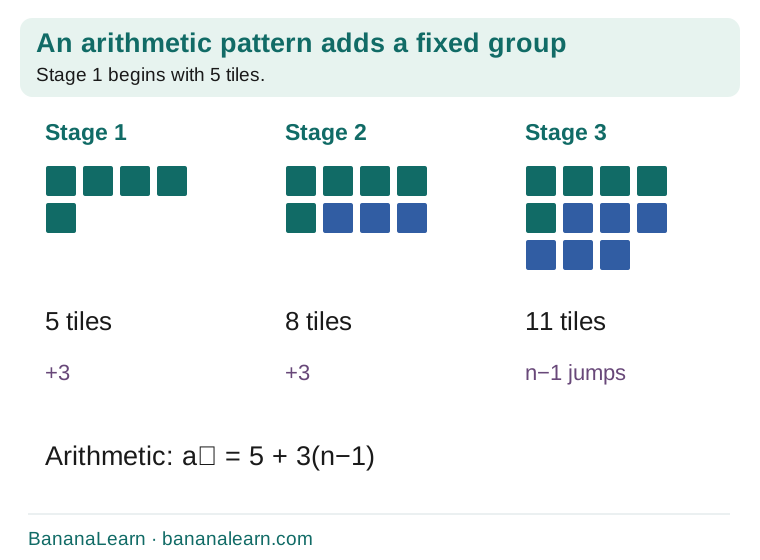
In 5,8,11,14, each term increases by 3. This is arithmetic, with a=5 and d=3. A negative difference gives a decreasing arithmetic sequence, such as 12,8,4,0.
Calculate each adjacent difference in order. A changing gap means the sequence is not arithmetic, even if every term is larger than the previous one.
From the first term to the nth term there are n−1 jumps. Therefore aₙ=a+(n−1)d. For the first example, aₙ=5+3(n−1)=3n+2.
Substitute n=1 as a quick check. The incorrect formula a+nd would move one jump too far. If given two non-adjacent terms, divide their difference by the number of position intervals.
On a narrow screen, swipe the diagram or open it full size.
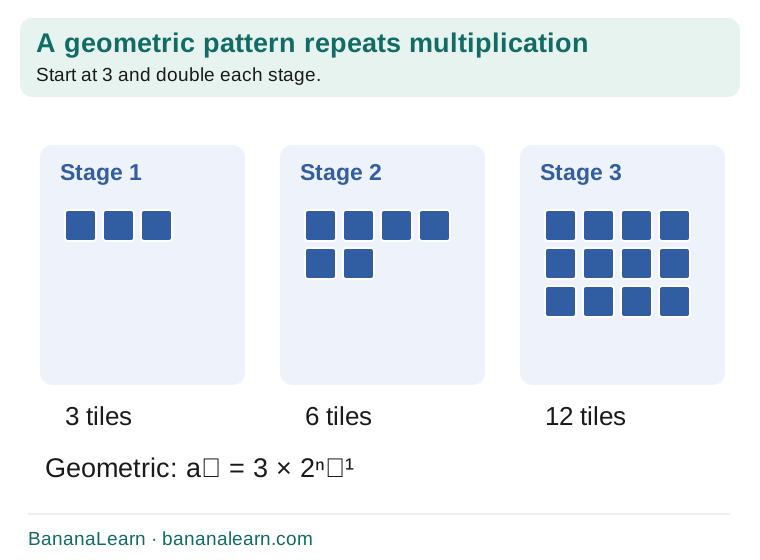
In 3,6,12,24, dividing a term by its predecessor gives 2 each time. This is geometric with a=3 and r=2. The pattern 16,8,4,2 has ratio 1/2.
A negative ratio makes signs alternate. For 2,−6,18,−54, r=−3. Division by zero needs care: do not use a ratio test across a zero denominator or assume a sequence of zeros determines a unique ratio.
Starting with a, multiply by r once to get the second term and n−1 times to get term n. Thus aₙ=arⁿ⁻¹. For 3,6,12,24, the rule is 3·2ⁿ⁻¹.
A fraction ratio and a negative ratio still fit the same rule. Evaluate the exponent first and keep negative bases in brackets, for example 2(−3)ⁿ⁻¹.
If an arithmetic sequence has term 2 equal to 9 and term 5 equal to 21, there are three position intervals, so d=(21−9)/3=4. The first term is 5.
For a geometric sequence with positive terms 4, __,36, the common positive ratio is 3 and the missing term is 12. If negative ratios are permitted, −12 also works as a different sequence. State the condition rather than silently discarding a branch.
An arithmetic tile pattern can add one fixed row each stage. A geometric counter pattern can triple its previous collection. Count the actual objects in the diagram before matching a formula.
“Increasing by 20%” describes a multiplier of 1.2 on the latest value. “Increasing by 20” describes an additive difference. Context should make the unit and repetition interval clear.
Use a record with positions, terms, adjacent differences and defined adjacent ratios. Then state a rule, calculate a distant term and check that n=1 recovers the first term.
This guide focuses on classifying and generating terms, not series sums. For total sums in arithmetic contexts, use the related arithmetic-progressions guide. Parents can ask why there are n−1 jumps rather than only checking the numerical answer.
See the reasoning
Try, explain, check
Try each task before opening its explanation. These are original BananaLearn questions, not official exam or past-paper questions. Where several answers can work, the explanation gives the criteria.
Arithmetic, d=4
All adjacent differences equal 4.
Geometric, r=2
All adjacent ratios equal 2.
4+3(n−1), or 3n+1
There are n−1 steps after term 1.
31
4+9×3=31.
162
2×3⁴=162.
−24
Multiply by −2 each time.
1
32×(1/2)⁵=1.
No
Its differences 3,5,7 are not constant.
No
Its adjacent ratios are not constant.
No
That gives 16 when n=1; use 10+6(n−1).
27
The positive ratio is 3.
Yes
9×(−3)=−27, then ×(−3)=81.
Copy these headings and fill them for one worked task, then for a fresh attempt. Use your own evidence rather than copying the model answer.
Explore BananaLearn’s games, learning features and one-to-one tutoring. Maths is our priority; English and Science tutoring are also available. Bring a recent example of schoolwork when checking teaching fit.
Original BananaLearn explanations, examples, illustrations and practice. Source facts checked 7 November 2026. Suggested levels are learning guides, not a claim that every board or textbook uses the same sequence.
How we prepare guides · Report a correction
Share the complete guide: https://bananalearn.com/learn/arithmetic-vs-geometric-sequences.html