
Start with the key idea
Support Year 5 maths by asking the child to explain the question, represent the quantities and show their first step. Offer one useful model, then return the thinking to the child. This guide uses England’s Year 5 programme as its reference; Scotland, Wales and Northern Ireland organise curriculum stages differently.
1. Check the school’s method and current topic
Begin with the assignment and any worked example sent by school. Ask which method the teacher has introduced. A different valid method can be useful later, but changing notation halfway through an unfamiliar homework task may add confusion.
England’s Year 5 programme includes larger whole numbers, decimal place value, fractions, measurement and geometry, among other areas. Schools have flexibility in sequencing within a key stage. The year label is a reference, not proof that every child has already met every example here.
For families elsewhere in the UK, match the topic with the school’s stage and current learning rather than assuming Year 5 means the same programme. Use the practical models below where they fit, and ask the teacher which method and scope to prioritise.
2. Separate reading, reasoning and calculation
Ask the child to retell the problem without calculating. If they cannot say what is known or what is being asked, start with the language or a sketch. Repeating an arithmetic rule will not repair a misunderstood story.
If the story is clear but the operation is uncertain, represent the relationship. Four equal bags suggest groups; a comparison might need a bar; elapsed time might need a timeline. Do not insist that one word such as “more” always selects one operation.
If the method is sensible but a fact is wrong, isolate the fact briefly. For 24 × 6, a child might know 20 × 6 but need help with 4 × 6. Keep the successful reasoning visible rather than restarting the entire question as though nothing was understood.
3. Use money carefully for decimal reasoning
For a £5 purchase payment and a £2.65 price, count up 35 p to £3 and £2 to £5. The change is £2.35. A number line makes the two gaps visible and gives a check on written subtraction.

Money is useful for tenths and hundredths, but decimal numbers are not restricted to two places. Year 5 work may involve thousandths, which need a place-value chart or measurement model rather than forcing every decimal into pounds and pence.
When comparing 0.48 and 0.5, write 0.50 alongside 0.48 and say the place values. The added zero does not change the value; it makes the common unit visible. Ask for a second example so the explanation is not only repeated from your demonstration.
4. Make a fraction of a quantity with equal groups
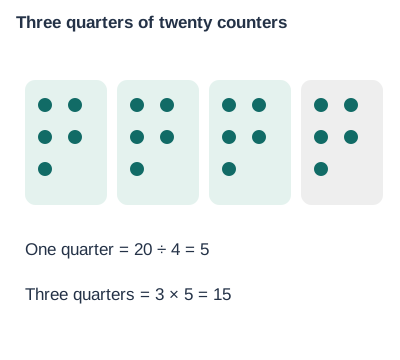
For three quarters of twenty counters, make four equal groups before selecting three. Each group has five counters, so three groups have fifteen. This connects the denominator and numerator to actions rather than a memorised sequence of buttons.
Keep the same whole when comparing fractional amounts. Half of a large pizza and half of a small pizza are the same fraction of their own wholes but need not be the same quantity of food. State what one whole represents.
For adding one half and one quarter, draw one consistently sized whole divided into quarters. The half occupies two quarters and the other quarter adds one more. The combined amount is three quarters; adding denominators would not preserve the size of the pieces.
5. Use everyday measures without skipping the units
A rectangular garden 8 m by 3 m has a boundary of 22 m and area of 24 m². Ask whether the question is about fencing or covering before choosing a calculation. A correct number with the wrong unit may reveal that the quantities have been mixed up.
For a journey from 16:40 to 18:05, jump twenty minutes to five, sixty minutes to six and five more minutes. The total is 85 minutes. Do not subtract clock displays as though an hour contained one hundred minutes.
Let the child estimate before measuring or calculating. A school ruler is not five metres long, and a short journey is not hundreds of hours. A rough sense of size can expose a misplaced zero or a wrong conversion direction.
6. End with one independent attempt
After helping with a model, change a number or the context and let the child try the next step. You can say “show me where the twenty is in your drawing” without completing the drawing yourself. Reduce the help as the structure becomes clear.
Keep a small note for the teacher when the same difficulty repeats: the task, the child’s approach and where they became stuck. “Compared decimals as whole numbers” is more useful than “does not understand decimals”. Avoid inferring a diagnosis from a homework problem.
Agree a reasonable stopping point when the task is causing prolonged frustration. Record the attempt and ask the school how much independent work is expected. The purpose of support is to make the next attempt more understandable, not to manufacture a perfectly completed sheet.
5 worked examples with reasoning
1. A child calculates 24 × 6 as 120 + 4. How can you explain the missing step?
- Split 24 into 20 and 4. Both parts are multiplied by six.
- 20 × 6 = 120 and 4 × 6 = 24, giving 144.
- Ask the child to model 23 × 6 independently next.
2. Find change from £10 for an item costing £6.75.
- Count 25 p to £7, then £3 to £10.
- Total change = £3.25.
- Check £6.75 + £3.25 = £10.
3. Find 2/5 of 30 counters.
- Make five equal groups of six.
- Select two groups: twelve counters.
- Ask what fraction of the counters remains: three fifths.
4. A rectangular mat is 7 m by 2 m. Find area and perimeter.
- Area = 14 m².
- Perimeter = 7 + 2 + 7 + 2 = 18 m.
- Explain which result describes covering and which describes the edge.
5. A child cannot start 0.6 + 0.25. What is one useful model?
- Rename 0.6 as sixty hundredths.
- Sixty plus twenty-five hundredths equals eighty-five hundredths, 0.85.
- Check that the sum is greater than 0.6 but less than one.
Save the guide or print the practice
Download to save or share
Complete guide with answers (PDF) · Worksheet without answers (PDF) · Worksheet and answer key (PDF)
Try each task before opening its answer. Give an example or reason, not only a label.
14 practice questions with explanations
Try each task before opening its answer. Give an example or reason, not only a label.
Write an answer and your reason before opening the explanation. Check the reasoning as well as the final answer.
- Parent check
A child cannot retell a word problem. What should you investigate first?
Answer and reasoning
The wording and meaning of the task.
An arithmetic explanation may be premature.
- Place value
Which is larger, 0.7 or 0.65? Explain.
Answer and reasoning
0.7.
Seventy hundredths exceed sixty-five.
- Decimal
Calculate 0.6 + 0.25.
Answer and reasoning
0.85.
Use a common hundredths unit.
- Money
Find change from £5 after paying £3.40.
Answer and reasoning
£1.60.
Count 60 p to £4 and £1 to £5.
- Multiply
Calculate 23 × 6.
Answer and reasoning
138.
120 + 18.
- Division
41 children need tables seating at most six each. Find the fewest tables.
Answer and reasoning
7 tables.
Six tables seat only 36 children.
- Fraction
Find 3/4 of 28.
Answer and reasoning
21.
28 ÷ 4 × 3.
- Fraction
Calculate 1/2 + 3/4.
Answer and reasoning
1¼.
Two quarters plus three quarters equals five quarters.
- Measure
Convert 1.25 m to centimetres.
Answer and reasoning
125 cm.
Each metre is one hundred centimetres.
- Area
Find the area of a rectangle 8 m by 3 m.
Answer and reasoning
24 m².
Multiply the lengths.
- Perimeter
Find the perimeter of a rectangle 8 m by 3 m.
Answer and reasoning
22 m.
Add all four sides.
- Time
Find the time elapsed from 16:40 to 18:05.
Answer and reasoning
85 minutes.
20 + 60 + 5.
- Parent check
After showing one worked example, what gives stronger evidence than copying it?
Answer and reasoning
A fresh independent attempt.
It checks transfer of the method.
- School link
What should you record when a difficulty repeats?
Answer and reasoning
The question, the child’s working and the exact sticking point.
Specific evidence helps the teacher choose a next step.
Use the ideas without looking at the notes
Listen to the child’s interpretation, choose one model and then try a fresh example. Use specific working to communicate with the teacher if a difficulty persists.
Common questions
Does this cover every UK curriculum?
No. England’s programme is the reference; check the school’s curriculum and stage elsewhere in the UK.
Should I teach my preferred written method?
First understand the method currently taught by school, then discuss alternatives without mixing steps.
How much should I help?
Offer enough structure to reveal the idea, then return a manageable next step to the child.
Is using counters too easy for Year 5?
A clear representation can make a difficult relationship visible; it can be removed as understanding improves.
What if the homework takes too long?
Keep the attempt and contact the teacher about the difficulty and expected time, rather than completing it for the child.
Connect your learning
Ask about guided Maths learning if your child needs help explaining these ideas.
About this guide
Original explanations, examples, diagrams and practice by BananaLearn. The grade label indicates the intended learning level; this is not an official textbook extract or exam paper.