Science · Suggested Grade 7
SOF ISO Class 7 Practice 2026–27: Evidence & Reasoning
Two plants grew differently. That does not prove the fertiliser caused it if their light, water and starting sizes also differed.
Original explanations and practice by BananaLearn · Published 1 November 2026
Official resource: Check the official SOF dates and organiser information. The practice below is original BananaLearn work.
On a small screen, swipe across the illustration to read every label.
Check the current event name and your school date
SOF’s current schedule calls its science competition the International Science Olympiad, ISO. The 2026–27 first-level schedule lists 30 October, 19 November and 3 December 2026, with a school selecting its date. On 1 November the latter two dates are upcoming. Verify your school’s entry and current official Class 7 syllabus.
Families using an older NSO reference should confirm the current organiser’s document rather than assume every similarly named competition is the same. This original practice is not an official paper, official answer key, complete syllabus or promise of examination performance.
Reason from the information actually supplied
Science questions can ask for a term, a mechanism, a prediction or an evaluation of evidence. Underline the variable being changed, what is measured and what is held comparable. A familiar topic can still require a different reasoning task.
Keep observations separate from conclusions. A higher reading is something recorded; a claim about why it is higher needs a controlled comparison and a suitable model. The fictional investigations here teach that distinction without pretending to report real experiments.
Worked heat case: distinguish the transfer process
A metal spoon’s handle warming while its other end is in warm water is an introductory example of conduction through the solid. In a fluid, bulk movement can transfer thermal energy by convection. Radiation can transfer energy without a material medium.
Several processes may occur together in a real setting. The question asks which mechanism the described feature illustrates, not whether the others cease to exist. These are explanations on paper; do not use boiling water or hot metal to test an answer unsupervised.
Worked plant case: a fair comparison
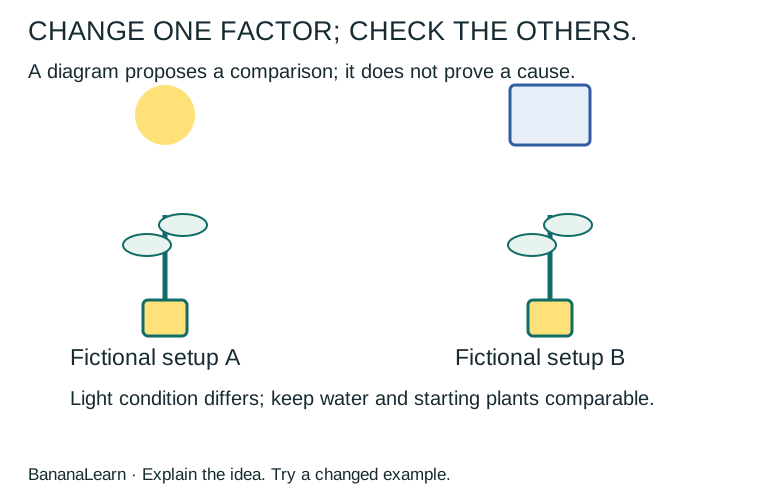
Suppose a question asks whether light affects a plant measure. Comparable plants, soil, water, container size, observation time and starting condition help make the comparison more informative. Change the intended light condition and record it, while acknowledging biological variation.
If the fertilised plant also received more light and water, its greater growth cannot isolate the fertiliser’s effect. Repeating and using more than one comparable plant can strengthen evidence. A single outcome should not be called proof that a treatment always works.
Breathing, respiration and plant nutrition
Breathing moves air into and out of the respiratory system. Cellular respiration releases usable energy through reactions in cells. Photosynthesis in green plants makes organic substances using light energy. Plants respire too, including at night; photosynthesis and respiration are not simple day-versus-night labels.
For water transport, xylem carries water and dissolved minerals, while phloem mainly carries sugars. A question mentioning leaves may concern gas exchange, transport or photosynthesis. Read which material or process it asks about before naming a structure.
Read simple data without overclaiming
In fictional one-hour plant setups, recorded losses are 6 g and 10 g. Their rate difference is 4 g/h, but a cause cannot be identified unless the setup supplies relevant controls. In another fictional cooling comparison, a change from 60°C to 44°C is a fall of 16°C.
A greater total change is not automatically a faster rate if the observation times differ. Always divide by the stated time when comparing average rates. Use units to show whether the answer is a temperature, a change or a rate.
A manageable revision cycle
Try the questions, explain the reason and identify one idea to repair. Use the linked concept guide before doing a changed question. Record a successful explanation as well as mistakes, so revision does not become a list of unexplained crossed-out answers.
Parents can ask What else changed? and Does that observation establish the cause? The target is careful reasoning rather than an invented score-to-rank conversion. The selected topics remain a small independent practice set, not an official coverage checklist.
Science reasoning record
Copy the record into a notebook or use it to organise your own answer. Blank spaces are for your work.
| Question | Observation / supplied fact | Explanation | Uncertainty or changed check |
|---|---|---|---|
| ___ | ___ | ___ | ___ |
| ___ | ___ | ___ | ___ |
| ___ | ___ | ___ | ___ |
12 questions with explained answers
Try the questions before opening the answers. Explain the reason, then try a changed example to check your understanding.
A spoon handle warms through its solid material. Main illustrated process?
Show answer and explanation
Conduction
Thermal energy transfers through the solid.Bulk movement of a warm fluid transfers energy by what process?
Show answer and explanation
Convection
The fluid movement carries energy.Which transfer can occur through a vacuum?
Show answer and explanation
Radiation
It does not require a material medium.Two plant groups differ in light, water and fertiliser. Can growth isolate fertiliser alone?
Show answer and explanation
No
Several variables changed.A light comparison should hold water and plant starting condition comparable. Why?
Show answer and explanation
To reduce alternative explanations
This supports a fairer comparison without guaranteeing identical biology.Do plants respire at night?
Show answer and explanation
Yes
Cellular respiration continues in living plant cells.Is breathing the same process as cellular respiration?
Show answer and explanation
No
Ventilation and cell reactions are different.Which tissue mainly carries water in a plant?
Show answer and explanation
Xylem
Do not confuse it with phloem sugar transport.6 g/h and 10 g/h: difference?
Show answer and explanation
4 g/h
10 − 6.60°C to 44°C: temperature decrease?
Show answer and explanation
16°C
60 − 44.Same total change over different times: necessarily same rate?
Show answer and explanation
No
Rate depends on time as well as amount.Does this practice set establish an official olympiad rank?
Show answer and explanation
No
It is independent learning practice.
Keep the ideas connected
For help with a school-learning difficulty, bring one attempted question to a discussion about tutoring and curriculum fit. Maths is our priority; English and Science tutoring are also available.
Sources, scope and sharing
The examples, diagrams and practice are original BananaLearn work. Grade labels suggest a learning level; teaching sequences and school requirements can differ. Official sources below support the stated facts and resource links. These activities are independent resources, not official exam questions or endorsed campaign materials.
How we prepare learning guides · Report a correction
Share this guide: https://bananalearn.com/learn/sof-iso-class-7-practice-2026-27.html