
Is the child distracted, or unsure what to do?
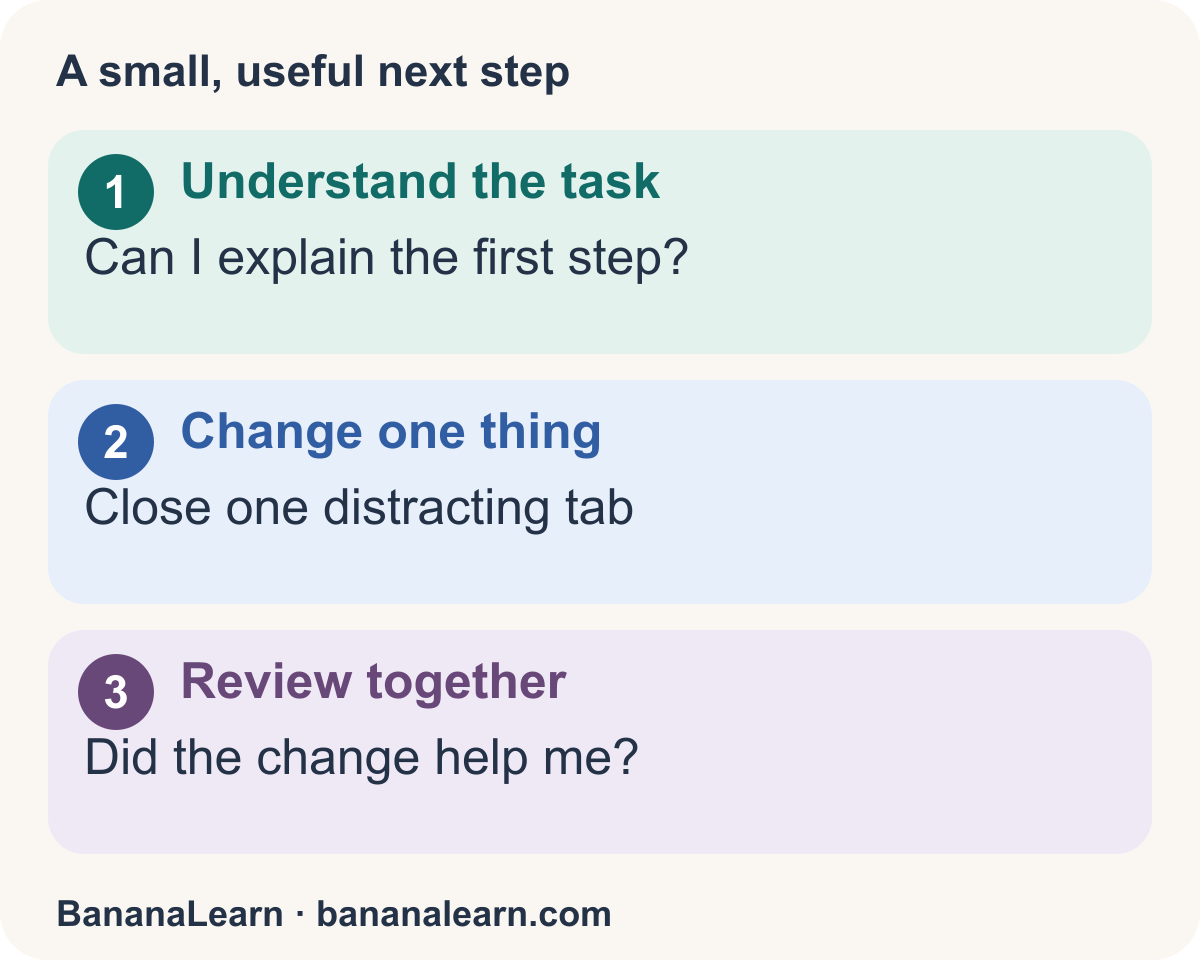
A child staring out of the window may have lost their place, be tired, or not know how to begin. The same visible behaviour can have different explanations. Ask, “Show me what you would do first.” If the child cannot explain the instruction, a tidier desk alone will not solve the problem.
Use a familiar task to compare. Can they begin an easy example but stop at a new type? Does the interruption happen when writing is required, or even when explaining aloud? These are observations to discuss, not a home test for attention disorders.
Choose a time when basic needs such as food and rest have been considered. Avoid using the plan to push through illness, persistent distress or exhaustion.
Check the workspace together
- Visible task: open the correct page and cover unrelated questions if that feels helpful.
- Materials: put the required pencil, ruler and notebook within reach.
- Device: if needed for work, open only the relevant material and silence optional notifications.
- Sound and movement: ask what is distracting rather than assuming everyone needs the same environment.
- Questions: keep a small space to note something to ask later, without abandoning the current step.
A kitchen table can work; a new desk or paid app is not a prerequisite. When space is shared, an agreed quieter period may be more practical than expecting complete silence.
A one-change experiment
Imagine Yusuf is writing three sentences about a plant. He keeps switching to another browser tab. His parent first asks him to explain the science aloud. He can, so they agree to close the unrelated tab and write one sentence before checking in.
His first sentence is: “The roots take in water from the soil.” They read it once and he chooses the next point. The measure of success is a clear sentence and a manageable return to work, not an uninterrupted ten-minute performance.
On another day he cannot explain how water reaches the plant. That is a content question. They revisit the lesson instead of repeating the focus routine more firmly. If both the task and environment change at once, it becomes harder to tell which support helped.
Plan the break and the return
- Name a small endpoint: one question, one paragraph plan or one labelled drawing.
- Ask the child whether a visible timer would help. Use flexible timings, not a claim about what their age should tolerate.
- Before pausing, mark the next action with a note: “Start sentence two about the stem.”
- Choose a break that is easy to finish: stretch, get water or look outside.
- Return to the marked step and notice what support is still needed.
If a competitive game makes returning harder, choose another break activity. This does not mean games are inherently bad; the immediate job is making the transition predictable.
Adapt for age and review the result
A younger child may need a picture showing “read, try, check”. An older learner can choose a work block and place the phone outside reach voluntarily. Explain the purpose of the change and review it together rather than using surprise restrictions.
After two or three attempts, look at task completion, understanding and the child's experience. A quieter child is not necessarily a more engaged learner. Keep the change only if it helps. If distractions remain a problem across home and school, share observations with the teacher and ask about appropriate support.
Bring an example of the task, the point at which work stopped and what helped them return. Avoid labels such as “never concentrates”: they conceal the useful details and can make the child feel blamed.
Further reading: Oxford Owl: creating a workable home-learning routine. The examples and printable activities on this page were created by BananaLearn.
Our focus experiment
Choose one change. Record what happened after the work; this is not a test of the child.
A completed example
Task: Three plant sentences
One change: Closed an unrelated tab
What was completed: Two accurate sentences
Child’s feedback: Knowing the next step helped
Opens a separate sheet with the completed example and writing space. Save it as a PDF or print it using your browser. No account is required.
Questions parents ask
What is the best homework timer length?
There is no universal number. Choose a small meaningful task and adjust to the child and the work. A timer is optional.
Should I remove every distraction?
Reduce avoidable interruptions while making the space practical for your household. Ask the child which change helps and test one at a time.
Does difficulty concentrating mean ADHD?
A homework observation cannot establish a diagnosis. Discuss persistent difficulties with the school and a qualified professional when appropriate.
Would a teacher help with the next step?
BananaLearn offers 1-on-1 Maths, English and Science tutoring. Tell us your child’s grade, curriculum and what they are finding difficult so we can discuss a suitable fit.
Ask about a free 50-minute session