
Start with the key idea
A tissue is an organised group of cells, with associated material where present, that works in a particular function. Tissue structure reflects its job; organs contain several tissues working together.
1. Use function to organise the topic
Multicellular organisms divide work among specialised cells and tissues. A tissue is not merely any collection of nearby cells: its cells and associated material form an organised functional unit. An organ, such as a leaf or heart, combines several tissue types. Keep the cell–tissue–organ hierarchy visible while studying names.
For each tissue, answer three questions: where is it found, what does it do, and which structural feature helps it do that? This method is stronger than memorising isolated definitions. A transport tissue needs a pathway; a protective lining needs closely arranged cells; a flexible support tissue must permit bending.
The classifications in this guide are school-level groupings. Individual tissues can have multiple functions and specialised subtypes. Use typical examples rather than claiming one job or appearance fits every situation.
2. Distinguish meristematic and permanent tissues
Meristematic tissue contains cells that actively divide and supplies new cells for growth. Apical meristems occur at growing root and shoot tips and contribute to length. Lateral meristems contribute to increases in girth in plants that show such growth. Intercalary meristems occur at locations such as the bases of leaves or internodes in some plants, including grasses.

Permanent tissues develop when cells become specialised; many no longer divide under ordinary conditions. Permanent does not mean dead. Some permanent tissues contain living cells, while others include dead cells whose walls remain useful.
Do not confuse a growing region with the whole organ. A root contains several tissues, and growth is concentrated in particular zones. The diagram highlights selected regions rather than pretending that every root cell is actively dividing.
3. Compare three simple permanent plant tissues
Parenchyma typically has living cells with relatively thin walls. It can store substances and, when chloroplasts are present, perform photosynthesis. Air spaces in specialised parenchyma can help aquatic plants. These variations show why the location and structure belong in an answer.
Collenchyma provides flexible support, often in young stems and leaf stalks. Its living cells typically have unevenly thickened walls. Sclerenchyma provides strength through thick, lignified walls; its cells are usually dead at maturity. A hard protective shell is therefore not explained by flexible collenchyma merely because both are supporting tissues.
Compare flexibility and wall pattern rather than ranking tissues as stronger or better in every situation. A young bending stalk and a hard seed coat solve different mechanical problems.
4. Treat xylem and phloem as complex tissues
Xylem and phloem are complex tissues because they contain more than one cell type working together. Xylem transports water and mineral ions, mainly from roots toward aerial parts, and also contributes support. Important conducting elements are dead at maturity, but xylem includes living cells too. Saying all xylem cells are dead is inaccurate.
Phloem transports organic substances such as sugars from sources to sinks. A source supplies sugar; a sink uses or stores it. The direction depends on the source and sink, so phloem transport is not simply always downward. Leaves commonly act as sources, while growing roots, fruits or shoots can be sinks.
Keep the transported substance in your explanation. Water and mineral transport is different from distributing sugars made during photosynthesis, even though both pathways belong to the same plant.
5. Connect four animal tissue groups with structure
Epithelial tissue covers surfaces and lines spaces. Closely arranged cells make an effective covering, while specialised forms can absorb or secrete. Connective tissues contain cells within an extracellular matrix; bone, cartilage and blood are examples with very different matrices and jobs. Blood is connective tissue even though its matrix is fluid.
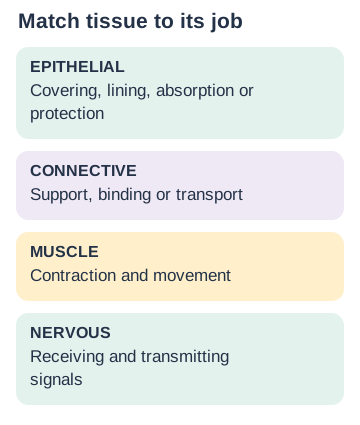
Muscle tissue contracts. Skeletal muscle is commonly associated with voluntary body movement; smooth muscle occurs in internal organs; cardiac muscle forms the muscular wall of the heart and works involuntarily. Cardiac and skeletal muscle are both striated, so stripes alone do not decide voluntary control.
Nervous tissue receives and transmits signals. Neurons have specialised extensions, supported by other cells. A complete answer connects communication to structure rather than saying nervous tissue only exists in the brain.
6. Write comparisons that explain, not just name
A comparison should use the same feature on both sides. For xylem and phloem, compare transported materials and source-to-destination patterns. For collenchyma and sclerenchyma, compare wall characteristics, typical cell condition at maturity and flexibility. Mixing location on one side with colour on the other is not a fair comparison.
In an unfamiliar example, identify the job first. A lining preventing wear suggests epithelial tissue; a hard supportive matrix suggests a connective tissue such as bone; active contraction suggests muscle. Add a structural reason and keep conclusions conditional when evidence is incomplete.
Use prepared diagrams and safe classroom materials. You do not need to cut animals or damage living plants to understand tissues. Finish by explaining how two tissue types cooperate in one organ, such as xylem and photosynthetic parenchyma in a leaf.
5 worked examples with reasoning
1. Why is a leaf an organ rather than one tissue?
- It contains protective, transport and photosynthetic tissues.
- These cooperate in several functions.
- An organ combines different tissue types.
2. Which plant tissue suits flexible support in a young stalk?
- Identify flexible support rather than rigid protection.
- Collenchyma has living cells with unevenly thickened walls.
- This structure suits the job.
3. Repair: All permanent tissues are dead.
- Permanent refers to specialisation, not death.
- Parenchyma and collenchyma typically contain living cells.
- Some other permanent tissues include dead cells useful through their walls.
4. Why can phloem carry sugars toward a growing shoot?
- A mature leaf can supply sugar as a source.
- The growing shoot uses it as a sink.
- Transport follows source-to-sink demand, not a fixed downward rule.
5. Why is blood classified as connective tissue?
- It has cells in an extracellular fluid matrix.
- It transports substances and connects body functions.
- A tissue need not be a solid sheet.
Save the guide or print the practice
Download to save or share
Complete guide with answers (PDF) · Worksheet without answers (PDF) · Worksheet and answer key (PDF)
Try each task before opening its answer. Give an example or reason, not only a label.
14 practice questions with explanations
Try each task before opening its answer. Give an example or reason, not only a label.
Write an answer and your reason before opening the explanation. Check the reasoning as well as the final answer.
- Hierarchy
Arrange cell, organ and tissue.
Answer and reasoning
Cell → tissue → organ.
Each level combines earlier units.
- Growth
Which meristem commonly increases root length?
Answer and reasoning
Apical meristem.
It occurs near the growing tip.
- Girth
Which meristem group contributes to girth?
Answer and reasoning
Lateral meristems.
This applies to plants showing secondary growth.
- Living
Is permanent tissue always dead?
Answer and reasoning
No.
Many permanent cells are living.
- Storage
Name a common storage tissue.
Answer and reasoning
Parenchyma.
Its roles vary with location.
- Flexibility
Which simple tissue offers flexible support?
Answer and reasoning
Collenchyma.
Unevenly thickened living cells suit bending regions.
- Strength
Which simple tissue has thick lignified walls?
Answer and reasoning
Sclerenchyma.
Cells are usually dead at maturity.
- Water
Which tissue transports water and mineral ions?
Answer and reasoning
Xylem.
It also contributes support.
- Sugar
Which tissue distributes sugars from sources to sinks?
Answer and reasoning
Phloem.
The source-sink relation determines transport.
- Complex
Why is xylem a complex tissue?
Answer and reasoning
It contains more than one cell type.
The types cooperate.
- Lining
Which animal tissue group lines surfaces?
Answer and reasoning
Epithelial.
Its cells are closely arranged.
- Blood
What kind of tissue is blood?
Answer and reasoning
Connective.
Its extracellular matrix is fluid.
- Heart
Is cardiac muscle voluntarily controlled?
Answer and reasoning
No.
It is striated but involuntary.
- Signal
Which tissue specialises in transmitting signals?
Answer and reasoning
Nervous.
Its cells have structures suited to communication.
Use the ideas without looking at the notes
Create a comparison table with tissue, location, job and helpful structure. Include parenchyma, collenchyma, sclerenchyma, xylem, phloem and the four animal tissue groups.
Common questions
Are tissue and organ synonyms?
No. Organs contain several tissue types.
Does xylem contain only dead cells?
No. Important conducting cells are dead at maturity, but living cells are also present.
Does phloem always move food downward?
No. It connects sources to sinks, which vary in position.
Is every striated muscle voluntary?
No. Cardiac muscle is striated and involuntary.
Why study structure as well as names?
Structure explains how a tissue performs its function and helps solve unfamiliar questions.
Connect your learning
Ask about guided Science learning if your child needs help explaining these ideas.
About this guide
Original explanations, examples, diagrams and practice by BananaLearn. The grade label indicates the intended learning level; this is not an official textbook extract or exam paper.