
Start with the key idea
Roots usually anchor a plant and absorb water and minerals. The stem supports parts and transports substances. Green leaves make food using light, water and carbon dioxide. Flowers are reproductive structures; fruits protect or help disperse seeds, and seeds can grow into new plants.
1. Begin with the whole flowering plant
Look at a bean or sunflower plant in a picture. Identify the roots below the soil, the stem, the leaves and any flowers or fruits. Not every plant will show all these parts at the same time: a young seedling may have no flowers yet.
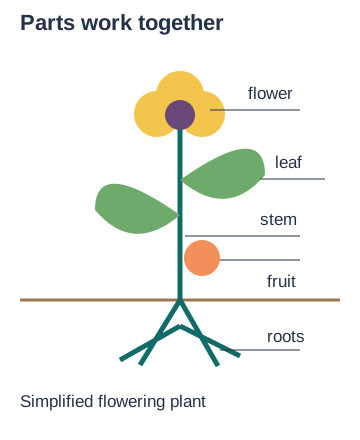
A diagram is a simplified model. Real roots branch in many directions and leaves overlap. Use the model to learn where parts connect, then compare it with a real plant without digging it up.
This guide describes a typical flowering plant. Ferns, mosses and other plant groups do not follow every detail of this flower-and-fruit pattern. Keep the scope clear instead of saying every plant has flowers.
2. Roots anchor the plant and absorb resources
Roots help hold a plant in place. They absorb water and dissolved mineral nutrients from the surroundings, usually soil. Many fine roots spread through a large area, helping the plant reach water.
Roots do not eat soil like an animal eats food. Plants need minerals from soil, but green parts make sugars using light energy. Saying “roots take food from the soil” hides that important difference.
Some roots also store food made by the plant. A carrot is a familiar storage-root example. This extra job does not replace absorption and anchorage. Avoid tasting unknown roots; familiar food examples can be discussed from pictures.
3. The stem supports and connects the parts
The stem holds leaves and flowers in positions where they can function. It also contains transport tissues carrying water and other substances between parts. A soft green stem and a woody trunk look different but share important jobs.
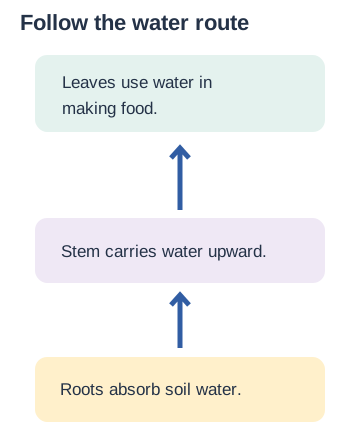
Water taken up by roots moves through the plant towards leaves. Sugars made in green parts can be transported to growing or storage parts. At Grade 3, use arrows to show that the plant is connected, without memorising every tissue name.
A leaf resting beside a stem is not the same as a leaf attached to it. In a labelled drawing, make the connections visible. An isolated label without a clear pointing line can leave the learner guessing which part is meant.
4. Green leaves make food using light
Most green leaves use light energy to make sugars from water and carbon dioxide. This process is called photosynthesis. Oxygen is released. The green pigment chlorophyll helps the plant absorb light.
Water is needed, but water alone is not the plant’s food. Soil minerals are needed too, but they are not the sugars made by photosynthesis. Begin with these different roles before learning a word equation in a later grade.
Leaves also exchange gases with the air and lose water vapour. These processes are not visible as large holes opening and closing in an ordinary classroom photograph. Use a simple explanation rather than asking a child to see structures too small to observe unaided.
5. Connect flowers, fruits and seeds
Flowers are involved in reproduction in flowering plants. After successful fertilisation, parts of the flower can develop into a fruit containing seeds. A fruit may help protect the seeds and aid their dispersal.
A seed contains an embryo and often stored food for early growth. A viable seed can germinate under suitable conditions. A seedling first uses stored resources before its green leaves become established food-making parts.
Every flower does not necessarily become a fruit: pollination, fertilisation and suitable conditions matter. A tomato is botanically a fruit because of its development and seeds, even though people often group it with vegetables in cooking. Different classification purposes can give different labels.
6. Use the parts to explain what a plant needs
Choose a plant already growing safely in a pot. Draw what is visible and label only what you can identify. For roots that remain underground, use a separate diagram rather than pulling the plant out.
Explain a pathway: roots absorb water, the stem transports it and leaves use it in food-making. Then explain another job, such as roots helping hold the plant upright. This is stronger than reciting six labels with no connections.
For a simple review, ask what might happen if the plant cannot get enough water or light. Describe a possibility, not an instant guaranteed result. Plants vary, and changes often take time. Record observations and avoid overwatering as a “test”.
5 worked examples with reasoning
1. A seedling has roots, a stem and leaves but no flowers. Is it incomplete?
- It may simply be young.
- Plant parts appear at different stages of development.
- A young flowering plant need not already have flowers or fruit.
2. Explain the route of soil water to a leaf.
- Roots absorb water.
- Transport tissues in the stem carry it through the plant.
- Leaves use water in processes including photosynthesis.
3. Correct “The roots eat the soil.”
- Roots absorb water and mineral nutrients.
- Green parts make sugars using light energy.
- Do not describe soil as a meal eaten by roots.
4. Why is a carrot useful in a lesson about roots?
- It is a familiar storage-root example.
- Its stored material was produced by the plant.
- Some roots have storage as an additional function.
5. Why can a tomato be called a fruit in Science?
- It develops from flower structures after fertilisation and contains seeds.
- Botanical grouping uses plant structure and development.
- Cooking categories use a different purpose.
Save the guide or print the practice
Download to save or share
Complete guide with answers (PDF) · Worksheet without answers (PDF) · Worksheet and answer key (PDF)
Try each task before opening its answer. Give an example or reason, not only a label.
14 practice questions with explanations
Try each task before opening its answer. Give an example or reason, not only a label.
Write an answer and your reason before opening the explanation. Check the reasoning as well as the final answer.
- Label
Which part usually anchors a plant?
Answer and reasoning
Roots.
They help hold it in the growing medium.
- Transport
Which part connects roots with leaves?
Answer and reasoning
The stem.
It supports and contains transport tissues.
- Food
Which parts usually do most food-making in a bean plant?
Answer and reasoning
Green leaves.
They use light, water and carbon dioxide.
- Resources
Name two things roots absorb.
Answer and reasoning
Water and mineral nutrients.
These support plant functions but are not a ready-made sugar meal.
- Flower
What is a main function of flowers?
Answer and reasoning
Reproduction in flowering plants.
Flowers are involved in producing seeds.
- Fruit
Give one job of a fruit.
Answer and reasoning
Protecting seeds or helping their dispersal.
Different fruits do this in different ways.
- Seed
What can a seed that is able to grow develop into?
Answer and reasoning
A new plant under suitable conditions.
Viability and conditions both matter.
- Scope
Does every plant group make flowers?
Answer and reasoning
No.
This guide models a typical flowering plant.
- Stage
Why might a young plant have no fruit?
Answer and reasoning
It has not reached that reproductive stage.
Parts vary over the life cycle.
- Correct
Repair: Soil is the food that roots eat.
Answer and reasoning
Roots absorb water and minerals; green parts make sugars.
Separate resources from food-making.
- Storage
Which familiar vegetable is a storage root: carrot or pea pod?
Answer and reasoning
Carrot.
A pea pod is a fruit containing seeds.
- Pathway
Put in order: leaves, roots, stem for incoming soil water.
Answer and reasoning
Roots → stem → leaves.
This is a simplified transport route.
- Observe
How can you study roots without damaging a potted plant?
Answer and reasoning
Use a labelled picture or an already prepared safe seedling model.
Do not uproot a plant merely to complete the task.
- Explain
Why should plant diagrams show connections as well as labels?
Answer and reasoning
The parts work together.
Connections help explain movement of substances and support.
Use the ideas without looking at the notes
Draw a flowering plant and label six parts where appropriate. Beside each label, write a job. Add arrows showing the simplified route of water from roots to leaves.
Common questions
Do roots make all the food?
No. Green parts usually make sugars through photosynthesis; roots mainly absorb water and minerals and may store food.
Are flowers always present?
No. They depend on the plant group and stage.
Is a tree trunk a stem?
Yes. It is a woody stem with support and transport roles.
Does every seed germinate?
No. It must still be able to grow and have suitable conditions.
Why are leaves green?
Many contain chlorophyll, a pigment that helps absorb light for photosynthesis.
Connect your learning
Ask about guided Science learning if your child needs help explaining these ideas.
About this guide
Original explanations, examples, diagrams and practice by BananaLearn. The grade label indicates the intended learning level; this is not an official textbook extract or exam paper.