English · Suggested Class 9
Colons & Semicolons: Class 9 Examples and Editing Practice
The bus was late; we still arrived on time. The bus was late: a fallen branch blocked the road. The mark changes the relationship between two complete ideas.
Original BananaLearn guide · 2 November 2026
On a phone, swipe across the illustration to read every label.

A complete clause is the starting point
An independent clause can stand as a sentence: The gate was locked. A dependent clause such as because the gate was locked cannot normally stand alone in formal prose. Before choosing a semicolon or colon, identify whether the words before and after it form complete ideas.
The punctuation does not repair a missing verb or an unfinished thought by itself. A sentence such as The team practised; because the final was close uses a semicolon before a dependent clause and needs revision. The team practised because the final was close needs no such mark.
Use a semicolon to link related independent clauses
A semicolon can join two closely related independent clauses without a coordinating conjunction: The rain stopped; the match resumed. Both halves could be sentences. The semicolon presents their connection while avoiding a comma splice.
Compare The rain stopped, and the match resumed, which uses a comma plus and. A full stop is another valid choice. The aim is a clear relationship and rhythm, not a rule that a semicolon is always more sophisticated or correct than a shorter sentence.
Use a colon for what follows an introduction
In the standard school-writing pattern, a colon follows a complete introductory clause and points to an explanation, example or list: We had one problem: the bridge was closed. The second part explains the problem named in the first.
A colon can also introduce a list after a complete clause: Pack these three items: a notebook, a ruler and a pencil. Avoid inserting it automatically after any form of includes or such as. For example, My bag contains: a ruler and a notebook interrupts the verb’s ordinary connection to its object.
On a phone, swipe across the illustration to read every label.
Compare the same ideas with different marks
The lights went out; everyone waited links two related events as independent clauses. The lights went out: the battery had failed makes the second clause an explanation of the first. A semicolon does not itself promise that the second clause supplies a reason; the reader must infer the relationship from the wording.
A full stop can work in both cases if the sentences remain clear. In a specific editing exercise, explain why a colon or semicolon fits the requested relationship rather than insisting that every alternative punctuation choice is wrong. Punctuation choices are constrained by grammar but also affected by the intended meaning.
Link clauses with however or therefore
Write The route was longer; however, it was safer. The word however is not a coordinating conjunction like but, so a comma alone before it does not properly join these independent clauses in formal writing. A full stop before However is also possible.
Similarly, The battery was empty; therefore, the lamp did not work connects a result to a cause. The semicolon separates complete clauses, and the comma after therefore marks the introductory connector. Do not add a semicolon every time however appears inside one clause: The route, however, was safer is a different structure.
Use semicolons inside a complicated list
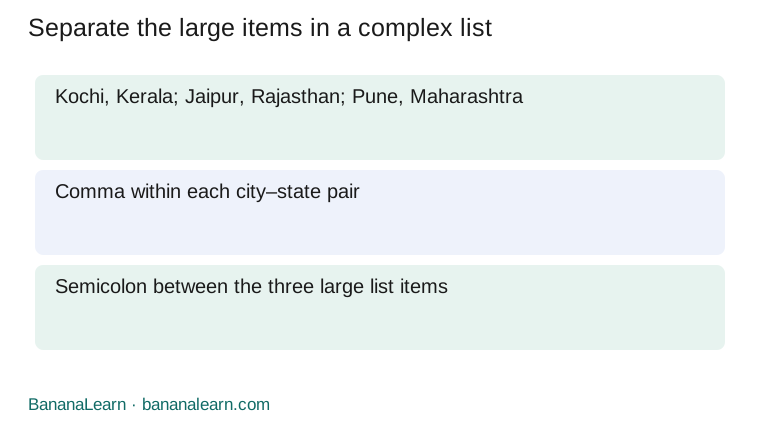
Semicolons can separate list items that already contain commas: Our group visited Kochi, Kerala; Jaipur, Rajasthan; and Pune, Maharashtra. Each city-and-state pair forms one item. The semicolons help the reader see the larger divisions.
A simple list such as apples, pears and oranges usually needs ordinary commas rather than semicolons. The list use is different from joining independent clauses; city-and-state pairs do not need to be complete sentences for this particular function.
Edit a short paragraph in stages
Original: We needed three things: patience, a map and water. The path was muddy, we took a shorter loop. However, the view was excellent. The first sentence already has a suitable colon. The second has a comma splice: two independent clauses joined by only a comma.
One repair is The path was muddy; we took a shorter loop. Another is Because the path was muddy, we took a shorter loop. The final sentence can remain separate. Choose a repair that preserves the original meaning; do not change who acted or invent a reason absent from the original.
A checking routine for useful punctuation
Read the words before the mark as a possible sentence. For a clause-joining semicolon, do the same after it. For a colon, ask whether the first part appropriately introduces what follows. For a complex list, check that each large item is clear.
Use the exercises to explain choices aloud before rewriting. A child who places marks wherever they pause while reading may need help recognising clauses. Grade placement here is suggested; publishers and style guides differ on some colon conventions, so use the teacher’s required style while preserving grammatical clarity.
An editing decision sheet
Copy this record into a notebook. Fill each blank using your own example or the activity above.
On a phone, swipe across a wide table to see every column.
| Question | Answer for your sentence |
|---|---|
| Complete first clause? | ___ |
| Complete second clause, if joining? | ___ |
| Relationship: related / explanation / list | ___ |
| Chosen punctuation and reason | ___ |
| A valid alternative version | ___ |
12 questions with explained answers
Try each question first. Open the explanation to check your reasoning. These are original BananaLearn questions, not official exam questions.
Repair the comma splice: The bell rang, the lesson ended.
Check answer and reasoning
The bell rang; the lesson ended.
Both halves are independent clauses. A full stop or comma plus a suitable conjunction can also work.Choose the mark: We knew the cause __ the tank was empty.
Check answer and reasoning
A colon fits the explanatory meaning.
The complete first clause introduces the explanation.Is Pack: your notebook and ruler a good standard colon construction?
Check answer and reasoning
No.
It interrupts the verb and its object. Write Pack your notebook and ruler, or introduce a complete clause first.Repair: The road was closed, however, we found another route.
Check answer and reasoning
The road was closed; however, we found another route.
However does not join independent clauses with a comma alone.Can a semicolon join It was cold; because the window was open?
Check answer and reasoning
Not in this clause-joining use.
The second part is dependent. Use It was cold because the window was open.Why use semicolons between Kochi, Kerala; Jaipur, Rajasthan; Pune, Maharashtra?
Check answer and reasoning
To separate larger list items containing their own commas.
The city-state pair stays together.Does a simple apple, pear and orange list need semicolons?
Check answer and reasoning
Usually no.
Ordinary commas make the simple divisions clear.Supply an explanation after We changed our plan:
Check answer and reasoning
For example, the hall was unavailable.
The second part explains the complete introductory statement.Is The route, however, was safer a comma splice?
Check answer and reasoning
No.
It is one independent clause with an interrupting connector.Can a full stop replace the semicolon in The sky darkened; we went inside?
Check answer and reasoning
Yes.
The two parts can stand as separate sentences; the intended connection remains understandable.What should be checked before choosing a semicolon to join clauses?
Check answer and reasoning
Whether both sides are complete independent clauses.
A pause alone is not the grammatical test.Choose a clear list introduction: I packed: pens and paper / I packed two things: pens and paper.
Check answer and reasoning
I packed two things: pens and paper.
The introductory clause is complete before the colon.
Choose your next learning step
- Review sentence boundaries
- Revisit commas before adding new marks
- Apply punctuation in a complete paragraph
Explore BananaLearn games, learning resources and tutoring. Maths is our priority; English and Science tutoring are also available. Share your current schoolwork when checking teaching fit.
Sources and scope
Explanations, activities, diagrams and practice are original BananaLearn work. Class labels suggest a learning level; school sequences and current textbook editions can differ. Sources checked 2 November 2026.
How we prepare guides · Report a correction
Share the complete guide: https://bananalearn.com/learn/class-9-colons-semicolons.html