Maths · Suggested Class 7
Multiplying & Dividing Integers: Class 7 Signs Explained
If the temperature falls 3 degrees each hour, four hours bring a change of −12 degrees. But what does a negative number of hours mean? Use patterns to understand the sign rule before applying it.
Original BananaLearn guide · 2 November 2026
On a phone, swipe across the illustration to read every label.

Keep the size and the sign as separate decisions
An integer product tells you both a size and a direction or sign. For 4×(−3), first find the magnitude 4×3=12. There are four changes of −3, so the total is −12. Repeated addition explains multiplication by a positive whole number: (−3)+(−3)+(−3)+(−3)=−12.
The sign rule is about multiplication and division. It is not a rule for every pair of signed numbers. For example, (−5)+(−2)=−7, while (−5)×(−2)=10. Before choosing a sign rule, identify the operation. Parentheses make a negative number visibly one operand.
A number-line model for repeated negative changes
A freezer is at −2°C and its temperature changes by −3°C each hour for four hours. The total change is 4×(−3)=−12°C. Its final temperature is −2+(−12)=−14°C. The product gives the change, not the starting temperature or final reading.
On the number line, start at 0 to represent total change and draw four leftward jumps of 3, ending at −12. If you instead start the same jumps at −2, the endpoint represents the final temperature −14. Label what the line measures; an unlabelled jump diagram can hide this difference.
Why negative times negative is positive
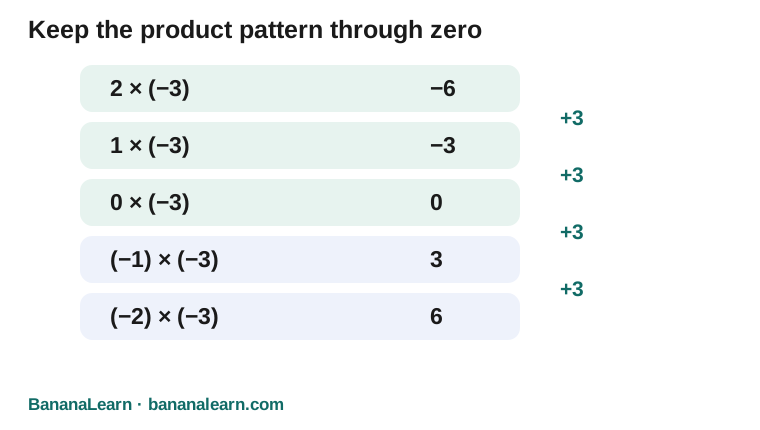
Fix the second factor at −3. As the first factor decreases by 1, the products follow: 2×(−3)=−6, 1×(−3)=−3, 0×(−3)=0. Continuing the same increase of 3 gives (−1)×(−3)=3, (−2)×(−3)=6 and (−3)×(−3)=9. The rule preserves the multiplication pattern through zero.
Distributivity gives a second check. Since 3+(−3)=0, (−2)×[3+(−3)]=0. Expanding gives (−2)×3+(−2)×(−3)=0. The first product is −6, so the second must be +6 to make zero. Treat this as an explanation of the rule, rather than trying to draw a literal negative number of groups.
On a phone, swipe across the illustration to read every label.
Use the four multiplication cases
Positive×positive is positive; positive×negative and negative×positive are negative; negative×negative is positive. Thus 7×5=35, 7×(−5)=−35, (−7)×5=−35 and (−7)×(−5)=35. The magnitude stays 35; the signs decide which side of zero the result lies on.
Worked example: (−8)×(−6)=48. State why: the factors have the same sign, so their nonzero product is positive, and 8×6=48. For (−8)×6 the signs differ, so the product is −48. Saying two negatives make a positive without naming multiplication can cause errors in later addition questions.
Division asks for the missing factor
For (−42)÷6, ask: 6 times which number equals −42? The answer is −7 because 6×(−7)=−42. For (−42)÷(−6), ask: (−6) times which number equals −42? The answer is +7. This multiplication check is more reliable than remembering a separate unexplained rule.
Worked example: 56÷(−8)=−7 because (−8)×(−7)=56. Division of two nonzero integers with the same sign is positive; different signs give a negative quotient. However, integer division does not always produce an integer: (−7)÷2=−3.5, a valid number but not an integer. Never round unless asked.
Zero is a special case, not another sign
Any integer multiplied by 0 gives 0. Also 0÷5=0 and 0÷(−5)=0 because either divisor multiplied by 0 gives 0. Zero is neither positive nor negative, so do not call those results positive just because a sign pattern appears similar.
Division by zero is undefined: 5÷0 would need a number q with 0×q=5, which is impossible. For 0÷0, every number would satisfy 0×q=0, so it does not select a unique quotient and is also undefined. Do not cancel a zero divisor or write that the answer is 0.
Longer expressions: sign, magnitude, then order
For (−2)×(−3)×(−4), first multiply (−2)×(−3)=6, then 6×(−4)=−24. A product with an odd number of negative factors is negative and an even number is positive, provided no factor is zero. A zero factor makes the entire product zero.
Multiplication and division have equal priority and are evaluated left to right when no grouping changes the order. Thus (−24)÷6×(−2)=(−4)×(−2)=8. It is not (−24)÷[6×(−2)]=2. Brackets can deliberately change that calculation; do not insert them silently.
Try a ten-minute explanation check
Spend two minutes on the leftward-jump model, two on the product pattern through zero, and four solving mixed questions. Finish by asking the learner to explain a division result using multiplication. If the magnitude is correct but the sign is wrong, return to the sign pattern; if the magnitude is wrong, practise that multiplication fact separately.
Use a fresh example the next day instead of asking the child to recite the same answer. Success here means independently choosing the operation, explaining the sign and checking a result. It does not establish fluency across the whole school chapter. Check your textbook sequence before treating this suggested Class 7 lesson as a board syllabus list.
Separate the steps in your working
Copy this record into a notebook. Fill each blank using your own example or the activity above.
On a phone, swipe across a wide table to see every column.
| Expression | Sign or zero? | Magnitude | Multiplication check |
|---|---|---|---|
| (−72)÷9 | ___ | ___ | 9×___=−72 |
| (−8)×(−7) | ___ | ___ | Use the pattern through zero |
| 0÷(−6) | ___ | ___ | (−6)×___=0 |
| (−12)÷5 | ___ | ___ | 5×___=−12 |
12 questions with explained answers
Try each question first. Open the explanation to check your reasoning. These are original BananaLearn questions, not official exam questions.
Calculate 6×(−4).
Check answer and reasoning
−24
Six negative changes of 4 total −24; the factors have different signs.Calculate (−6)×(−4).
Check answer and reasoning
24
The factors have the same sign and 6×4=24.Calculate (−9)×0.
Check answer and reasoning
0
Any zero factor makes the product zero.Calculate (−63)÷7.
Check answer and reasoning
−9
7×(−9)=−63.Calculate (−63)÷(−7).
Check answer and reasoning
9
(−7)×9=−63.Calculate 48÷(−6).
Check answer and reasoning
−8
(−6)×(−8)=48.Calculate (−2)×(−5)×(−3).
Check answer and reasoning
−30
The first two factors give 10; multiplying by −3 gives −30.Calculate (−36)÷6×(−2).
Check answer and reasoning
12
Work left to right: −36÷6=−6, then (−6)×(−2)=12.A reading starts at 5°C and changes −2°C per hour for 4 hours. Find the final reading.
Check answer and reasoning
−3°C
The change is 4×(−2)=−8°C. Add it to the starting 5°C.Is (−9)÷2 an integer?
Check answer and reasoning
No; it equals −4.5.
An integer has no fractional part. Negative division is valid here but its result is not an integer.Choose the defined expression: 0÷(−4) or (−4)÷0.
Check answer and reasoning
0÷(−4)=0 is defined.
For the other expression, no number multiplied by 0 gives −4.Repair: (−5)+(−3)=15 because two negatives make a positive.
Check answer and reasoning
The sum is −8.
The quoted sign rule applies to multiplication. Addition combines two negative changes.
Choose your next learning step
- Review positive and negative positions
- Reconnect integers with everyday changes
- Keep multiplication and division in order
- Explore CBSE Class 7 Maths support
Explore BananaLearn games, learning resources and tutoring. Maths is our priority; English and Science tutoring are also available. Share your current schoolwork when checking teaching fit.
Sources and scope
Explanations, activities, diagrams and practice are original BananaLearn work. Class labels suggest a learning level; school sequences and current textbook editions can differ. Sources checked 2 November 2026.
How we prepare guides · Report a correction
Share the complete guide: https://bananalearn.com/learn/class-7-multiplying-dividing-integers.html