Maths · Suggested Class 7
Dividing Fractions: Class 7 Models & Word Problems
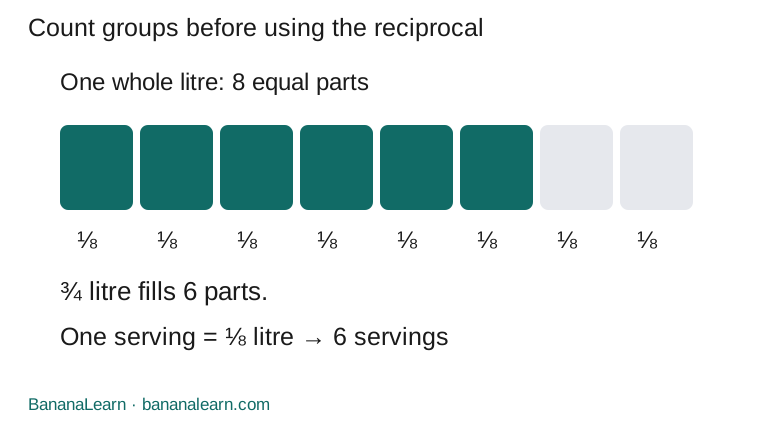
A jug holds ¾ litre. Each serving is ⅛ litre. There are six servings, even though both numbers in the division are smaller than one. The answer counts servings, not litres.
Original BananaLearn guide · 2 November 2026
On a phone, swipe across the illustration to read every label.
Ask what the quotient means
Fraction division can ask how many groups of one size fit into an amount, or what one share is when an amount is divided into a stated number of equal shares. These are connected interpretations, but the units in the answer differ. In ¾ litre ÷ ⅛ litre per serving, the result is a number of servings. In ¾ litre ÷ 3 people, the result is litres per person.
Begin with a sketch and name the whole. A bar that represents one litre has eight equal eighth-litre parts. Three-quarters of that litre fills six parts. Counting groups of one eighth gives six. The picture explains why a division can produce a larger number than either fraction without creating extra liquid.
Use common units before using a shortcut
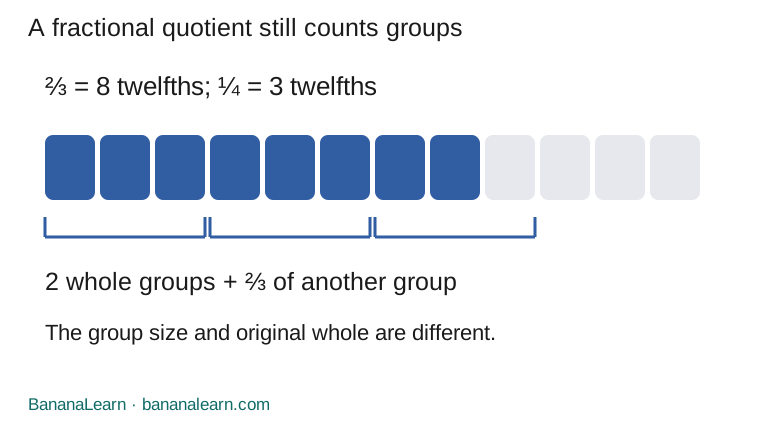
To calculate ⅔ ÷ ¼, express both amounts in twelfths: ⅔=8/12 and ¼=3/12. The question becomes how many groups of three twelfths fit into eight twelfths? Eight divided by three gives 8/3, or 2⅔ groups. Two complete groups use six twelfths; the remaining two twelfths make two-thirds of another group.
The remainder is not 2/12 groups. It is 2/12 of the original whole, which is 2/3 of a group whose size is 3/12. Distinguishing the original whole from the group explains the fractional part of the quotient. If a context permits only complete filled containers, report two full containers and state the remaining amount separately.
Derive multiplication by the reciprocal
For nonzero fractions a/b and c/d, first use the common denominator bd. Their amounts are ad/(bd) and bc/(bd), so their quotient is ad÷bc = ad/(bc). This is the same as (a/b)×(d/c). The denominator b and d are nonzero, and c must also be nonzero because a divisor of zero is not allowed.
Only the divisor is replaced by its reciprocal. For ⅔ ÷ ¼, keep ⅔ and multiply by 4/1 to get 8/3. Reversing both fractions would instead compute 3/2×4 and answer a different question. Verify the quotient by multiplying it by the original divisor: (8/3)×¼=⅔.
On a phone, swipe across the illustration to read every label.
Worked example: a quantity of ribbon
A 2½-metre ribbon is cut into lengths of ⅜ metre. Convert the mixed number first: 2½=5/2. Then (5/2)÷(3/8)=(5/2)×(8/3)=20/3=6⅔ lengths. That is the mathematical quotient, including a fractional length-sized group.
If the question asks how many complete ⅜-metre pieces can be cut, answer six. They use 6×⅜=18/8=2¼ metres. The remaining ribbon is 2½−2¼=¼ metre. Do not round 6⅔ up to seven full pieces; seven would require 2⅝ metres, more ribbon than available.
Worked example: equal sharing
Share ⅚ kilogram of flour equally between five bags. Each bag gets (5/6)÷5=(5/6)×(1/5)=1/6 kilogram. The answer is an amount in each bag. Multiply 1/6 kilogram per bag by five bags to check that the original 5/6 kilogram is recovered.
Compare ⅚ ÷ ⅙=5: that asks how many sixth-kilogram portions fit into ⅚ kilogram. The same numbers can describe different questions depending on the divisor. Write a short unit sentence after the calculation instead of deciding from keywords such as share or each alone.
Predict the size of a positive quotient
For a positive starting amount, dividing by a positive number smaller than one gives a quotient larger than the starting number. Dividing by a number greater than one gives a smaller quotient. Dividing by one leaves it unchanged. These comparisons concern positive values; do not apply them without checking signs in a later signed-number problem.
For example, ⅘÷2=⅖, but ⅘÷⅖=2. Before calculating ⅘÷⅕, predict an answer larger than ⅘. This estimate will not supply the exact quotient, but it can catch a reversed reciprocal. Division by zero remains undefined, including when the numerator is zero.
Simplify without losing the operation
For 9/10 ÷ 3/5, rewrite as 9/10×5/3. Then simplify factors across the multiplication: 9÷3=3 and 5÷10=1/2, giving 3/2. Cancelling is justified by common nonzero factors in a product; it is not permission to cross out arbitrary digits in the original division.
A mixed number such as 1⅔ must become 5/3 before multiplication. Writing 1⅔ as 13/3 concatenates digits and changes the value. Keep a line of working between the original division and the simplified product so a reader can see which number was inverted.
A short routine for learners and parents
First name the whole and the unit of the answer. Draw the amount and one group, or describe one equal share. Predict the size, calculate using the reciprocal, and multiply back. Finally answer the actual question: exact quotient, whole groups or a remaining amount.
When a child gets the numerical quotient right but gives the wrong unit, return to the drawing rather than assigning more identical calculations. Use the record below with a fresh example. This lesson extends unit-fraction division to a fraction divisor; check the sequence in the child’s current textbook rather than assuming all boards introduce it in the same class.
A division record that keeps the units visible
Copy this record into a notebook. Fill each blank using your own example or the activity above.
On a phone, swipe across a wide table to see every column.
| Step | Your working |
|---|---|
| Original amount and whole | ___ |
| Group size or number of shares | ___ |
| Predicted answer unit | ___ |
| Exact quotient and multiplication check | ___ |
| Whole pieces / remainder if required | ___ |
12 questions with explained answers
Try each question first. Open the explanation to check your reasoning. These are original BananaLearn questions, not official exam questions.
Calculate ¾ ÷ ⅛.
Check answer and reasoning
6
Three-quarters is six eighths, so six groups of one eighth fit.Calculate ⅔ ÷ ¼.
Check answer and reasoning
8/3 = 2⅔
Use 8 twelfths divided by groups of 3 twelfths, or multiply ⅔ by 4.Calculate ⅘ ÷ 2.
Check answer and reasoning
⅖
Share four fifths equally between two groups.Calculate ⅘ ÷ ⅖.
Check answer and reasoning
2
Two groups of two fifths make four fifths.Calculate 9/10 ÷ 3/5.
Check answer and reasoning
3/2
Multiply 9/10 by 5/3 and simplify.Calculate 1⅔ ÷ ⅚.
Check answer and reasoning
2
Convert to 5/3, then multiply by 6/5.How many full ⅜-metre pieces fit in 2½ metres?
Check answer and reasoning
6 full pieces; ¼ metre remains.
The exact quotient is 6⅔, but the context requires complete pieces.Share ⅚ kg into five equal bags.
Check answer and reasoning
⅙ kg per bag.
(5/6)÷5=1/6; five such amounts make 5/6.A pupil inverts both fractions in ⅔ ÷ ¼. Repair the method.
Check answer and reasoning
Keep ⅔; multiply by 4/1.
Only the divisor is replaced by its reciprocal.Before calculating ⅗ ÷ ⅒, should the quotient exceed ⅗?
Check answer and reasoning
Yes; it equals 6.
The positive divisor is smaller than one; tenths fit six times into six tenths.Is ½ ÷ 0 defined?
Check answer and reasoning
No.
No number multiplied by zero recovers one half.Check the proposed quotient: ⅗ ÷ 9/10 = ⅔.
Check answer and reasoning
It is correct.
(2/3)×(9/10)=18/30=3/5.
Choose your next learning step
- Revisit division involving a unit fraction
- Check division using fraction multiplication
- Support a child using fraction models
- Check CBSE Class 7 teaching fit
Explore BananaLearn games, learning resources and tutoring. Maths is our priority; English and Science tutoring are also available. Share your current schoolwork when checking teaching fit.
Sources and scope
Explanations, activities, diagrams and practice are original BananaLearn work. Class labels suggest a learning level; school sequences and current textbook editions can differ. Sources checked 2 November 2026.
How we prepare guides · Report a correction
Share the complete guide: https://bananalearn.com/learn/class-7-dividing-fractions-word-problems.html