English · Suggested Grade 5
Homophones in Context: Class 5 Meaning & Editing Practice
Spell-check may accept every word in “Your going to put they’re books over their.” Meaning—not the sound—reveals the three errors.
Original explanations and practice by BananaLearn · Published 1 November 2026
On a small screen, swipe across the illustration to read every label.
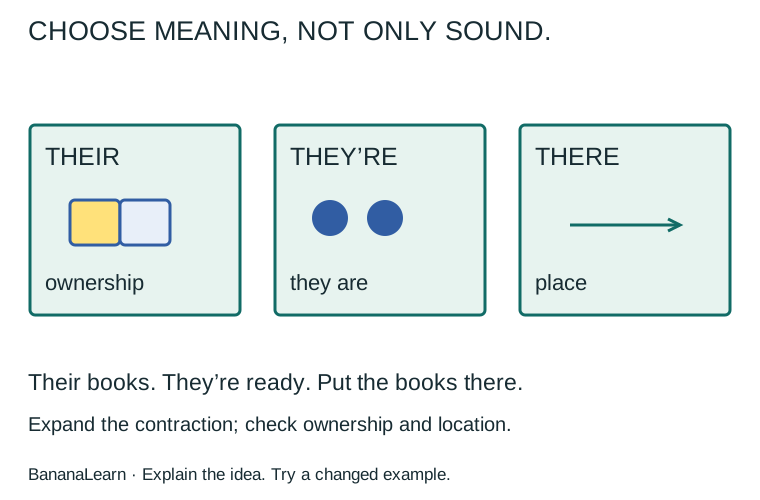
Sound alone cannot choose the spelling
Homophones sound the same in a given accent but have different meanings or spellings. Some pairs vary with accent, so this guide focuses on common school-writing confusions. Read the whole sentence and work out the word’s job before choosing it.
In the opening sentence, the intended message is You’re going to put their books over there. You’re means you are, their shows ownership, and there indicates a place. A correctly spelled word can still be the wrong word for its context.
There, their and they’re
There can point to a place: Leave the bag there. It also appears in expressions such as There is a spare bag. Their shows a connection or ownership: their bag. They’re is the contraction of they are: They’re carrying the bag.
Use expansion as a test, not a magic spelling trick. If they are fits the intended sentence, they’re may be correct. Their are carrying the bag fails because their cannot replace the subject-and-verb expression. For a place, ask where rather than whose.
Your and you’re; its and it’s
Your describes something connected to the person addressed: your pencil. You’re means you are: You’re ready. Its is possessive: The bird lifted its wing. It’s means it is or it has: It’s raining; It’s been a long day.
Apostrophes do not always mean ownership. These possessive forms, your and its, do not use one. Expand it’s before editing. The sentence The robot lost it’s wheel becomes The robot lost it is wheel, which does not convey the intended ownership.
To, too and two
Two is the number 2. Too can mean also or more than suitable: I want to come too; the box is too heavy. To has other grammatical jobs, including direction and the infinitive: walk to the gate; try to explain.
Worked case: We need two volunteers to carry the box because it is too heavy for one. Each spelling fits a different meaning. Avoid a rule such as every word before a verb must be to; the surrounding sentence still matters.
Hear and here; one and won
Here indicates this place, while hear relates to hearing sound: Can you hear the bell from here? One is a number and won is the past tense of win: One group won the challenge. Meaning can be checked by replacing a word with a short definition.
If a learner writes We one the quiz, ask whether the message concerns the number 1 or a past result. We won the quiz fits the result. Do not claim a sound-alike pair has identical pronunciation for every speaker; vocabulary teaching should respect accent differences.
Edit an original paragraph in two passes
Draft: Their are two teams here. Your on the blue team. Put you’re cards over their. First read for meaning: two teams exist; the reader belongs to blue; cards have an owner and a destination. A clear edit is There are two teams here. You’re on the blue team. Put your cards over there.
In a second pass, expand each contraction and check each possessive. This separates noticing the meaning from remembering the spelling. Multiple corrections can be needed in one sentence, so finding the first error is not proof the rest are correct.
Make a useful personal word record
Record the mistaken word, intended meaning, corrected sentence and a new example. Group words by meaning rather than recopying a list without context. Use a small number of pairs until the learner can explain the choice independently.
For a home check, ask the child to create one sentence containing two and too, then explain both. Keep the focus on communicating clearly. A single homophone slip does not establish a reading problem or show that a student does not know the underlying idea.
Meaning-first spelling record
Copy the record into a notebook or use it to organise your own answer. Blank spaces are for your work.
| Confused set | Intended meaning | Corrected sentence | New example |
|---|---|---|---|
| there / their / they’re | ___ | ___ | ___ |
| your / you’re | ___ | ___ | ___ |
| its / it’s | ___ | ___ | ___ |
| to / too / two | ___ | ___ | ___ |
12 questions with explained answers
Try the questions before opening the answers. Explain the reason, then try a changed example to check your understanding.
Choose: ___ going to read now. (you are)
Show answer and explanation
You’re
Expand it to you are.Choose: Bring ___ notebook.
Show answer and explanation
your
The notebook belongs to the person addressed.Choose: ___ books are on the shelf. (belonging to them)
Show answer and explanation
Their
Their shows ownership.Choose: Put it over ___. (place)
Show answer and explanation
there
There names the place.Choose: ___ waiting outside. (they are)
Show answer and explanation
They’re
They are can be expanded here.Choose: The dog wagged ___ tail.
Show answer and explanation
its
Possessive its has no apostrophe.Choose: ___ been a busy week.
Show answer and explanation
It’s
Here it contracts it has.Choose: The bag is ___ heavy.
Show answer and explanation
too
Too means excessively in this context.Choose: We need ___ pencils. (2)
Show answer and explanation
two
The meaning is a number.Choose: Can you ___ the music from here?
Show answer and explanation
hear
The meaning concerns sound.Choose: Our team ___ the match.
Show answer and explanation
won
This is the past tense of win.Correct: Your putting they’re coats over their.
Show answer and explanation
You’re putting their coats over there.
The meanings are you are, ownership and place.
Keep the ideas connected
For help with a school-learning difficulty, bring one attempted question to a discussion about tutoring and curriculum fit. Maths is our priority; English and Science tutoring are also available.
Sources, scope and sharing
The examples, diagrams and practice are original BananaLearn work. Grade labels suggest a learning level; teaching sequences and school requirements can differ. Official sources below support the stated facts and resource links. These activities are independent resources, not official exam questions or endorsed campaign materials.
How we prepare learning guides · Report a correction
Share this guide: https://bananalearn.com/learn/class-5-homophones-in-context.html