English · Suggested Grade 4
Class 4 Prefixes and Suffixes: Build Words & Explain Meaning
Helpful and helpless share the word help, but describe very different situations. Break the word into meaningful parts before guessing from its length.
Original explanations and practice by BananaLearn · Published 31 October 2026
On a small screen, swipe across the illustration to read every label.
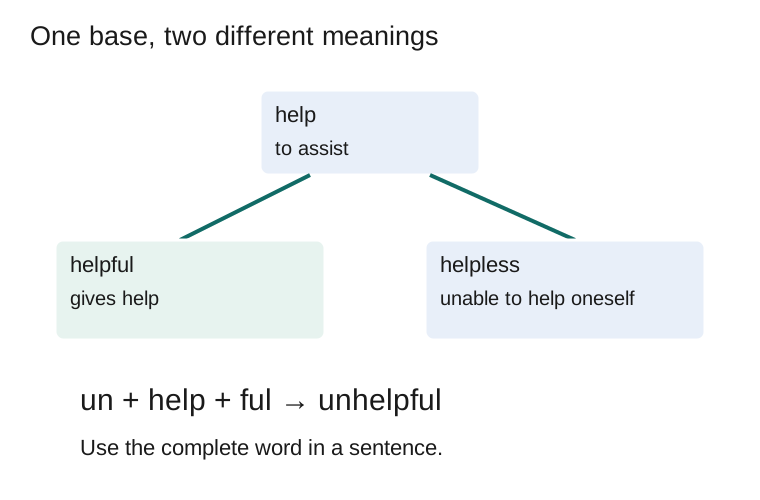
Base word, prefix and suffix
A base word can often stand on its own, such as help, play or kind. A prefix is added before a base, as in replay. A suffix is added after it, as in playful. These parts can help you work out meaning, but the complete word must still make sense in its sentence.
Start with familiar bases you can read and explain. Say play, replay and playful aloud, then use each in a sentence. A long word is not automatically made from any short word you can spot inside it. The letters un in uncle are not a prefix that means not.
Prefixes change a word’s meaning
Un- often means not, as in unfair. Re- often means again, as in reread. Pre- can mean before, as in preview. Mis- can mean wrongly, as in misread. Notice that misread and reread describe different things: one concerns an error and the other concerns repetition.
Do not attach every prefix to every base. Unhappy is established English, but unblue is not an ordinary replacement for not blue in everyday school writing. Word-building is a way to investigate real words, not a rule that every combination must exist. Check a dictionary or a teacher when the result sounds unfamiliar.
Suffixes add meaning and can change a word’s job
The suffix -ful can mean full of or having a quality: care becomes careful. The suffix -less can mean without: care becomes careless. The spelling -ful has one l even though the separate word full has two. The suffix -ness can turn some adjectives into nouns: kind becomes kindness.
The suffix -er can name a person who does something, as in teacher, but not every final er has that meaning. Bigger uses a different -er to compare size. Look at how the whole word functions: a teacher is a person; a bigger bag describes a comparison.
Worked example: unpack unhelpful
Start with help, meaning to assist. Add -ful to make helpful, describing something or someone that gives help. Add un- to make unhelpful, describing the opposite in this context. The word can be shown as un + help + ful. The prefix and suffix do not replace the base; they change how it is used.
Compare The map was helpful with The map was unhelpful because it had no street names. The second sentence gives a reason, so the reader knows what unhelpful means in that situation. A person can make an unhelpful comment without being permanently labelled an unhelpful person.
Worked example: use the sentence to choose the ending
In Please be ___ when carrying the glass, careful fits the instruction. Careless would give the opposite message. In Her ___ made the new pupil feel welcome, kindness fits because the sentence needs a noun naming a quality. Kind alone does not fit that position.
Meaning and grammar work together. If you write The teacher was kindness, the idea may be understandable but the word form does not fit: use kind. If you write I will replay the paragraph to read it again, reread is normally the more suitable choice for printed text. Choose the whole word that matches the action.
Spelling can change at the join
Many combinations simply join, such as re + play = replay and kind + ness = kindness. Others change the base spelling. Happy becomes happiness: the final y changes to i before -ness. Hope becomes hoping: the silent e is dropped before -ing. These are patterns to learn with examples, not instructions to alter every ending.
For a short one-syllable word ending consonant–vowel–consonant, the last consonant is often doubled before -ing, as in run → running. Playing does not double y, and helping does not double p. Begin with the common words in the practice set before extending to longer words with stress-dependent spelling patterns.
Build a word family you can actually use
Make a small word family around care: care, careful, careless and carefully. Write a sentence for each. Carefully describes how an action is done: She carried the tray carefully. Careful describes a person or thing: She was careful with the tray.
A useful record has base, added part, meaning, spelling change and sentence. A parent can ask how the new word changes the meaning of the sentence. If a learner can name the prefix but cannot use the word, return to a concrete example. Finish by editing one of your own paragraphs rather than collecting long lists of disconnected words.
Copy this word-family notebook
Copy the record into a notebook or use it to organise your own answer. Blank spaces are for your work.
| Base | Added part | New word | Meaning in a sentence | Spelling change |
|---|---|---|---|---|
| help | un- and -ful | unhelpful | ___ | None |
| happy | -ness | ___ | ___ | ___ |
| Your base | ___ | ___ | ___ | ___ |
10 questions with explained answers
Try the questions before opening the answers. Explain the reason, then try a changed example to check your understanding.
Add a prefix meaning again to read.
Show answer and explanation
reread
Re- marks doing the reading again.Make the opposite of fair with a common prefix.
Show answer and explanation
unfair
Un- means not in this word.Which means read wrongly: reread or misread?
Show answer and explanation
misread
Mis- signals an error; re- signals repetition.Complete: Please be care___ with the vase.
Show answer and explanation
careful
The instruction asks for care, not its absence.How many l letters are in the suffix -ful?
Show answer and explanation
One
Careful ends -ful, not -full.Turn happy into a noun with -ness.
Show answer and explanation
happiness
The final y changes to i.Add -ing to hope.
Show answer and explanation
hoping
Drop the silent e before -ing.Add -ing to run.
Show answer and explanation
running
The final n doubles in this short consonant–vowel–consonant word.Does uncle contain un- meaning not?
Show answer and explanation
No
A matching letter sequence alone does not establish a meaningful prefix.Correct: Her kind made me feel welcome.
Show answer and explanation
Her kindness made me feel welcome.
This position needs the noun naming the quality.
Keep the ideas connected
For help with a school-learning difficulty, bring one attempted question to a discussion about tutoring and curriculum fit. Maths is our priority; English and Science tutoring are also available.
Sources, scope and sharing
The examples, diagrams and practice are original BananaLearn work. Grade labels suggest a learning level; teaching sequences and school requirements can differ. Official sources below support the stated facts and resource links. These activities are independent resources, not official exam questions or endorsed campaign materials.
How we prepare learning guides · Report a correction
Share this guide: https://bananalearn.com/learn/class-4-prefixes-suffixes-word-building.html