
Start with the key idea
Living organisms carry out life processes such as using energy, growing and responding to their surroundings. A single clue such as movement is not enough. Non-living objects do not carry out the full set of life processes; some were once part of living organisms.
1. Look for a pattern of life processes
A puppy grows, needs food and water, responds to sounds and eventually develops into an adult dog. These observations fit together as evidence that the puppy is alive. Do not choose only one familiar action and treat it as a complete test.
Living things use energy, exchange materials with their surroundings and respond in ways that help them function. Plants and animals do this differently. A plant does not eat a sandwich or walk to a water bowl, yet it is living.
For Grade 3, begin with a healthy plant and a familiar animal. Compare how each grows and obtains what it needs. Use observations over time instead of expecting every life process to be visible in one photograph.
2. Movement is a clue with important limits
A toy car may move when pushed or powered by a battery. A cloud moves in the wind, and water flows downhill. These movements do not make the toy, cloud or water living organisms. Ask what causes the movement and what other evidence is present.

A rooted plant stays in the same place but can grow towards light over time. A sleeping animal may appear still. Movement from one place to another is therefore neither a necessary everyday observation nor a sufficient proof of life.
In a sorting activity, give a reason stronger than “it moves”. “The plant grows, uses water and makes new parts” refers to several connected observations. Do not pull up a plant or disturb an animal to test it.
3. Understand a seed that looks inactive
A viable seed, meaning one able to grow, contains a living embryo (a tiny young plant). Under suitable conditions it can germinate and develop into a plant. Dry seeds may remain dormant, meaning resting with very little visible activity, so they need not show obvious movement or rapid growth when you first look at them.
Not every seed will germinate: it may be damaged, too old or in unsuitable conditions. One unsuccessful classroom attempt does not prove that every seed is non-living. Observe several seeds and discuss water, air and a suitable temperature.
An adult can help place a few suitable seeds on damp paper in a ventilated container. Keep the paper damp rather than waterlogged and wash hands afterwards. Record visible changes; do not eat the experimental seeds or grow unknown plants.
4. Separate living now from once living
A wooden chair is not alive, although its wood came from a tree. A paper sheet is not a living organism either. Material can come from something living without continuing all the processes of life in the finished object.
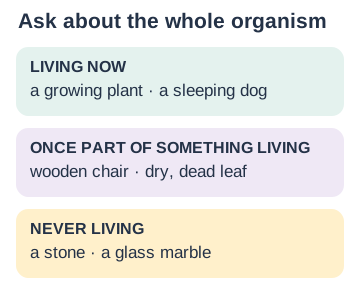
A fallen leaf may be recently detached and contain living cells for a time, but it is no longer a whole growing plant. For a simple sorting task, state the condition: a dry, dead leaf is once living. Ambiguous examples deserve discussion rather than an unexplained mark.
Use three groups when useful: living organisms, once-living material and things that were never living. This helps explain why a stone and a wooden chair are both non-living now but have different origins.
5. Be careful with growth and reproduction
A crystal can become larger as more material joins it. A balloon gets bigger when air enters. Those changes alone do not show the coordinated life processes of an organism. Living growth involves the organism making and organising its own material using energy and resources.
Living species reproduce, but every individual does not have to produce young to be alive. A child is living even though the child is not reproducing. Some animals cannot reproduce and are still living organisms.
Similarly, needing water is not a complete test: a washing machine uses water, but it is non-living. Link the clues together and consider what kind of object you are observing.
6. Make an observation table without guessing
Draw four columns: object, what I observed, what I infer, and what I still need to know. For a potted plant, you might observe a new leaf after a week and infer growth. For a parked car, seeing it move later is evidence of movement but not of life.
Use photographs or safe everyday objects. Do not touch unfamiliar animals, fungi or discarded biological material. You can compare a picture of a tree with a picture of a wooden desk and explain the relationship without collecting samples.
Finish with a new example and ask for two reasons. Accept “I need more information” when the object or its condition is unclear. Science classification improves when learners distinguish evidence from a quick guess.
5 worked examples with reasoning
1. A battery toy walks across the floor. Is it living?
- Movement is visible, but a battery and mechanism cause it.
- It does not carry out the coordinated life processes of an organism.
- Classify the toy as non-living.
2. A plant does not walk. Is it non-living?
- Walking is only one kind of movement.
- The plant grows, uses resources and responds over time.
- It is living.
3. Is a wooden pencil living?
- The wood came from a tree.
- The manufactured pencil does not function as a living organism.
- It is non-living now and contains material from a once-living source.
4. A seed failed to sprout. What can you conclude?
- Record the failed germination in those conditions.
- The seed may no longer be able to grow, or the conditions may be unsuitable.
- Do not conclude that all seeds are non-living.
5. Does a child need to reproduce to count as living?
- No. Reproduction is considered across the life cycle and species.
- Individuals can be alive without producing offspring.
- Use the wider pattern of life processes.
Save the guide or print the practice
Download to save or share
Complete guide with answers (PDF) · Worksheet without answers (PDF) · Worksheet and answer key (PDF)
Try each task before opening its answer. Give an example or reason, not only a label.
14 practice questions with explanations
Try each task before opening its answer. Give an example or reason, not only a label.
Write an answer and your reason before opening the explanation. Check the reasoning as well as the final answer.
- Sort
Classify a healthy growing tree.
Answer and reasoning
Living.
It carries out connected life processes.
- Sort
Classify a glass marble.
Answer and reasoning
Non-living; never a living organism.
It does not carry out life processes.
- Origin
Classify a wooden chair now.
Answer and reasoning
Non-living.
Its wood came from a tree, but the chair is not an organism.
- Movement
Does a river flowing prove that water is alive?
Answer and reasoning
No.
Physical movement alone is not sufficient evidence.
- Stillness
Is a sleeping cat non-living because it is still?
Answer and reasoning
No.
It continues life processes while resting.
- Seed
Why can a dry seed that is still able to grow be living?
Answer and reasoning
It contains a living embryo that can develop in suitable conditions.
A resting seed can show very little visible activity.
- Growth
Does an inflating balloon become alive?
Answer and reasoning
No.
Adding air makes it larger without life processes.
- Water
A machine uses water. Is that enough to classify it as living?
Answer and reasoning
No.
A single shared feature is insufficient.
- Reproduction
Is a living animal that cannot reproduce still alive?
Answer and reasoning
Yes.
Individual reproduction is not required to be alive.
- Observe
Give one safe observation of plant growth.
Answer and reasoning
For example: Record a new leaf appearing over several days.
Observe without damaging the plant.
- Evidence
What causes a pushed toy car to move?
Answer and reasoning
An external push.
The movement is not evidence of a living organism.
- Uncertainty
Why should a sorting task say dry, dead leaf rather than just leaf?
Answer and reasoning
The condition matters.
A growing leaf and dead material are different cases.
- Compare
Give a difference between a stone and a wooden desk.
Answer and reasoning
The desk contains material from a tree; the stone was never a living organism.
Both are non-living now.
- Explain
Why should you use more than one sign of life?
Answer and reasoning
Non-living objects can share individual features such as movement or getting bigger.
A connected pattern gives stronger evidence.
Use the ideas without looking at the notes
Choose three safe examples: a plant, a toy and an object made from wood. Write what you actually observe, then explain the classification using more than one clue.
Common questions
Are plants living if they cannot walk?
Yes. They grow, use resources and respond to conditions.
Are all seeds alive?
A viable seed is living; some seeds are dead or damaged. The condition matters.
Is wood alive?
A wooden object is non-living now even though its material came from a tree.
Does every living individual reproduce?
No. Individuals can be alive without reproducing.
Is movement enough to prove life?
No. Toys, water and clouds also move.
Connect your learning
Ask about guided Science learning if your child needs help explaining these ideas.
About this guide
Original explanations, examples, diagrams and practice by BananaLearn. The grade label indicates the intended learning level; this is not an official textbook extract or exam paper.