
Start with the key idea
Write a Teachers’ Day speech around one honest example of teaching and what it helped you do. In India, Teachers’ Day is observed on 5 September. Confirm the school’s celebration date and speaking instructions separately.
1. Know the occasion and the audience
In India, Teachers’ Day is observed on 5 September, the birthday of Dr Sarvepalli Radhakrishnan. A school may hold its celebration on a different working day. Confirm the actual programme rather than assuming a 2027 assembly time from the calendar date.
This guide offers original student speeches and an editing method. It is not a prediction of an official 2027 theme or award announcement. Use current school instructions for the greeting, length, language and any required references.
Choose the audience carefully. A whole-school assembly needs a message that recognises many teachers. A small class event can include a more specific example, provided it is respectful and does not reveal private information.
2. Turn praise into a teaching example
Begin with an action you have actually noticed: a teacher checking everyone’s understanding, explaining an error without ridicule, or helping a quiet learner contribute. Then explain why it matters. This gives the audience a scene rather than a string of adjectives.

Avoid claiming that a teacher is perfect or that every student has had exactly the same experience. You can express gratitude honestly without making universal claims. “Thank you for showing us another way when the first explanation was unclear” is specific and credible.
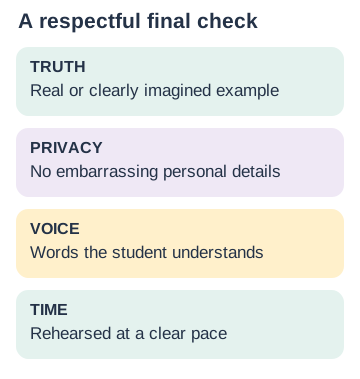
Do not invent a personal story for emotional effect. If you use an imagined classroom moment, introduce it as an example. Keep classmates’ names and private difficulties out unless sharing them is appropriate and permitted.
3. Original assembly speech
Good morning, respected teachers and friends. On Teachers’ Day, we often say thank you. Today I would like to make that thank-you more specific. Thank you for the moments when a difficult idea becomes a little clearer.
Sometimes that happens through a diagram. Sometimes it happens because you ask one question and wait for us to think. Sometimes it happens when you notice an error and help us understand the step behind it, instead of letting us believe that a wrong answer means we cannot learn.
Teaching also helps us learn how to work with others. We practise listening, asking for help, explaining our reasons and trying again after feedback. These habits matter beyond a single test.
Our gratitude can be part of an ordinary lesson too. We can arrive prepared, listen when someone is speaking, ask honest questions and use the feedback we receive. We will not always get everything right, but we can take responsibility for our part in learning.
To all the teachers who guide, challenge and encourage us, thank you for your work and patience. We wish you a happy Teachers’ Day.
This is a model for adaptation. Replace a general example with a truthful detail if it helps, and time the speech at the speaker’s natural clear pace.
4. A shorter version for a class event
Good morning, everyone. Happy Teachers’ Day. Thank you to our teachers for helping us understand ideas, not only finish tasks. A useful explanation, a carefully chosen question or a chance to correct a mistake can change how we approach our work.
We can show our thanks by taking learning seriously: bringing what we need, listening to feedback and asking when we do not understand. Today we celebrate your effort. In our next lesson, we can show that appreciation through our own effort. Thank you.
The shorter model keeps one message: connect gratitude with a specific learning action. If the teacher gives a strict time limit, rehearse and trim the wording. Do not rush through the longer version simply because it contains more compliments.
5. Make the delivery sound like the student
Read the draft aloud. Replace a word the speaker cannot comfortably explain with a familiar word. Mark a pause after the greeting and before the final thank-you. A warm, clear voice is usually more effective than a forced dramatic performance.
Practise the first and last sentences until their meaning feels familiar. Use a cue card with the sequence: occasion, teaching example, why it matters, our response, thanks. If a line is forgotten, continue with the next idea rather than inventing a new claim.
Ask a listener whether the speech sounds sincere and whether the example is clear. Accept feedback about a confusing sentence. The goal is not to imitate an adult’s vocabulary; it is to express a thoughtful message the student understands.
6. Check the final version for respect and accuracy
Check names and titles with the school. Avoid jokes about appearance, age, salary, private life or a learner’s difficulty. Humour should not require embarrassing someone. A speech can be light and warm through a familiar classroom detail.
Keep historical context brief and verified. The date and Radhakrishnan reference are enough for these models; a long biography is a different task. Do not add an unverified quotation simply because it is often shared online.
Before printing, confirm the school event date, final duration and whether the child needs a microphone rehearsal. A parent can help with these practical checks while preserving the student’s own message.
5 worked examples with reasoning
1. Improve “You are the best teacher in the universe.”
- Replace the unprovable comparison with a specific action.
- For example: Your diagram helped me understand the step I had missed.
- Explain the learning rather than ranking people.
2. A child uses a word they cannot explain.
- Ask what they want the sentence to mean.
- Choose a familiar expression for that meaning.
- Read the revised sentence aloud.
3. A joke names a classmate who struggles with reading.
- Remove the identifying detail and the joke.
- Use a respectful general example of asking for help.
- Gratitude does not need someone else’s embarrassment.
4. The school celebrates on a day other than 5 September.
- Keep the factual observance date separate from the event date.
- Use the school’s confirmed programme in the greeting if needed.
- Do not label the school date as the national observance.
5. The speech is too long.
- Keep the central thank-you and one teaching example.
- Remove repeated adjectives and unrelated biography.
- Time the clearer version again.
Save the guide or print the practice
Download to save or share
Complete guide with answers (PDF) · Worksheet without answers (PDF) · Worksheet and answer key (PDF)
Draft or revise each speech extract before reading the suggested response. Check accuracy, clarity, audience and delivery; several original answers may work.
14 practice questions with explanations
Draft or revise each speech extract before reading the suggested response. Check accuracy, clarity, audience and delivery; several original answers may work.
Write an answer and your reason before opening the explanation. Check the reasoning as well as the final answer.
- Date
When is Teachers’ Day observed in India?
Answer and reasoning
5 September.
The school may schedule its event separately.
- Context
Whose birthday is associated with the Indian observance?
Answer and reasoning
Dr Sarvepalli Radhakrishnan.
Keep the historical reference accurate.
- Specific
Replace “You are wonderful” with a teaching action.
Answer and reasoning
For example: You explained the diagram again when we were unsure.
A concrete action gives meaning to the thanks.
- Truth
Should a student invent a personal memory?
Answer and reasoning
No.
Use a real example or label an imagined one.
- Privacy
Should a speech reveal a classmate’s learning difficulty?
Answer and reasoning
No.
Choose an example that respects privacy.
- Audience
How may a school assembly differ from a class speech?
Answer and reasoning
It should recognise a wider teaching community.
Avoid assuming one class experience represents everyone.
- Voice
What should happen to a word the speaker does not understand?
Answer and reasoning
Replace it with familiar wording that preserves the meaning.
The child should understand the speech.
- Time
How should duration be checked?
Answer and reasoning
Read aloud at a clear pace and time it.
Length on the page is not exact speaking time.
- Cue
List three useful cue-card prompts.
Answer and reasoning
Teaching example, why it mattered, thank-you.
Other connected prompts are acceptable.
- Humour
What kind of joke should be removed?
Answer and reasoning
One that embarrasses a teacher or child through a personal detail.
Warmth should not depend on ridicule.
- Evidence
Must a famous quotation be included?
Answer and reasoning
No.
Original wording can communicate gratitude well.
- Action
Name a classroom action that can express appreciation.
Answer and reasoning
For example: listen to feedback and use it in the next attempt.
The action connects thanks with learning.
- Edit
What should be cut before speaking faster?
Answer and reasoning
Repetition and irrelevant material.
Clarity should remain.
- Final check
What practical details should be confirmed?
Answer and reasoning
School event date, names, time limit and delivery arrangements.
These are event-specific and should not be guessed.
Use the ideas without looking at the notes
Speech rehearsal checklist: Check the occasion and every factual claim. Keep one main message, one specific example and a connected ending. Replace invented personal claims with truthful or clearly imagined examples. Read aloud, time the whole speech, mark pauses and practise looking up at the audience. Confirm the school’s instructions before the event.
Common questions
Is this an official 2027 speech?
No. These are original models to adapt to school instructions.
Can the school celebrate on another date?
Yes. Confirm the school programme while keeping the national observance date accurate.
Should the speech sound very formal?
Use respectful language the student understands and can say naturally.
Can I shorten the model?
Yes. Keep one specific example and a connected closing.
Connect your learning
Ask about English learning support if your child needs help explaining these ideas.
About this guide
Original explanations, examples, diagrams and practice by BananaLearn. The grade label indicates the intended learning level; this is not an official textbook extract or exam paper.