
Start with the key idea
A diary entry records an experience from the writer’s personal viewpoint, including thoughts, feelings and reflection. Select meaningful details rather than listing every event, and keep the voice honest and coherent.
1. Choose a moment worth thinking about
A diary can record ordinary life, a surprising event, a difficult choice or a small success. The event does not need to be dramatic. What matters is the writer’s personal response: why did this moment stay in your mind? A quiet conversation can produce a richer entry than an invented adventure.
For a school task, read the prompt carefully. It may ask you to imagine a character’s experience or write from your own viewpoint. Keep the chosen perspective consistent and avoid adding facts that contradict the situation.
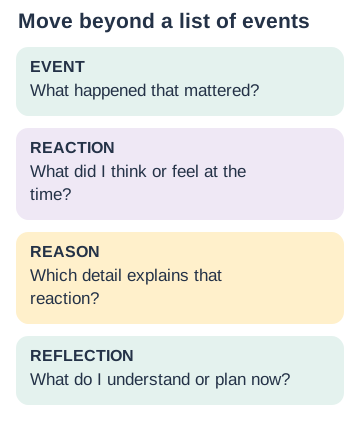
Select a central moment and a small number of supporting details. A complete list from waking up to bedtime often leaves little space for reflection. The reader should understand the event, but the entry’s value comes from what the experience meant to the writer.
2. Use first person and a clear time frame
A date is a useful diary feature; a time may be added if the task asks for it. Some classroom formats use “Dear Diary”, while others do not require it. Follow the stated convention without allowing the format to dominate the content.
First-person words such as I, me and my show the personal viewpoint. Past tense usually describes the event, while present tense can express a current feeling: “I forgot my opening line this morning. I still feel embarrassed, but I am glad I continued.” A future plan can appear near the end.
These tense changes are natural when their time references are clear. Random shifts without a reason can confuse the reader. Keep names and references understandable, even in a personal piece, and avoid unexplained jumps between unrelated events.
3. Read the original fictional diary entry
18 August 2027
8:30 p.m.
Dear Diary,
I thought the worst part of today’s presentation would be standing at the front. It was actually the silence after I forgot my second line. For a moment, I could hear the ceiling fan more clearly than my own thoughts. I stared at the picture of our water filter and wished someone else would speak.
Then I remembered the small heading on my cue card: explain the first layer. I took a breath and described the gravel in my own words. The sentence was not the one I had practised, but it made sense. When I looked up, my classmates were still listening.
I am relieved that I finished, but I am more surprised by what helped. Memorising every word had made one forgotten line feel like a wall. The headings gave me a way around it. Next time I will practise explaining the ideas in different words, not only repeating a script.
I still wish I had started smoothly. Even so, one pause did not ruin the whole presentation. That is something I want to remember.
This is an invented model, not a report of a real student. Its reflection is personal and limited to the experience rather than a claim that one method suits everyone.
4. Show feelings through relevant detail
The model does not rely only on labels such as nervous and relieved. Hearing the fan, staring at the picture and wishing someone else would speak show the tense moment. The details are selected because they explain the feeling; they are not a requirement to describe every sense in every entry.
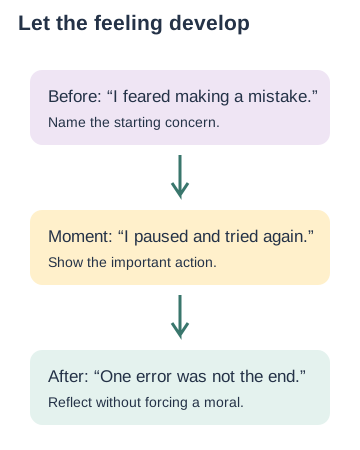
Connect a feeling to its cause. “I felt disappointed because I had practised the opening carefully” is more specific than “I was very sad”. A character can have mixed feelings: embarrassment about the pause and pride in continuing can both be true.
Avoid extreme claims that do not fit the event. “My life was destroyed” is usually too much for a forgotten presentation line. Honest, proportionate language often feels more convincing than exaggerated emotion.
5. Let the ending develop from the event
Reflection asks what the writer understands now. The model notices that cue-card headings helped recover the explanation. Its future plan follows directly: practise explaining ideas in different words. A generic ending such as “I learned a very important lesson” does not tell the reader what changed.
Not every diary entry needs a cheerful resolution or a moral. Sometimes the writer remains uncertain, asks a question or decides to speak to someone. A thoughtful unfinished feeling can be more honest than a sudden perfect solution.
Keep reflection separate from unsupported certainty about other people. “I worried that they were laughing at me” reports the writer’s worry. “Everyone hated my presentation” claims knowledge the writer may not have. Personal voice does not remove the need for careful distinctions.
6. Revise while protecting personal boundaries
Read the entry for a clear connection between event, reaction and reflection. Remove routine details that do not support the central moment. Check that the voice sounds like a person thinking, rather than a formal report addressed to an official.
For school practice, you can use an imagined event when allowed. You do not need to disclose a private or distressing experience to write well. Avoid including another person’s sensitive information in a piece that may be read aloud or shared.
Finally check the requested length, date format, paragraphing and tense. Keep the concrete detail that makes the entry memorable, but cut repeated statements of the same feeling. A good diary entry gives enough context to understand the experience and enough reflection to see why it mattered.
5 worked examples with reasoning
1. Improve: Today was bad.
- Choose the specific moment.
- Connect it to a feeling.
- For example: I forgot my second line and froze while the classroom stayed quiet.
2. What does the ceiling-fan detail do in the model?
- It shows the writer’s heightened awareness during silence.
- It supports the nervous moment.
- It is relevant sensory detail, not decoration.
3. Repair: Everyone thought I was terrible.
- The writer cannot know everyone’s thoughts from the given evidence.
- State the feeling as a worry.
- I worried that my classmates would think I was unprepared.
4. Write a reflection linked to the cue card.
- Identify what helped: the heading.
- Explain the change in understanding.
- I realised that knowing the ideas helped me continue when the exact words disappeared.
5. Can the ending still contain embarrassment?
- Yes. Mixed feelings are realistic.
- The writer can be relieved and still wish the start had gone better.
- An honest ending need not be perfectly cheerful.
Save the guide or print the practice
Download to save or share
Complete guide with answers (PDF) · Worksheet without answers (PDF) · Worksheet and answer key (PDF)
Try each task before opening its answer. Give an example or reason, not only a label.
14 practice questions with explanations
Try each task before opening its answer. Give an example or reason, not only a label.
Write an answer and your reason before opening the explanation. Check the reasoning as well as the final answer.
- Voice
Which viewpoint is usual in a diary entry?
Answer and reasoning
First person.
It records the writer’s experience.
- Format
Is Dear Diary compulsory in every task?
Answer and reasoning
No.
Follow the specified convention.
- Focus
Why avoid listing every routine event?
Answer and reasoning
It leaves little space for the meaningful moment and reflection.
Selection gives the entry focus.
- Model
What did the writer forget?
Answer and reasoning
The second line of the presentation.
That triggered the tense moment.
- Model
What helped the writer continue?
Answer and reasoning
A cue-card heading about the first layer.
It prompted an explanation in new words.
- Detail
Why mention hearing the fan?
Answer and reasoning
It conveys the uncomfortable silence and attention.
The detail supports the feeling.
- Tense
Can past events and current feelings use different tenses?
Answer and reasoning
Yes.
Make the time references clear.
- Reflection
What future practice does the writer plan?
Answer and reasoning
Explaining ideas in different words.
The plan follows from the experience.
- Evidence
Repair “Everyone hated it” when no evidence is given.
Answer and reasoning
For example: I worried that people disliked it.
A worry is not a proven fact.
- Ending
Must every entry end with a happy moral?
Answer and reasoning
No.
Uncertainty can be honest and thoughtful.
- Privacy
Must you reveal a private experience for good writing?
Answer and reasoning
No.
An allowed fictional or ordinary event can work well.
- Emotion
Can two feelings appear together?
Answer and reasoning
Yes.
Mixed emotions can make the reflection realistic.
- Revision
What should repetitive feeling sentences become?
Answer and reasoning
One precise feeling linked to an event.
Specificity is stronger than repetition.
- Purpose
What makes a diary more than an event report?
Answer and reasoning
Personal thoughts, feelings and reflection.
It explains the experience from within.
Use the ideas without looking at the notes
Write about a small mistake and what happened next, real or imagined as the task allows. Include one concrete detail, one mixed feeling and a reflection that follows from the event.
Common questions
Can I invent a diary entry?
Yes when the task asks for or permits an imagined experience.
Should the language be very formal?
Usually a personal, natural voice fits better.
Can I ask questions in the entry?
Yes. Questions can show genuine uncertainty or reflection.
Must all five senses appear?
No. Use only details that support the experience.
What should I check first when revising?
Whether the event, feelings and reflection connect clearly.
Connect your learning
Ask about guided English learning if your child needs help explaining these ideas.
About this guide
Original explanations, examples, diagrams and practice by BananaLearn. The grade label indicates the intended learning level; this is not an official textbook extract or exam paper.