
Start with the key idea
An informal letter is a personal message to someone you know, such as a friend or relative. Match the tone to the relationship, organise the message into clear paragraphs and include the details the reader needs.
1. Decide who is reading and why you are writing
A letter to a close friend may be lively and playful; a letter to a grandparent may be warm in a different way. Informal does not mean careless, rude or full of unexplained abbreviations. Think about what your reader already knows and what they will need you to explain.
Choose one main purpose: share an experience, invite someone, thank them, apologise or offer encouragement. A letter can do more than one thing, but a clear main purpose keeps the paragraphs connected. If an exam prompt gives details to include, make a short checklist before drafting.
Do not begin with memorised lines merely because they sound like letter language. “I hope you are well” can be natural, but it should lead into a real message. A shared question or recent event often makes a stronger opening.
2. Use a clear structure without treating it as a magic formula
A school letter task often asks for the sender’s address, date, greeting, body, closing and name. Follow the format specified by your teacher or assessment. Conventions can vary; a personal letter is not invalid simply because it uses a slightly different accepted layout.

Write the date clearly so the reader knows when the message was written. Begin with a suitable greeting such as “Dear Aanya,”. Start a new paragraph when the focus changes: opening connection, experience or invitation details, then closing response.
End with a closing appropriate to the relationship, such as “With love,” for a close family member or “Your friend,” where suitable. Do not add a formal subject line unless the task asks for one. A personal letter should feel like communication, not a form filled with decorative labels.
3. Read the original model letter
12 Lake Road, Pune
18 July 2027
Dear Aanya,
You asked whether our school garden project had started. It finally did on Friday, and my first job was much muddier than I expected! Our group prepared a small patch for beans beside the library.
At first, I tried to finish quickly. Then our teacher showed us how to space the seeds so the plants would have room to grow. I measured the gaps while Kabir made the labels. By the end, my shoes were covered in soil, but our two rows looked surprisingly neat.
We have made a watering rota for the next few weeks. I am looking forward to drawing the first shoots in my notebook. Have your balcony tomatoes started flowering yet? I would love to hear what you have noticed.
Write when you have time. I will send you a sketch when our beans appear.
With love,
Meera
This is a fictional practice letter. The sample address and date demonstrate layout; replace them with the details required by your own task, rather than copying them into a real message.
4. Develop one experience with selected details
The model does more than say the activity was enjoyable. It names a task, shows an initial mistake and explains what changed. Measuring seed gaps and making labels give the reader a concrete picture. You do not need to list every minute of the afternoon.
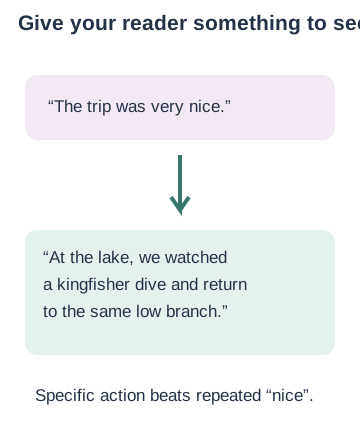
Use a small number of relevant details: what you saw, did, learned or felt. Connect the feeling to an event. “I felt proud because our two rows were neat” tells the reader more than repeating “It was amazing” three times.
A friendly letter is a conversation, so include a genuine question when appropriate. The question about balcony tomatoes connects the writer’s experience to the cousin’s interests. Avoid adding unrelated questions just to make the letter longer.
5. Keep the voice warm and the message complete
Contractions such as I’m or we’ve can suit informal writing, but use them consistently and correctly. Choose familiar words rather than replacing simple language with formal expressions such as “I hereby wish to inform you”. A natural voice still needs complete sentences and clear references.
For an invitation, include what, when, where and how to reply. For an apology, name what happened, acknowledge the effect and say how you will repair it. For thanks, mention the particular help or gift and why it mattered. Purpose determines the necessary details.
Protect privacy when writing public examples. A classroom model can use fictional names and addresses. A real personal letter should be shared only with its intended reader unless you have permission to share it more widely.
6. Revise for the reader, not only for marks
Read the letter aloud as if speaking to that person. Remove phrases that sound borrowed or overblown. Check that each paragraph has a clear focus and that time order is easy to follow. If your reader has not seen the event, add the one missing detail they need.
Then check spelling, punctuation, verb tense and the requested length. Past events generally need past tense, while a future plan needs an appropriate future expression. A letter can move between these times when the change is clear.
Finally check the task requirements against your planning list. A beautifully worded invitation without a date is incomplete. A warm thank-you letter that never names the help is vague. Good writing balances personal voice with practical usefulness.
5 worked examples with reasoning
1. Improve: I hereby inform you that my trip was nice.
- The tone is stiff and the detail vague.
- Use a personal opening and one specific event.
- For example: You would have loved the lake; we watched a kingfisher dive beside our boat.
2. What is missing from “Come to my party on Saturday”?
- The reader needs time and place.
- A reply method may also help.
- Add accurate event details before sending.
3. Write a specific thank-you sentence.
- Name the help.
- Explain its effect.
- For example: Thank you for helping me practise; I felt calmer during the reading presentation.
4. Why does the model ask about tomatoes?
- It connects with the cousin’s experience.
- It turns a report into a conversation.
- The question is relevant rather than filler.
5. How should a letter about yesterday’s match begin?
- Locate the event in time.
- Give the reader a clear reason for writing.
- For example: Yesterday’s match had a surprise ending, and I wanted to tell you about it.
Save the guide or print the practice
Download to save or share
Complete guide with answers (PDF) · Worksheet without answers (PDF) · Worksheet and answer key (PDF)
Try each task before opening its answer. Give an example or reason, not only a label.
14 practice questions with explanations
Try each task before opening its answer. Give an example or reason, not only a label.
Write an answer and your reason before opening the explanation. Check the reasoning as well as the final answer.
- Purpose
Name one suitable reader for an informal letter.
Answer and reasoning
A friend or relative, for example.
Tone depends on the relationship.
- Opening
What makes an opening feel personal?
Answer and reasoning
A real shared connection or clear reason for writing.
It should suit the reader.
- Format
Should every informal letter use a formal subject line?
Answer and reasoning
No.
Follow the task and accepted personal-letter convention.
- Model
What did Meera’s group plant?
Answer and reasoning
Beans.
The model states the project.
- Model
What job did Kabir do?
Answer and reasoning
He made the labels.
Specific details make the account clear.
- Detail
Replace “It was nice” with a specific observation.
Answer and reasoning
For example: We watched a kingfisher dive into the lake.
Many precise, relevant observations can work.
- Invite
List three details an invitation needs.
Answer and reasoning
Event, time and place.
The reader must be able to act on it.
- Thanks
Why name the particular help in a thank-you letter?
Answer and reasoning
It makes the gratitude specific.
The reader understands what mattered.
- Tone
Is informal writing the same as careless writing?
Answer and reasoning
No.
Clarity and grammar still matter.
- Paragraph
When should a new paragraph begin?
Answer and reasoning
When the focus changes.
Paragraphs organise the message.
- Tense
Which tense usually describes a completed trip?
Answer and reasoning
Past tense.
Future plans may use future expressions.
- Question
Why include a relevant question to the reader?
Answer and reasoning
It invites a personal response.
It keeps the letter conversational.
- Privacy
Should you publish a real home address in a practice example?
Answer and reasoning
No.
Use fictional details for public models.
- Review
What should you check after grammar?
Answer and reasoning
Whether all task details are included.
A correct but incomplete letter may not serve its purpose.
Use the ideas without looking at the notes
Write to a friend about something you tried for the first time. Include one precise action, one honest feeling and a relevant question. Revise the letter aloud before checking the format.
Common questions
Can I use contractions?
Yes, when they suit the relationship and task.
Must every letter begin with I hope you are well?
No. A specific, natural opening often works better.
How many paragraphs should I use?
Enough to separate the main parts clearly; follow any task instruction.
Can a personal letter include humour?
Yes, if it fits the reader and does not obscure the message.
Should I copy the model address?
No. It is fictional and only demonstrates layout.
Connect your learning
Ask about guided English learning if your child needs help explaining these ideas.
About this guide
Original explanations, examples, diagrams and practice by BananaLearn. The grade label indicates the intended learning level; this is not an official textbook extract or exam paper.