
Start with the key idea
Regrouping changes how a number is represented, not its value. Forty-two can be 4 tens and 2 ones or 3 tens and 12 ones. To calculate 42 − 17, subtract 7 ones from 12 ones and 1 ten from 3 tens. The result is 2 tens and 5 ones: 25.
1. A ten is a group of ten ones
The digits in 42 mean four tens and two ones. Four tens are forty; two ones make forty-two. The position of each digit tells you its value. A 4 in the tens place does not mean four individual pencils.

Build the number with four groups of ten and two loose objects. Now open one group. You have three groups of ten and twelve loose objects. Count the value: 30 + 12 = 42. You did not add ten new objects or throw away a group.
This exchange is the idea behind regrouping. The written marks in a column calculation record the exchange. They should describe something the learner can show, rather than being a rule to memorise without meaning.
Before this lesson, check that your child can show a two-digit number in tens and ones and knows that ten ones make one ten. If those ideas are uncertain, practise building and renaming numbers before combining them with subtraction.
2. Exchange first, then take away
For 42 − 17, we must remove one ten and seven ones. From the usual representation of 42, there are only two loose ones. Exchange one of its four tens for ten ones. There are now three tens and twelve ones.
Remove seven of the twelve ones. Five ones remain. Remove one of the three tens. Two tens remain. Together they make twenty-five. Notice that the ten we opened cannot also remain among the tens: it has already become ones.
In a column method, line up tens under tens and ones under ones. Record the top number as 3 tens and 12 ones before subtracting. The bottom number stays 1 ten and 7 ones. We rename the amount we have, not the amount being removed.
Read your result as a number: ‘two tens and five ones, twenty-five’. Saying only ‘two and five’ can hide whether the learner understands the places.
3. Decide whether an exchange is needed
Compare the ones you have with the ones to remove. In 58 − 24, eight ones can supply four ones, so no exchange is needed. Subtract ones and tens to obtain 34. In 58 − 29, eight ones do not supply nine ones in the starting model, so exchange one ten.
After the exchange, 58 is four tens and eighteen ones. Eighteen minus nine leaves nine ones; four tens minus two tens leaves two tens. The answer is 29.
Regrouping is needed for the usual column method in this example; it is not a claim that every valid subtraction strategy must write an exchange. Counting up from 29 to 58 is another way to find the difference.
The examples here stay within non-negative whole numbers. ‘You can never subtract a larger number from a smaller number’ is not a general mathematical rule: later, negative numbers extend what subtraction can represent.
4. What if the number ends in zero?
For 60 − 26, the starting number has six tens and zero loose ones. Rename it as five tens and ten ones. Ten ones minus six ones leaves four ones. Five tens minus two tens leaves three tens. The result is 34.
The zero tells you there are no loose ones in the original representation. It does not mean the whole number contains nothing, and it does not prevent you from opening a ten.
Write both changes together: 6 tens becomes 5 tens, while 0 ones becomes 10 ones. If you change only the ones, you have accidentally represented seventy instead of sixty.
This guide uses one exchange from tens to ones. Once that is secure, the linked Grade 3 guide develops larger numbers and exchanges involving hundreds. Do not rush into several crossed-out digits before the single exchange makes sense.
5. Check by putting the removed part back
Subtraction and addition describe the same parts and whole. If 42 − 17 = 25, then the part removed, 17, plus the part remaining, 25, should rebuild 42. Check: 25 + 17 = 42.
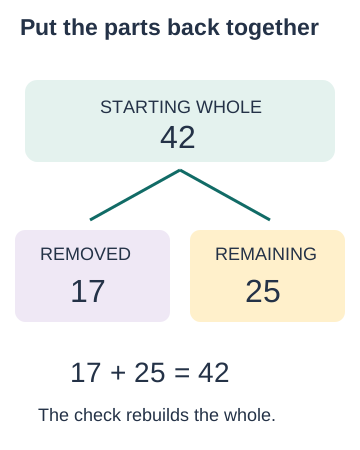
If a learner gets 35, adding back gives 35 + 17 = 52. That is ten too many. Return to the tens: did the learner remember that opening a ten leaves one fewer unopened ten?
You can also count up to check. From 17 to 20 is 3. From 20 to 40 is 20. From 40 to 42 is 2. The total increase is 3 + 20 + 2 = 25, the same difference.
An estimate can catch a very unlikely result, but it cannot prove the exact answer. Forty-two minus something close to twenty should leave something close to twenty. A result greater than forty-two would not fit this take-away story.
6. Explain the mistake instead of just crossing it out
‘Always subtract the smaller digit from the bigger digit.’ This can produce 35 for 42 − 17 by doing 7 − 2 and 4 − 1. It changes the direction of subtraction inside one column. Keep the original take-away story and rename the top number instead.
‘The little 1 means one pencil.’ In the exchange, one ten becomes ten ones. The mark records a change of unit. Use the words ‘one ten’ and ‘ten ones’ while pointing to the corresponding objects.
‘Keep four tens and write twelve ones.’ That represents 52, not 42. Check the value immediately after renaming, before doing the subtraction. Three tens and twelve ones is still 42.
For a short practice session: build one calculation, draw it, then record it in columns. Next try a fresh example without objects, using them to check afterwards. If an error repeats, return to the exchange; extra speed drills do not explain it.
5 worked examples with reasoning
1. Calculate 53 − 28.
- Rename 53 as 4 tens and 13 ones: 40 + 13 = 53.
- 13 ones − 8 ones = 5 ones. 4 tens − 2 tens = 2 tens.
- The result is 25. Check: 25 + 28 = 53.
2. Calculate 70 − 36.
- Rename 7 tens and 0 ones as 6 tens and 10 ones.
- 10 − 6 = 4 ones; 6 − 3 = 3 tens.
- The result is 34. Check: 34 + 36 = 70.
3. There are 31 seedlings. Seventeen are planted. How many are left?
- The whole is 31 and the part removed is 17, so calculate 31 − 17.
- Rename 31 as 2 tens and 11 ones. Remove 1 ten and 7 ones.
- 1 ten and 4 ones remain: 14 seedlings. Check: 17 + 14 = 31.
4. Find the difference between 62 and 47 by counting up.
- Start at 47. Add 3 to reach 50.
- Add 12 more to reach 62.
- The difference is 3 + 12 = 15. Check by regrouping: 5 tens 12 ones minus 4 tens 7 ones leaves 1 ten 5 ones.
5. A learner says 41 − 16 = 35. Find the error.
- Adding back gives 35 + 16 = 51, so the result cannot be correct.
- After opening one ten, 41 is 3 tens and 11 ones, not 4 tens and 11 ones.
- Subtract to get 2 tens and 5 ones. The correct result is 25.
Save the guide or print the practice
Download to save or share
Complete guide with answers (PDF) · Worksheet without answers (PDF) · Worksheet and answer key (PDF)
Draw tens as rods and ones as dots. Say what changes when you exchange a ten. Try the questions before checking the explanations; an adult can read the stories aloud.
16 practice questions with explanations
Draw tens as rods and ones as dots. Say what changes when you exchange a ten. Try the questions before checking the explanations; an adult can read the stories aloud.
Write an answer and your reason before opening the explanation. Check the reasoning as well as the final answer.
- Rename
Write 34 as 2 tens and some ones.
Answer and reasoning
2 tens and 14 ones.
20 + 14 = 34. One of the original three tens became ten ones.
- Rename
Write 50 as 4 tens and some ones.
Answer and reasoning
4 tens and 10 ones.
40 + 10 = 50; the value has stayed the same.
- Decide
Which needs an exchange in the usual column method: 67 − 23 or 67 − 28?
Answer and reasoning
67 − 28.
Seven ones can supply three ones, but not eight ones in the starting representation.
- Calculate
Calculate 32 − 15.
Answer and reasoning
17.
Rename 32 as 2 tens and 12 ones. Subtract 1 ten and 5 ones, leaving 1 ten and 7 ones.
- Calculate
Calculate 54 − 27.
Answer and reasoning
27.
4 tens and 14 ones minus 2 tens and 7 ones leaves 2 tens and 7 ones.
- Calculate
Calculate 81 − 46.
Answer and reasoning
35.
7 tens and 11 ones minus 4 tens and 6 ones leaves 3 tens and 5 ones.
- Zero
Calculate 40 − 18.
Answer and reasoning
22.
Rename 40 as 3 tens and 10 ones. Remove 1 ten and 8 ones.
- Zero
Calculate 90 − 55.
Answer and reasoning
35.
8 tens and 10 ones minus 5 tens and 5 ones leaves 3 tens and 5 ones.
- Story
A shelf has 43 books. Eighteen are borrowed. How many remain?
Answer and reasoning
25 books.
43 − 18 = 25. Adding the borrowed books back gives 25 + 18 = 43.
- Compare
Mina has 52 stickers and Ali has 37. How many more does Mina have?
Answer and reasoning
15 stickers.
The comparison asks for 52 − 37. Three more reaches 40 and twelve more reaches 52: 3 + 12 = 15.
- Check
Does 61 − 24 = 47 pass the addition check?
Answer and reasoning
No; the difference is 37.
47 + 24 = 71. Renaming 61 as 5 tens and 11 ones gives 37 after removing 2 tens and 4 ones.
- Check
A learner renames 72 as 7 tens and 12 ones. What is wrong?
Answer and reasoning
That represents 82. Use 6 tens and 12 ones.
Opening one ten leaves one fewer ten. 60 + 12 = 72.
- Explain
Why does opening a bundle of ten not change the total?
Answer and reasoning
The same ten objects are now counted individually.
Their grouping changed; no objects were added or removed during the exchange.
- Count up
Find 73 − 58 by counting up.
Answer and reasoning
15.
58 to 60 is 2 and 60 to 73 is 13. Add the increases: 2 + 13 = 15.
- Missing part
Complete 26 + □ = 41.
Answer and reasoning
15.
The missing part is 41 − 26. Check that 26 + 15 rebuilds 41.
- Create
Make a two-digit subtraction that needs one exchange and has answer 24.
Answer and reasoning
For example, 52 − 28 = 24.
Other answers are possible. Check both the difference and whether the starting ones digit is smaller than the ones being removed.
Use the ideas without looking at the notes
Draw two boxes labelled tens and ones. Build a number, rename one ten and check that its value is unchanged. Only then remove the requested amount. Say the answer with its units and add back to check.
Keep a small error note: ‘I forgot to reduce the tens’ is more useful than ‘I am bad at subtraction’. Try one fresh problem later to see whether the explanation transfers. Stop if the marks become guessing and return to the objects.
Common questions
Is regrouping the same as borrowing?
Borrowing is a common name for this written method. Exchanging or renaming makes clear that one ten becomes ten ones; nothing extra is added to the number.
Do we always need to regroup?
No. In the usual two-digit column method, compare the starting ones with the ones to remove. Other methods, such as counting up, can find the same difference without written exchange marks.
Why do we start with the ones?
In the usual column method, an exchange from tens changes the available tens. Resolving the ones first lets you record that change before subtracting tens.
Can the answer be negative?
Yes, subtraction can produce negative numbers. This introductory guide uses whole-number take-away examples whose answers are zero or positive; negative-number methods come later.
Should children stop using objects immediately?
No. Objects and drawings can help establish why the exchange works. Gradually connect the model to written calculation, and retain it as a way to check an uncertain step.
Connect your learning
Ask about guided Maths learning if your child needs help explaining these ideas.
About this guide
Original explanations, examples, diagrams and practice by BananaLearn. The grade label indicates the intended learning level; this is not an official textbook extract or exam paper.