After-School Online Tutoring: A Plan That Fits Your Child
School finishes. Homework starts. One difficult question takes over the evening. A useful tutoring plan starts by identifying that sticking point and finding a lesson time your child can sustain.
BananaLearn offers one-to-one online after-school tutoring in Maths, English and Science. Lessons can address current schoolwork, missing foundations or a focused revision goal. Tell us the class, curriculum, subject and local time zone so we can discuss the right starting point and available slots.
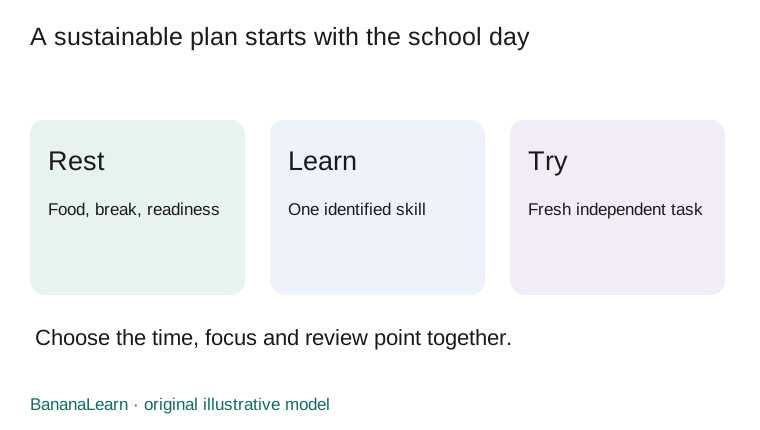
On a phone, swipe across the illustration to read every label.
Original teaching model; worked reasoning appears below.
Choose a clear reason for the lesson
A child who cannot start a word problem needs a different first lesson from a child who understands the method but loses signs in calculations. Bring a recent piece of work and describe what happened when the child tried independently. The goal might be choosing operations, explaining a paragraph or interpreting a Science diagram.
Choose one priority to begin with. Completing a large homework pile can conceal the same unresolved difficulty; a worked example followed by a fresh attempt makes that difficulty easier to see.
Plan around the actual school day
Write down school arrival time, a meal or snack, travel, clubs and bedtime before choosing a slot. Consider how alert the child usually is at the proposed time. A lesson that fits a calendar but repeatedly replaces rest is unlikely to be a practical routine.
For families abroad, give the student’s local time zone and preferred days. Confirm the local start time again when daylight-saving rules change; a fixed difference from India may not apply throughout the year.
Use a short independent task to identify the gap
Ask for one representative question rather than a full extra test at home. Notice whether the child can explain the question, choose a method, carry out the calculation and check the answer. These observations help distinguish a topic gap from a reading or organisation difficulty.
For English, a short paragraph can reveal whether the issue is sentence formation, understanding the text or supporting an answer with evidence. For Science, ask the child to connect a labelled diagram with an explanation.
Make the lesson and practice work together
A useful sequence is an explanation, a guided example, an independent attempt and a review of the reasoning. The independent question should change something meaningful so the child cannot succeed only by copying the previous steps.
For example, after sharing an amount in a ratio, change both the total and the ratio. A later check on another day gives better evidence of recall than repeating the same numbers immediately.
Decide what homework support should achieve
Bring the teacher’s instructions, the relevant pages and any feedback. Tutoring can help the child understand and attempt the task; the child should still produce their own schoolwork. Ask how the tutor will explain a method that differs from the one used in class.
If homework regularly takes hours, keep a brief record of the task, time spent and exact sticking point. Share repeated difficulties with the school as well as discussing tutoring support.
Review progress using actual work
Keep an early independent example, then revisit the same skill with a new question. Look for a clearer explanation, fewer prompts, a suitable method and successful transfer. A completed worksheet alone does not show which parts the tutor supplied.
Agree a review point and the evidence you would like to see. Adjust the priority when school content changes or the child is ready to move ahead.
Check the practical arrangements before committing
Confirm lesson length, current fees, scheduling, cancellation arrangements and how practice is shared. A quiet working area, stable connection and a way to write or show working matter as much as opening a video call.
Use our device-setup guide to rehearse hearing, reading, responding and receiving feedback. Discuss accessibility or communication needs directly so the format can be considered before scheduling.
Prepare a useful first enquiry
Include the child’s class, board or curriculum, subject, country/time zone and preferred lesson windows. Add a recent question or describe the part they find difficult. Avoid sending sensitive school records when a short description will do.
We can discuss the teaching focus and available lesson times. Maths is the priority subject at BananaLearn; English and Science tutoring are also available.
See the teaching approach
Maths: explain the operation
A child has 24 counters and puts 6 in each group. There are 24 ÷ 6 = 4 groups. Change the question: share the same 24 counters among 4 children. Each receives 6. Both use division, but the unknown quantity has changed.
Ask the child to name what the answer counts. This reveals more than asking them to repeat “divide by six”.
English: show the evidence
A short passage says a character packed an umbrella after checking the forecast. “The character expects rain” is an inference supported by those details. “The character dislikes summer” is not supported by that information alone.
A follow-up changes the evidence: the forecast is sunny and the umbrella is for shade. The child should reconsider the inference.
A workable routine
An illustrative evening might include food and rest after school, the booked lesson, then a short independent check at a suitable later point. On club days, a different lesson day may work better than squeezing every activity into the same evening.
Confirm the actual class duration and slot when booking. This example is a planning method, not a promised timetable or a requirement for daily tutoring.
Six questions to check the idea
These original questions illustrate reasoning. They are not an official exam paper or a placement score.
What should you bring to the first discussion?
A recent task, the child’s class/curriculum, the observed difficulty and suitable local lesson windows.
Does finishing homework prove understanding?
No. Check a fresh question and how much help the child needs.
Why recheck a lesson time after a clock change?
The family’s time zone may change its offset even when the tutor’s does not.
Should every missed question become another lesson?
Group questions by the underlying skill first; one misconception can affect many answers.
What is a useful sign of progress?
The child can select and explain a method on a changed task with less prompting.
What if a schedule repeatedly replaces rest?
Reconsider the slot or frequency rather than assuming more hours will solve the problem.
Questions parents and students ask
Which subjects can we ask about?
Maths, English and Science tutoring are available. Give the subject and current school topic in your enquiry.
Can tutoring fit an overseas school day?
Share the student’s local time zone and preferred windows. We will discuss available slots; confirm seasonal clock changes before scheduling.
Can lessons focus on foundations as well as current homework?
Yes. Describe both the current task and any earlier skills that seem to interrupt it, so the starting point can be chosen deliberately.
How often should my child attend?
Frequency depends on the goal, school workload and independent practice. Discuss a sustainable plan and a review point rather than choosing by hours alone.
Share the student’s class or course, current topic, country/time zone and preferred lesson windows. For an exam course, include the intended assessment date or year. We will discuss teaching priorities and availability.