Thin or tin? Give the first sound room to flow.
Keep the vowel and ending steady. Try changing only the beginning of thin and tin, then use each word where its meaning fits.
Start pronunciation practice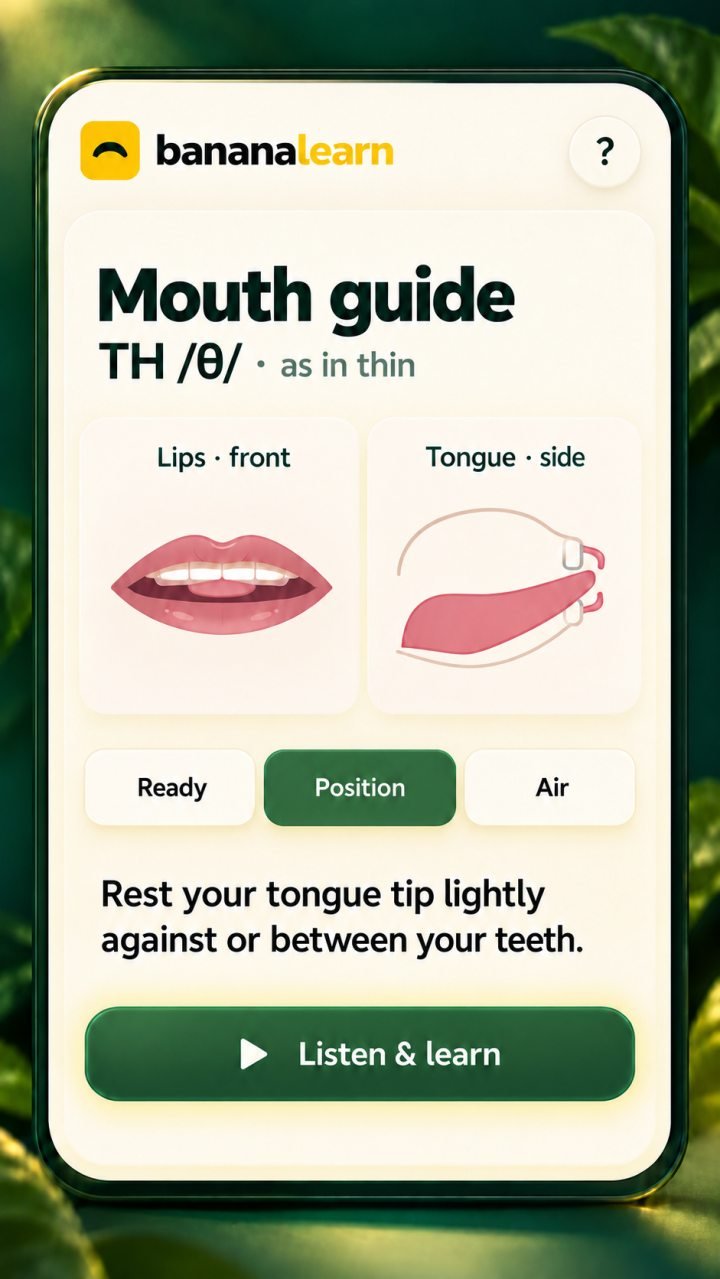
The sound you are practising
This activity focuses on /θ/, the beginning sound in thin, thank and three. Place your tongue tip lightly against or just between the front teeth and let air pass through. Keep your throat relaxed as you listen and try the sound.
For /t/, the start of tin, your tongue briefly stops the airflow behind the top teeth and releases it. Try saying the beginning of thin on its own, then the beginning of tin. Notice the flowing air in one and the brief stop in the other.
The spelling th also represents /ð/ in words such as this. That is a separate target. Work with the words below first so the example stays consistent. Different English accents realise these sounds differently. Use one clear model while practising the contrast.
Four pairs and the stories they belong in
A thin slice takes up little space from one flat side to the other.
A tin can hold biscuits, paint or another material.
| /θ/ beginning | /t/ beginning | Try a sentence |
|---|---|---|
| thin | tin | Put the thin cards inside the tin. |
| thank | tank | Thank the person who cleaned the water tank. |
| three | tree | Three birds landed in the tree. |
| thick | tick | Draw a tick with a thick pen. |
First read both meanings. Next, ask a partner to say one word while covering the sentence. Point to the word you heard. Use the sentence afterwards to check the meaning and practise speaking naturally.
A worked speaking turn
Imagine you want a narrow slice of bread. You say “a thin slice”, but your partner hears tin. Pause the sentence and listen to a model of thin. Try the first sound with a little flowing air, then add the rest of the word. Finish by saying “a thin slice” again.
Ask your partner which word they heard on the second attempt. If it is still unclear, return to the model and try one word at a time. A repeated word in isolation and a word inside a phrase can feel different, so practise both.
In the app, use the mouth guide for the sound you are practising. Follow the reference voice and compare your recording with the example. Feedback can help you decide what to listen for on the next attempt.
Listen, choose, then speak
These six questions check meaning. To add a listening challenge, ask a partner to say the two choices before you read them. A correct written choice alone does not show how you pronounce the word.
1. The recipe asks for a ___ slice of cucumber. Thin or tin?
Thin. It describes the size of the slice. Try the flowing first sound before saying the full phrase.
2. We keep the buttons in a metal ___. Thin or tin?
Tin. Here it names a container. Use the brief /t/ beginning.
3. ___ birds sat on the fence. Three or tree?
Three. It tells us how many birds there were. The tree is a plant they could sit in.
4. Please ___ your friend for the help. Thank or tank?
Thank. The sentence asks you to show appreciation. A tank could store liquid.
5. Put a ___ beside the correct answer. Thick or tick?
Tick. That is the mark. Thick describes something such as the width of a pen stroke.
6. Say a sentence with both tree and three.
One possibility is “Three apples fell from the tree.” Ask a partner which first sound they heard in each word.
Use a short practice record
Choose two pairs for today. Write four headings on paper: word I meant, word my partner heard, what I tried and second attempt. One example might be three / tree / listened to the first sound again / partner heard three.
Swap roles after two turns. Hearing a difference and producing it are different jobs. A learner who can point to three may still need help saying it. Someone who repeats the word well may need another listening turn to choose it without seeing the text.
Come back another day and try a new sentence using one of the same words. Keep the focus on a clear contrast your partner can understand. If the same difficulty persists across fresh attempts, bring one example to a teacher who can listen and suggest the next step.
Keep exploring
Sources and reference models
The activities and practice questions on this page are original BananaLearn examples. Use these references for the underlying explanation.