Move a light ray. Predict where it bounces.
An incoming ray makes 30° with the normal. The reflected ray makes 30° too. Use Bounce a beam to change the angle, then check the prediction yourself.
Open Bounce a beam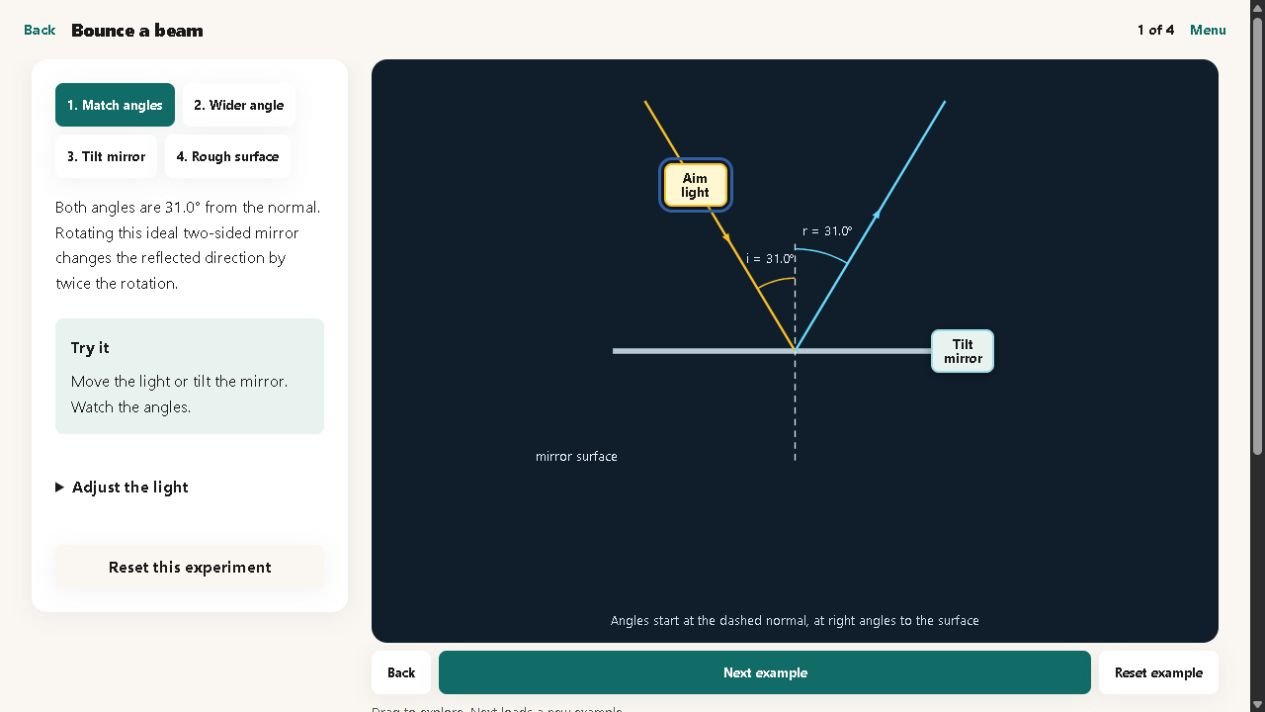
Start with the normal
The normal is a reference line at right angles to the reflecting surface where the light arrives. Measure both the incoming angle and the reflected angle from this line. For a smooth mirror, these angles are equal.
If the incoming ray makes 30° with the normal, it makes 60° with the mirror surface because the normal and surface meet at 90°. The reflected angle measured from the normal is still 30°.
This is the angle of incidence in the example.
Subtract 30° from the right angle of 90°.
Drawing a line perpendicular to the mirror first gives both angles a common starting point. It also helps you spot an answer measured from the wrong line.
Explore the four examples in the game
Open Bounce a beam and begin with Match angles. The first setup shows a smooth mirror and a normal. Move Aim incoming light, then read the incoming and bounced angles. The controls also support arrow keys.
- Match angles. Choose an incoming angle and predict the reflected reading before you look.
- Wider angle. Explore a ray further from the normal. Check how its angle to the surface changes.
- Tilt mirror. Keep the incoming direction fixed and turn the mirror. Watch the normal turn with the surface.
- Rough surface. Compare how rays reflect from differently oriented parts of the surface.
Use Reset this experiment to return to the starting setup. If you change both the light and the mirror together, you lose track of which change caused the new direction. Try one adjustment at a time.
A worked prediction at two settings
Keep the mirror still. Suppose the incoming angle is 25°. Predict a reflected angle of 25°, then read the simulation. The angle between either ray and the mirror surface is 90° − 25° = 65°.
Next set an incoming angle of 50°. The reflected angle becomes 50°, while the angle to the surface becomes 40°. Your two records might read 25°, 25°, 65° and 50°, 50°, 40°, under the headings incoming, reflected and surface angle.
The incoming ray moves closer to the surface as its angle from the normal increases. Looking at both measurements helps explain why one angle increases while the other decreases.
Try six angle questions
Draw a small mirror line and a normal beside each question. Write the angle you are measuring before calculating. Open the answer to compare the setup as well as the number.
1. The incoming angle is 35° from the normal. What is the reflected angle?
35°. Both angles use the same normal at the point where the ray meets the mirror.
2. A ray makes 20° with the mirror surface. Find its angle of incidence.
70°. The normal is 90° from the surface, so 90° − 20° = 70°.
3. The reflected angle is 42° from the normal. Find the angle between the incoming ray and the surface.
48°. The incoming angle is 42°, and the remaining angle to the surface is 90° − 42°.
4. A ray arrives along the normal. Which way does it reflect?
Back along the same line. Its incoming and reflected angles from the normal are both 0°.
5. The incoming direction stays fixed and a plane mirror turns by 4°. How much does the reflected direction turn in the standard setup?
8°. The reflected direction changes by twice the mirror rotation.
6. Someone measures an incoming angle from the mirror surface and a reflected angle from the normal. Can they compare those numbers directly?
They need a common reference. Convert the surface measurement by subtracting it from 90°, then compare both angles from the normal.
Investigate a tilted mirror
With a fixed incoming ray, turning an ideal plane mirror by 5° turns its normal by 5°. The reflected direction changes by 10° in the usual plane-mirror setup. Sketch the original and new normals to see why the change in the reflected direction is twice the mirror’s turn.
That doubled change concerns the direction the reflected ray travels through space. At each mirror position, the law of equal incoming and reflected angles still uses the new normal. Write down both kinds of measurement if you investigate them together.
In the game, move Tilt mirror a small amount and compare the readout and diagram. A very large turn may move you into a less familiar arrangement. Return to a small turn if you want to reason from your first sketch.
Explain a rough surface
A rough surface has tiny regions pointing in different directions. Their normals differ, so rays can leave in different directions even though each local reflection follows the same angle rule. This helps explain why a wall is visible from many positions while a smooth mirror gives a sharply directed reflection.
Compare the rough-surface example with the smooth mirror. Choose one small region and imagine drawing its own normal. Ask which direction the ray would go there. Repeat on a nearby region that slopes differently.
The simulation uses ideal rays to make the geometry visible. Moving markers show the direction of travel. Use the labelled angles and ray diagram for measurements, because a decorative perspective view can change how a drawn angle looks.
Record an investigation
Copy four headings into a notebook: incoming angle, predicted reflection, observed reflection and explanation. Test three settings with the mirror fixed. If a prediction differs from the reading, check whether both angles started at the normal.
For a further challenge, make a ray hit a second plane mirror. Draw a separate normal at each meeting point and apply the rule again. Explain each turn before deciding where the final ray goes.
Keep exploring
Sources and reference models
The activities and practice questions on this page are original BananaLearn examples. Use these references for the underlying explanation.