
Start with the key idea
A preposition usually begins a phrase showing a relationship such as place, time or direction: in the box, on Monday, towards the gate. In, on and at have common patterns, but their exact choice depends on meaning and usage. Read the whole phrase instead of translating one word in isolation.
1. Read a preposition with its phrase
In “The keys are under the chair”, under the chair tells where the keys are. Under is the preposition, and the chair completes its phrase. The phrase connects the keys to a reference object.
A single object can be described in several accurate ways: a bag may be under the table, beside a chair and near the door. A worksheet needs a scene or enough words to identify the intended relationship. Without those clues, several answers may be reasonable.
Do not translate a preposition word for word from another language and assume it will fit every English sentence. Learn short patterns such as on the bus and in the car through context. The choice is partly about established usage.
2. Use in, on and at as a starting map for place
In often presents something as inside an area or space: in a drawer, in a room, in Mumbai. On often presents contact with a surface: on the shelf, on the wall. At often treats a place as a point or meeting location: at the gate, at the station.
These are starting patterns, not definitions that explain every phrase. “On the bus” is the usual expression for travelling as a passenger; it does not mean sitting on the roof. “In the car” is the ordinary counterpart for a car.
“She is at the library” gives her general location. “She is in the library” emphasises that she is inside the building. Both can be correct. Supply the intended message before insisting on one answer.
3. Separate position from movement
“The ball is in the box” describes a position. “Put the ball into the box” describes movement to the inside. “The cat is on the wall” gives a position; “The cat jumped onto the wall” highlights movement to the surface.
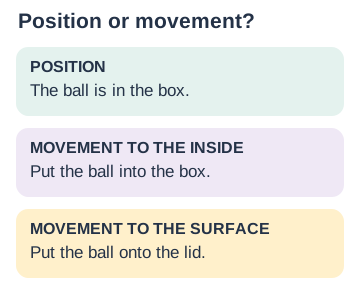
In and on can also occur naturally with movement verbs, as in “Put it in the box”. Into and onto make the movement relationship especially explicit. Do not mark a natural in phrase wrong solely because the verb involves motion.
Across means from one side to the other of an area or surface: walk across the field. Through describes movement within and out of something: walk through a tunnel. Towards gives a direction without guaranteeing arrival: walk towards the gate.
4. Build a simple time pattern, then learn its exceptions
Use at with clock times: at four o’clock, at noon. Use on with days and dates: on Monday, on 6 May. Use in with months, years and longer periods: in July, in 2027, in the morning. The year here is only a grammar example, not an announced event date.
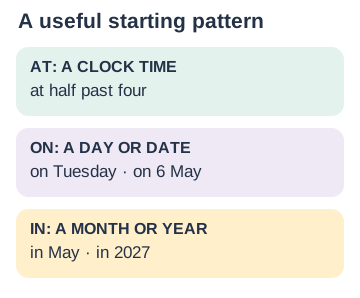
When a morning is attached to a particular day, use on: on Monday morning. Learn at night as an established phrase. These examples show why the small pattern is a starting aid rather than a complete rule.
Expressions with next, last, this and every commonly need no preposition: next Monday, last year, this morning, every Friday. Write “We meet next Tuesday”, not “We meet on next Tuesday”. British English commonly uses at the weekend; American English commonly uses on the weekend.
5. Distinguish a length, a starting point and a deadline
For introduces a duration: for two hours. Since introduces a starting point continuing to a later reference time: since Monday. In “I have lived here for three years”, three years measures the length; in “I have lived here since 2023”, 2023 identifies the beginning.
By sets a latest finishing time: “Finish the poster by Friday”. Until describes continuation up to a time: “Keep the poster on the wall until Friday”. These do different jobs. A deadline is not the same as how long an action continues.
Before and after compare times without fixing an exact moment: before lunch, after school. If a question asks for an exact time, these phrases may be too vague. Match the amount of information to what the reader needs.
6. Check the scene, the time and the variety of English
First identify the relationship: location, movement, clock time, duration or deadline. Next read the whole phrase aloud. Finally check whether another choice would express a different reasonable meaning. Explain that difference where it matters.
For practice, describe the position of three objects in a room without moving anything heavy. Then write a short plan with one clock time, one day and one duration. An adult can ask for the meaning of each phrase rather than only marking a gap right or wrong.
When the intended variety of English matters, state it. At the weekend and on the weekend are both established forms in different varieties. Learning a preferred classroom convention should not mean calling another standard variety ungrammatical.
5 worked examples with reasoning
1. Complete a clock time: “The lesson starts ___ 4:30.”
- 4:30 is a clock time.
- The usual preposition is at.
- The lesson starts at 4:30.
2. Complete: “We meet ___ Monday morning.”
- The phrase specifies a particular day’s morning.
- Use on with the day-based phrase.
- We meet on Monday morning.
3. Explain “at the museum” and “in the museum”.
- At identifies the museum as a location.
- In emphasises being inside the building.
- Both may be correct; the intended message decides.
4. Choose by or until: “Finish your drawing ___ six.”
- The instruction sets a latest completion time.
- Use by for that deadline.
- Finish your drawing by six.
5. Correct “I have waited since two hours.”
- Two hours is a duration, not a starting point.
- Use for with the length of time.
- I have waited for two hours. Since two o’clock would give a starting point.
Save the guide or print the practice
Download to save or share
Complete guide with answers (PDF) · Worksheet without answers (PDF) · Worksheet and answer key (PDF)
Try each task before opening its answer. Give an example or reason, not only a label.
16 practice questions with explanations
Try each task before opening its answer. Give an example or reason, not only a label.
Write an answer and your reason before opening the explanation. Check the reasoning as well as the final answer.
- Place
The keys are inside the drawer. Complete: They are ___ the drawer.
Answer and reasoning
In.
The scene specifies an interior position.
- Surface
A book rests on the top surface of a desk. It is ___ the desk.
Answer and reasoning
On.
The book is supported by the surface.
- Time
We begin ___ noon.
Answer and reasoning
At.
Noon names a point in time.
- Day
We meet ___ Friday.
Answer and reasoning
On.
Use on for a day.
- Month
The course starts ___ August.
Answer and reasoning
In.
Use in with a month.
- Day phrase
The match is ___ Sunday afternoon.
Answer and reasoning
On.
The phrase names a particular day’s afternoon.
- No preposition
Repair: We will meet on next Monday.
Answer and reasoning
We will meet next Monday.
Next Monday normally takes no preposition.
- Duration
I read ___ twenty minutes. Choose for or since.
Answer and reasoning
For.
Twenty minutes measures a duration.
- Starting point
I have waited ___ nine o’clock. Choose for or since.
Answer and reasoning
Since.
Nine o’clock identifies the starting point.
- Deadline
Send the form ___ Thursday. Choose by or until for a deadline.
Answer and reasoning
By.
It means no later than Thursday.
- Continuation
Stay here ___ the bell rings. Choose by or until.
Answer and reasoning
Until.
The staying continues up to that event.
- Direction
Does “walk towards the gate” prove that the person reached it?
Answer and reasoning
No.
Towards gives direction, not guaranteed arrival.
- Motion
Choose the more explicit movement word: Put the ball in / into the bag.
Answer and reasoning
Into.
Into explicitly shows movement inside; put it in the bag is also natural.
- Transport
Use the ordinary passenger expression: We are ___ the bus.
Answer and reasoning
On.
This is the usual expression and does not mean on the roof.
- Variety
Is on the weekend always wrong?
Answer and reasoning
No.
It is common in American English; at the weekend is common in British English.
- Create
Write a sentence with a time and a place phrase.
Answer and reasoning
For example: We meet at four o’clock in the library.
The first phrase gives time; the second gives place.
Use the ideas without looking at the notes
Write four short instructions: locate an object, move a light object, set a meeting time and set a deadline. Underline each preposition phrase and explain what relationship it adds.
Common questions
Are in, on and at interchangeable?
Sometimes more than one is possible, but the meaning or usual expression changes. Read the complete phrase.
Is put it in the box wrong because it shows movement?
No. It is natural English. Into makes the movement relationship more explicit.
Why on Monday morning but in the morning?
Monday morning names a day-specific period; in the morning gives a general part of the day.
What is the difference between for and since?
For gives a duration; since gives a starting point.
Do we say at or on the weekend?
Both occur in standard English. At is common in British English and on in American English.
Connect your learning
Ask about guided English learning if your child needs help explaining these ideas.
About this guide
Original explanations, examples, diagrams and practice by BananaLearn. The grade label indicates the intended learning level; this is not an official textbook extract or exam paper.